Unit 2
Painting traditions
Meet Indian miniature painting and Chinese ink landscape, find out how their techniques carry their meanings, and make work inspired by both.
Read
Small worlds and misty mountains
Imagine holding a painting no bigger than a school notebook. Bring it close to your face. In a space you could cover with your hand there is a palace garden with a tiled floor, peacocks on the roof, a queen waiting on a terrace and dark rain clouds crowding the top of the frame. Every leaf has been given its own tiny strokes. Now imagine a different painting, as tall as a door, hung on a wall. Almost all of it is empty. A few grey peaks float out of white mist, and far below, a boat the size of a rice grain drifts under them.
Both are masterpieces. Both were painted with a brush and water-based colour on a flat surface. Yet they could hardly be more different, and the differences are not accidents. This unit looks at two painting traditions, Indian miniature painting and Chinese ink landscape, to ask one question: how do the way a picture is made and the thing it means fit together?
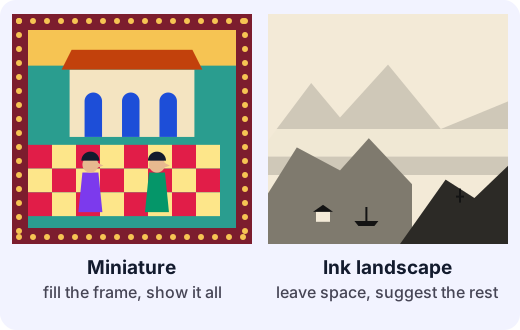
Indian miniature painting
A miniature is a small, finely detailed painting, usually made for a book or an album rather than a wall. In India, miniatures were made for centuries at royal courts and in hill kingdoms. Several styles grew, named for the places where they flourished.
Tradition Where and when What you notice Mughal Courts of the Mughal emperors, from the 1500s Fine realistic portraits, court scenes, hunts, detailed birds and flowers; a mix of Persian and Indian ways of painting Rajput Rajasthan courts such as Mewar, Bundi and Kishangarh, from the 1500s Bold colours, flat patterns, kings and festivals, epics and stories of Krishna Pahari ("of the hills") Kingdoms of the Himalayan foothills, such as Basohli and Kangra, 1600s-1800s Basohli: strong colours; Kangra: soft, lyrical colour and graceful faces, often scenes of Radha and Krishna Deccani Sultanate courts of central and southern India Rich colour and dream-like landscapes Many miniatures illustrate stories, poems and even ragas. A ragamala painting is a set of pictures, each showing a raga (a melodic mood in Indian music) as a scene: a lovesick heroine in the rain, a hunter in the forest at dawn. You can see why a unit on music in sargam lives next to this one.
How a miniature is made
Making one was slow, shared work, often by a workshop with different hands for different jobs.
- Prepare the surface. Sheets of paper were pasted together, then smoothed by rubbing with a polished stone until the surface was almost glossy.
- Draw lightly. The master drew the scene in fine lines.
- Lay colour in flat areas. Colours came from ground minerals and plants (for example lapis lazuli for blue, or vermilion for red) mixed with gum. This makes opaque watercolour, also called gouache: colour that covers the paper instead of letting it shine through. Artists laid it in solid blocks.
- Add the fine detail last. Using very thin brushes (traditionally made from squirrel hair) painters added faces, jewellery, grass, patterns on cloth. Gold or silver could be added for crowns and borders.
- Frame it. A painted border, often patterned, finished the page.
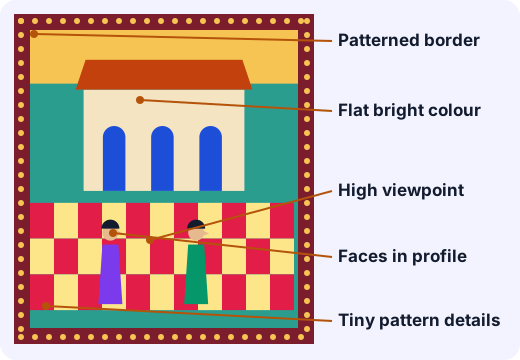
Technique and meaning together
Look again at the picture parts above and ask why.
- Flat colour and a high viewpoint. The painter looks down from above, so you can see the courtyard, the room, the garden and the sky in one picture. That is not lack of skill. A story has many parts, and this way the viewer sees them all at once. Rooms are shown as if the front wall has been lifted off.
- Faces in profile. A side view of a face shows clear, graceful features and emotion at a glance. Eyes and gestures do the talking.
- Pattern and fine detail. A miniature was held in the hands or turned page by page in an album, so the viewer was close. Detail rewards that closeness, and shows the patron's wealth and the painter's care.
- Bright, pure colour. Colour carries feeling. Dark blue clouds mean the monsoon and longing; red can mean passion or festival; green means the lush season.
Try it: Find a picture of an Indian miniature in a library book or on a museum website. Find three places where the painter shows two moments or two rooms in one frame. What does the high viewpoint let you see that a street-level view would not?
Chinese ink landscape
Chinese shan shui ("mountain-water") landscape painting developed over more than a thousand years and flowered in the Song dynasty (around the 900s to 1200s). It is painted in black ink on silk or paper. Ink is made from soot and glue pressed into a stick; the painter rubs it on an inkstone with water. With only this one colour, the painter makes many tones, from nearly white to deep black, by changing how much water is in the brush.
Here the picture is the opposite of crowding. Empty space is a main character. The blank paper stands for mist, cloud, water, and the quiet between things. Mountains in the distance are painted pale; the ones near the viewer are dark and strong. A tiny hut, a boat or a traveller shows how small people are before the vast world. Song writers described three kinds of distance in a landscape, high, deep and level, and a good painter could use all three in one picture.
Painters did not copy a single view. They walked in the hills, remembered, and then painted the feeling of mountains: the picture is a mental journey rather than a record of one spot. Long handscrolls were unrolled a section at a time, so the viewer travelled through the landscape as the scroll moved.
Technique and meaning together
- Ink tones and brush strokes show the character of rock, tree and water. The line is full of feeling, a trace of the painter's own movement.
- Empty space gives the viewer room to imagine and to rest. In this tradition silence is part of the picture.
- Small human figures express humility and harmony between people and nature.
Two traditions, two questions
Indian miniature Chinese ink landscape Size and use Small, held close, in albums and books Often large, hung or unrolled Colour Rich, flat, opaque Ink tones, one colour Space Filled, high viewpoint, many things at once Open, misty, much left empty Subject Court life, epics, poetry, music Mountains, water, mist, travellers What it asks of you Look closely and follow the story Look slowly and feel the space Common mistakes
- "The figures look flat because the artists did not know perspective." The flatness was a choice that made it possible to show a whole story in one frame.
- "The ink painting is unfinished because so much is blank." The blank is deliberate and part of the meaning.
- "Painting inspired by a tradition means copying a picture." To be inspired is to learn why the tradition does what it does and then use that idea in your own subject. Name the tradition you learned from, and treat sacred subjects with respect.
Making inspired work
Take one idea from each tradition and let it shape your own picture. From miniatures: a story scene, a high viewpoint, flat colour laid first and detail added last, a patterned border. From ink painting: pale far hills and dark near ones, a mist band left blank, one tiny human. Next you will make one piece of each.
Activity
Make two inspired paintings
Make one painting inspired by Indian miniature painting and one inspired by Chinese ink landscape, then write about how each technique carries its meaning. About 2 hours, over one or two sessions.
You'll need
- Two pieces of thick paper or card (about A5 for the miniature, A4 for the ink painting)
- Pencil, eraser and a ruler
- Poster paint, gouache or pencil colours for the miniature; a thin brush (or the finest you have)
- Black ink, or black poster paint thinned with water; a soft brush, a cup of water, a saucer for mixing
- Old newspaper to protect the table
- Optional: a gold or yellow pen for details, a picture of a miniature and of an ink landscape from a book or a museum website
Steps
- Look first. Spend 5 minutes studying a real Indian miniature and a real Chinese ink landscape (a library book or a museum website). Write one sentence about what each makes you feel.
- Miniature, plan. Choose a story scene from daily life, nature or a favourite folk tale, for example: a girl on a terrace watching monsoon clouds and peacocks, a village market at dawn, or a festival procession. Lightly draw a frame 1.5 cm inside the paper edge. Sketch the scene in thin pencil using a high viewpoint, so you can see rooms, courtyard and sky at once.
- Miniature, colour. Paint large areas in flat, solid colour with no shading: sky, floor, walls, clothes. Let each area dry before painting next to it. Choose colours for feeling (for example deep blue clouds for the monsoon).
- Miniature, detail and border. When dry, use your thinnest brush for faces in profile, patterns on clothes and floor, leaves and jewellery. Last, paint a patterned border between the edge and the frame.
- Ink landscape, plan. On a new sheet, decide where the mist band goes. Choose one tiny human or boat, and one hut. Lightly mark where far mountains, near mountains and water go. Do not draw everything in pencil; the brush will do the work.
- Ink landscape, paint. Dilute your ink in the saucer to make three tones: very pale, medium and dark. Paint the far mountains with the pale tone. Leave a band of blank paper for mist. Paint the middle hills in medium tone and the near rocks in the darkest tone. Add the tiny figure, hut or boat with a few strokes.
- Reflect in writing. For each painting, write 3 sentences: which technique you borrowed (for example flat colour, high viewpoint, empty space), what it makes the viewer feel, and why the technique suits that meaning.
Safety
- Use non-toxic paints and ink. Wash hands afterwards. Keep brushes and paint out of your mouth.
- Cover the table, and tie back long hair and sleeves near wet paint.
- Ink and paint stain clothes; wear an old shirt.
- Sharpened pencils are pointy; keep them in a pot and not in your pocket.
Keeping a log of the activity is for registered learners. Register to do this.
Quick check
Painting traditions check
Eight questions about Indian miniature painting and Chinese ink landscape.
1.Which describes how a traditional Indian miniature is usually painted?
- Opaque watercolour from ground minerals and plants, on smoothed paper, with very fine brushes
- Thick oil paint on a large stretched canvas
- Charcoal smudged on rough cloth
- Spray paint on a wall
Choose one
2.Which of these are features of Indian miniature painting? Pick all that apply.
- Small size, made to be held close
- A painted, often patterned border
- Flat, solid areas of bright colour with fine detail on top
- A huge canvas with a lot of empty space
- Only black ink, in many tones
Choose all that apply
3.Figures and rooms in a miniature look flat, seen from a high viewpoint. What is the best explanation?
- It lets the painter show the whole story, many rooms and moments, at once
- The painters had not learned how to draw depth
- It was cheaper to paint
- There is no reason; it was random
Choose one
4.Match each tradition to the description that fits it best.
- Mughal miniature
- Kangra (Pahari) miniature
- Chinese shan shui
Match each to: Ink in many tones with mist and empty space, showing mountains and water · Soft, lyrical colour and graceful faces, from the Himalayan foothills · Fine realistic portraits and court scenes, mixing Persian and Indian ways of painting
5.In this ink landscape, what does the blank band across the middle most likely stand for?
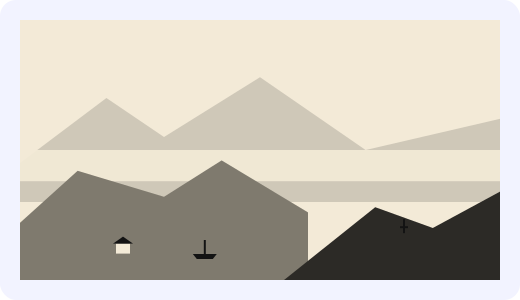
- Mist or cloud, and space for the viewer to imagine
- A place where the painter ran out of ink
- A place for the painter to sign
- Snow, painted with white paint
Choose one
6.Put the steps of making a miniature in a sensible order.
- Smooth the paper surface
- Lay down flat areas of colour
- Draw the scene lightly
- Add fine details with a thin brush
Put these in order
7.In the ink landscape, a tiny boat and hut sit below huge mountains. What does this size difference most likely express?
- People are small in the vastness of nature, and live in harmony with it
- The painter could not draw boats correctly
- The owner of the painting was very rich
- A battle is about to start
Choose one
8.You want to paint a busy festival procession in a town, with many people, a palace, shops and a river, all visible in one picture. Which borrowed idea would help most?
- A miniature's high viewpoint and flat, filled space
- An ink painting's large blank mist band
- A single tiny figure and a lot of empty paper
- Neither tradition could help
Choose one
Answering and checking are for registered learners. Register to do this.
Quick check
New puzzles
Use what you know about the two traditions on pictures and problems you have not seen.
1.A museum label describes a painting: it is about as big as a book page, has a patterned border, bright flat colours, a high viewpoint and a king on a terrace with musicians. Which tradition is it closest to?
- Indian miniature painting
- Chinese ink landscape
- A large European oil portrait
- A modern abstract painting with no objects
Choose one
2.An ink painter wants a mountain to look far away. Which choice does that?
- Paint it in pale, watery ink and let mist hide its base
- Paint it in the darkest ink with sharp outlines
- Paint it bright red
- Paint it larger than the near mountains
Choose one
3.A paper for a miniature is 20 cm wide and 15 cm tall. The painter leaves a border 2 cm wide all the way round. What is the area, in square centimetres, of the painted scene inside the border?
Answer with a number
4.You are making a painting inspired by a tradition from another culture or from your own heritage. Which actions are respectful and honest? Pick all that apply.
- Learning what the images mean and where the style came from
- Saying which tradition inspired the work
- Saying you invented the whole style yourself
- Painting a sacred figure in a silly joke to get laughs
Choose all that apply
Answering and checking are for registered learners. Register to do this.
Your turn
How technique carries meaning
Write about your own two paintings from the activity, or, if you have not yet made them, about one Indian miniature and one Chinese ink landscape you can look up.
- Name the Indian miniature school or style you learned from (for example Mughal, Rajput, Pahari or Kangra) and one technique you borrowed. Explain what that technique does for the story.
- Name one technique from Chinese ink landscape you used (empty space, ink tones, small figure) and explain what it makes the viewer feel.
- Complete the sentence "In both traditions, technique and meaning go together because ..." and give one example from each tradition.
- Say one thing the two traditions have in common and one thing that is very different.
How it's judged
- Naming and describing techniques
- Linking technique to meaning
- Comparing the traditions
- Honesty about inspiration
Writing and submitting your answer is for registered learners. Register to do this.
Like what you see?
Register for free to answer the quick checks, do the activities and save your work. Your work is saved on your device and syncs to your account.