"Before we build simulations in silicon, we must learn to see the code written into the physical world."
The mystery
The Great Fruit Salad Paradox
The morning laboratory smelled of tart green Granny Smith apples, sweet seedless grapes, and cold tap water.
Agent Spark was hovering three inches above the porcelain kitchen sink, its antenna twitching with intense mechanical concern. The sink was filled to the brim with clear water. Floating proudly on the surface like an unsinkable green battleship was a massive Granny Smith apple. It weighed a hefty 220 grams—nearly half a pound.
Sitting next to the sink on a paper towel was a single, tiny green grape. It weighed exactly 4.8 grams—scarcely heavier than a postage stamp.
Agent Spark's LED eyes flared into an alarming, strobe-like crimson: ▲ ▲.
Agent Spark: "EMERGENCY MALFUNCTION! Chief Scientist, evacuate the laboratory perimeter! The physical universe has experienced a catastrophic logic fault!" Chief Scientist:(putting down a cutting board) "Whoa, Spark! Calm your gyroscopes. What logic fault? We're just making an afternoon fruit salad." Agent Spark:(voice pitching up an octave into a squeaky panic) "Observe the sink! That colossal Granny Smith apple possesses a mass of 220,000 milligrams. Yet it refuses to plummet! It rests comfortably upon the surface tension boundary layer! Meanwhile, observe this diminutive green grape!"
With a tiny mechanical manipulator arm, Agent Spark nudged the grape over the lip of the sink.
Bloop.
The tiny grape broke the surface and plummeted straight to the bottom of the basin like a lead sinker, coming to rest beside the drain plug.
Agent Spark spun 180 degrees in mid-air, its faceplate glowing with utter bewilderment.
Agent Spark: "Diagnostic telemetry confirms: Grape mass = 4.8g. Apple mass = 220.0g. Conclusion: The grape is 45 times LIGHTER than the apple, yet the grape sank and the apple floated! According to my naive processing register: Heavy things sink, and light things float! If heavy things float and light things sink, gravity is broken, water is broken, and math has ceased to exist!" Chief Scientist:(smiling) "Gravity isn't broken, Spark. And neither is math. Your only problem is that your mental code is running the wrong condition!" Agent Spark:(eyes blinking into curious blue question marks ? ?) "Wrong condition? How can mass be the wrong condition for sinking?" Chief Scientist: "Because water doesn't care how heavy an object is all by itself. Water only asks one question: 'How heavy is this object compared to the exact amount of water it pushes out of the way?' You're looking at Mass, but water enforces Density!"
           AGENT SPARK'S FLAWED NAIVE RULE:
   ┌──────────────────────────────────────────────┐
   │  IF object.mass > 100 grams:                 │
   │      state = SINKS                           │
   │  ELSE:                                       │
   │      state = FLOATS                          │
   └──────────────────────────────────────────────┘
                          ▲
                          │ Exploded by the Grape & Apple!
                          ▼
            THE TRUE PHYSICAL CODE OF WATER:
   ┌──────────────────────────────────────────────┐
   │  density = object.mass / object.volume       │
   │  IF density > fluid.density:                 │
   │      state = SINKS                           │
   │  ELSE:                                       │
   │      state = FLOATS                          │
   └──────────────────────────────────────────────┘
Agent Spark:(eyes spinning into geometric polygons) "Fascinating! The physical world is executing a hidden mathematical conditional! Mass divided by volume! Chief Scientist, we must convert this kitchen into an unplugged computational proving ground immediately!"
Unplugged lab
Saturation & Buoyancy
A kitchen is not merely a place to cook meals. It is a full-scale physical chemistry and physics engine.
In this laboratory, we will run two hands-on, screen-free experiments that unlock the two foundational concepts of computational thinking: thresholds (when does an accumulator tip over?) and relational conditionals (how do two competing variables determine a system's state?).
Experiment 3.1: The Color Mixing Saturation Threshold
In computer programming, a threshold is a specific numerical boundary. Once a counter crosses that boundary, the state of the system abruptly transforms. Let us observe a threshold occurring right inside a glass of water.
Drop 0         Drop 1          Drop 3          Drop 7          Drop 15
 [  ]           [░░]            [▒▒]            [▓▓]            [██]
Clear       Pastel Tint     Vibrant Tint      Dark Shade      Saturated / Opaque
Lab Materials:
1 Tall, completely clear drinking glass (smooth glass, no patterns).
Exactly 250 milliliters of clear tap water.
1 Bottle of dark liquid food coloring (dark blue, black, or red).
1 White index card with the word "CODE" written in bold black marker.
1 Stirring spoon.
The Scientific Mystery:
When you add drops of concentrated dye to water, does the transparency decrease forever in a smooth, endless curve, or does it hit an abrupt saturation threshold where the text behind the glass completely disappears?
Step-by-Step Protocol:
Great minds of the lab
Archimedes and the Golden Crown Mystery
To understand how water displacement became the foundation of all physical measurement, we travel back more than two thousand two hundred years to the ancient Greek city-state of Syracuse on the island of Sicily.
There lived one of the greatest mathematicians, engineers, and natural philosophers who ever walked the Earth: Archimedes of Syracuse (c. 287 – c. 212 BCE).
                 ARCHIMEDES' WATER DISPLACEMENT TRIAL (c. 250 BCE)

         PURE GOLD (Dense: 19.3 g/cm³)       CHEAP SILVER (Less Dense: 10.5 g/cm³)
           Small Volume = Little Water          Large Volume = Lots of Water

             ┌───┐                                ┌───────┐
             │   │ Displaces 52 ml                │       │ Displaces 95 ml
             └───┘                                └───────┘
              ▲                                      ▲
              │                                      │
         ┌────┴────┐                            ┌────┴────┐
         │ ~~~~~~~ │   Water level rises        │ ~~~~~~~ │   Water level rises
         │ [Gold]  │   only a little!           │[Silver] │   DRAMATICALLY HIGHER!
         └─────────┘                            └─────────┘
The King's Suspicion
The tyrant King Hiero II of Syracuse had won a great military victory. To thank the gods, he commissioned a magnificent votive crown (a golden laurel wreath) to be placed in an ancient temple. He weighed out a precise block of pure yellow gold and handed it to a local goldsmith.
Several weeks later, the craftsman returned with a breathtakingly beautiful wreath. The king placed it on a scale: it weighed the exact same amount as the original lump of gold.
Digital sandbox
Archimedes Buoyancy Simulator
Now let us translate Archimedes' physical discovery into digital code.
Inside our companion proving ground, Agent Spark operates the Archimedes Buoyancy & Saturation Sandbox. In this environment, every digital object has three editable sliders:
Let us inspect the Python script that powers our kitchen laboratory engine.
This module implements two distinct physical models: Archimedean buoyancy dynamics and iterative color saturation thresholds.
The Kitchen Physics Simulator (kitchen_physics_simulator.py)
Like what you see?
Register for free to run the experiments, make predictions and solve the bug-detective cases. Your work is saved on your device and syncs to your account.
Setup the Sensor Card: Stand your printed "CODE" card upright against a wall. Place the clear glass of water directly in front of the card, 2 inches away. Look through the water. Can you read the letters clearly? (Yes—water is 100% transparent).
Formulate the Hypothesis: Complete your formula card:
IF I add dark dye one drop at a time and stir thoroughly, THEN the word "CODE" will become completely illegible at exactly ________ drops, BECAUSE pigment particles absorb and scatter incoming light photons until transmission drops below the human eye's contrast threshold.
Run the Loop (Iteration):
Add 1 drop of dye. Stir 5 times with your spoon. Look through the glass. Can you read "CODE"? (Yes, it looks light blue).
Add a second drop. Stir. Observe.
Continue adding drops, one single drop at a time, keeping a tally in your lab notebook.
Log the State Change: Note the exact drop where the letters vanish into inky darkness! That number is your liquid's transparency threshold.
Experiment 3.2: Sink or Float? The Density Puzzle
Now we tackle Agent Spark's fruit salad paradox. Why does an apple float while a grape sinks?
Figure 3.1: Clear glass beakers demonstrating buoyancy density: a buoyant apple slice floats on the surface while a denser grape sinks to the bottom.
Lab Materials:
1 Large transparent mixing bowl or deep clear vase filled with room-temperature water.
1 Fresh grape.
1 Apple slice (or whole small apple).
1 Solid metal coin or steel paperclip.
1 Plastic Lego brick.
1 Cup of table salt.
1 Tablespoon.
The Density Rule Defined:
Density is the measure of how tightly packed matter is inside a given space:
Density=Volume (space occupied in cubic centimeters)Mass (weight in grams)
Pure fresh water has a density of exactly 1.0 gram per cubic centimeter (1.0 g/cm3).
If an object has a density less than 1.0, it is lighter than the volume of water it displaces. Water pushes it up! →FLOATS.
If an object has a density greater than 1.0, it is heavier than the volume of water it displaces. It falls down! →SINKS.
Before placing each object in the water bowl, write down your hypothesis and rationale:
Object Under Test
Hypothesis: Sink or Float?
Physical Rationale (Air pockets? Solid metal?)
Actual Observation
Surprise Data?
Grape
____________________
_____________________________________________
____________________
[ ] Yes [ ] No
Apple Slice
____________________
_____________________________________________
____________________
[ ] Yes [ ] No
Plastic Lego
____________________
_____________________________________________
____________________
[ ] Yes [ ] No
Metal Coin
____________________
_____________________________________________
____________________
[ ] Yes [ ] No
(Spoiler: Plastic Lego bricks are made of ABS plastic, which has a density of around 1.04 g/cm3. They sink—unless a bubble of air is trapped beneath their studs!)
The Curveball Trial: The Saltwater Levitation Trick
Leave your sunken grape at the bottom of the glass.
Now, take your tablespoon and add 4 heaping tablespoons of salt into the water. Stir gently with a long spoon until the salt dissolves.
Watch the bottom of the glass!
As the salt dissolves, the grape slowly wiggles, detaches from the glass floor, and ascends toward the surface like a miniature submarine!
Why? The grape didn't change its mass. The grape didn't change its volume. You changed the fluid's density! Dissolving salt into water packs heavy sodium and chlorine ions into the liquid, boosting water's density from 1.0 g/cm3 to 1.15 g/cm3. Suddenly, the grape (1.11 g/cm3) is lighter than the salty water surrounding it!
However, a palace rumor reached the king's ears:
"The goldsmith kept a bag of your pure gold for himself! He melted cheap silver into the alloy to make up the missing weight!"
King Hiero was furious, but he faced an impossible scientific puzzle:
Gold and silver looked identical when mixed and polished.
The crown was consecrated as a sacred religious offering. King Hiero could not melt it down, hammer it flat, or cut it open to inspect its core.
The king summoned Archimedes to the palace:
"Archimedes, prove to me whether this crown is pure gold or a fraudulent counterfeit—without damaging a single leaf on this wreath!"
The Bathhouse Epiphany
For days, Archimedes pondered the dilemma. He knew that gold was one of the heaviest substances known to humanity. Silver was much lighter. If the goldsmith had substituted silver, a wreath containing silver would need to be physically bulkier to reach the required weight.
But how could anyone measure the exact, irregular volume of a tangled wreath of hundreds of delicate golden leaves? You could not measure it with a ruler!
Exhausted, Archimedes visited the public baths of Syracuse to relax. The stone tub was filled right up to the brim with warm water.
As Archimedes stepped over the stone edge and lowered his body into the water, he watched water spill over the rim and splash across the tiled floor.
He stared at the spilled water.
       ┌────────────────────────────────────────────────────────┐
       │                 THE "EUREKA!" REVELATION               │
       │                                                        │
       │   "The volume of water that spills over the rim        │
       │    is EXACTLY EQUAL to the volume of my submerged body!│
       │                                                        │
       │    Water can measure the shape of ANY irregular solid!"│
       └────────────────────────────────────────────────────────┘
The realization hit him like a lightning bolt!
Legend tells that Archimedes was so overwhelmed with excitement that he leapt from the bath and ran completely naked through the streets of Syracuse toward his workshop, shouting at the top of his lungs:
"EUREKA! EUREKA!" (Ancient Greek for: "I have found it! I have found it!")
The Crown Investigation
Archimedes tested the king's crown using his new principle of water displacement:
Trial 1: He took a block of pure, authenticated gold that weighed the exact same mass as the crown (say, 1,000 grams). He placed it in a vessel filled to the brim with water, and measured the exact volume of water that overflowed. Because gold is exceptionally dense (19.3 g/cm3), it displaced a relatively small volume of water:
Volumepure gold=19.3 g/cm31000 g≈51.8 cm3
Trial 2: He submerged a block of pure silver of the exact same mass. Because silver is far less dense (10.5 g/cm3), it displaced nearly twice as much water:
Volumesilver=
The Crown Trial: Archimedes filled the vessel to the brim again, and carefully lowered the king's crown into the water.
If the crown was pure gold, it would displace exactly 51.8 cm3 of water.
The water overflowed. Archimedes measured the overflow: it was significantly greater than 51.8 cm3!
The crown displaced too much water! It was physically bulkier than pure gold could ever be! The goldsmith had indeed stolen the king's gold and replaced it with cheap silver.
Archimedes had used water displacement to expose the crime, inventing the foundational physics of buoyancy and hydrostatic measurement.
How the Code Thinks: The Conditional Fork
When you click [EXECUTE SIMULATION], Agent Spark does not evaluate subjective feelings about wood, metal, or fruit. It executes a crisp conditional branching statement:
density = object.mass / object.volume

if density < fluid.density:
    object.state = "FLOATING"
    submerged_percentage = (density / fluid.density) * 100
elif density == fluid.density:
    object.state = "NEUTRALLY BUOYANT"  # Hovers like a submarine!
    submerged_percentage = 100
else:
    object.state = "SINKING"
    submerged_percentage = 100
Notice the power of this abstraction:
If you place an object in Olive Oil (density=0.92 g/cm3), an object with density 0.95 will SINK.
If you drop that exact same object into Corn Syrup (density=1.40 g/cm3), it will FLOAT high on the surface!
The object did not change—the relational comparison between the object and the fluid changed!
#!/usr/bin/env python3
"""
Kitchen Physics Simulator - Chapter 3
Author: Dileep Pandey (with Chief Scientist & Agent Spark)
Description: Simulates fluid buoyancy (Archimedes' Principle) and
             pigment saturation thresholds using clean computational logic.
"""

from dataclasses import dataclass
from typing import Optional, Tuple

@dataclass
class Fluid:
    name: str
    density_g_per_cm3: float  # Water = 1.0, Saltwater = 1.03, Olive Oil = 0.92

@dataclass
class SubmergedItem:
    name: str
    mass_grams: float
    volume_cm3: float

    @property
    def density(self) -> float:
        """Calculates mass divided by volume with division-by-zero protection."""
        if self.volume_cm3 <= 0.0:
            raise ValueError(f"Physical volume must be greater than zero! Given: {self.volume_cm3}")
        return self.mass_grams / self.volume_cm3

class ArchimedesBuoyancyEngine:
    """Simulates physical buoyancy interactions between objects and fluids."""

    @staticmethod
    def evaluate_buoyancy(item: SubmergedItem, fluid: Fluid) -> Tuple[str, float]:
        """
        Determines if an object sinks or floats, and calculates the percentage
        of the object submerged beneath the waterline.
        """
        obj_density = item.density

        # CONDITIONAL BRANCH 1: Density is strictly less than fluid
        if obj_density < fluid.density_g_per_cm3:
            submerged_ratio = (obj_density / fluid.density_g_per_cm3) * 100.0
            status = f"FLOATING ({submerged_ratio:.1f}% submerged)"
            return status, submerged_ratio

        # CONDITIONAL BRANCH 2: Density exactly matches fluid (neutral buoyancy)
        elif abs(obj_density - fluid.density_g_per_cm3) < 0.001:
            status = "NEUTRALLY BUOYANT (Hovering mid-depth)"
            return status, 100.0

        # CONDITIONAL BRANCH 3: Density exceeds fluid density
        else:
            status = "SINKING (Plummets to floor)"
            return status, 100.0

# -------------------------------------------------------------
# Color Saturation Threshold Simulation
# -------------------------------------------------------------
def simulate_color_saturation(
    water_volume_ml: float,
    dye_drop_volume_ml: float = 0.05,
    max_opacity_threshold: float = 0.95
) -> int:
    """
    Simulates adding dye drops one at a time until opacity crosses the threshold.
    Returns the exact drop count where transparency drops below readable threshold.
    """
    current_dye_ml = 0.0
    drops_added = 0
    opacity = 0.0

    print("\n--- INITIATING COLOR MIXING SATURATION LOOP ---")
    while opacity < max_opacity_threshold:
        drops_added += 1
        current_dye_ml += dye_drop_volume_ml

        # Opacity model: Beer-Lambert law approximation
        # Opacity = 1 - e^(-k * concentration)
        concentration = current_dye_ml / water_volume_ml
        opacity = 1.0 - (2.71828 ** (-120.0 * concentration))

        print(f"Drop #{drops_added:02d} | Concentration: {concentration:.5f} | Opacity: {opacity * 100:.1f}%")

        if drops_added > 100:  # Failsafe limit
            break

    print(f"🎯 SATURATION THRESHOLD REACHED at Drop #{drops_added}! Water is completely opaque.")
    return drops_added

# -------------------------------------------------------------
# Main Execution Demonstration
# -------------------------------------------------------------
if __name__ == "__main__":
    water = Fluid("Freshwater", 1.0)
    salt_water = Fluid("Dense Saltwater", 1.15)

    apple = SubmergedItem("Granny Smith Apple", mass_grams=200.0, volume_cm3=240.0)
    grape = SubmergedItem("Green Grape", mass_grams=5.0, volume_cm3=4.2)

    print("==========================================================")
    print("🔬 BUOYANCY TEST 1: FRESHWATER TANK")
    print("==========================================================")
    status_apple, _ = ArchimedesBuoyancyEngine.evaluate_buoyancy(apple, water)
    status_grape, _ = ArchimedesBuoyancyEngine.evaluate_buoyancy(grape, water)
    print(f"Apple (Density: {apple.density:.2f} g/cm³): {status_apple}")
    print(f"Grape (Density: {grape.density:.2f} g/cm³): {status_grape}")

    print("\n==========================================================")
    print("🔬 BUOYANCY TEST 2: SALTWATER TANK")
    print("==========================================================")
    status_grape_salt, _ = ArchimedesBuoyancyEngine.evaluate_buoyancy(grape, salt_water)
    print(f"Grape in Saltwater (Density: {grape.density:.2f} vs {salt_water.density_g_per_cm3} g/cm³): {status_grape_salt}")

    # Run the saturation experiment
    simulate_color_saturation(water_volume_ml=250.0)
Line-by-Line Code Breakdown
Lines 10–23 (Fluid and SubmergedItem): We define our physical objects using clean object-oriented encapsulation. Notice the @property decorator on density: whenever the code references item.density, it automatically computes mass / volume on the fly.
Lines 21–22 (ValueError safety guard): If a user tries to create an object with zero volume (volume_cm3 = 0.0), the code immediately raises an explicit error instead of allowing a catastrophic crash (ZeroDivisionError). In software engineering, this is called defensive programming.
Lines 34–48 (evaluate_buoyancy conditionals): Notice how clean and readable this decision tree is. If density<fluid, it floats. The percentage of the object that stays submerged is simply the ratio of its density to the fluid's density! If an iceberg has a density of 0.92 g/cm3 in seawater (1.03 g/cm3), exactly 89.3% of the iceberg remains hidden beneath the ocean surface!
Lines 63–79 (simulate_color_saturation loop): We simulate the physical absorption of light using a while loop that terminates the instant opacity >= max_opacity_threshold. This is the digital equivalent of our card test in Experiment 3.1.
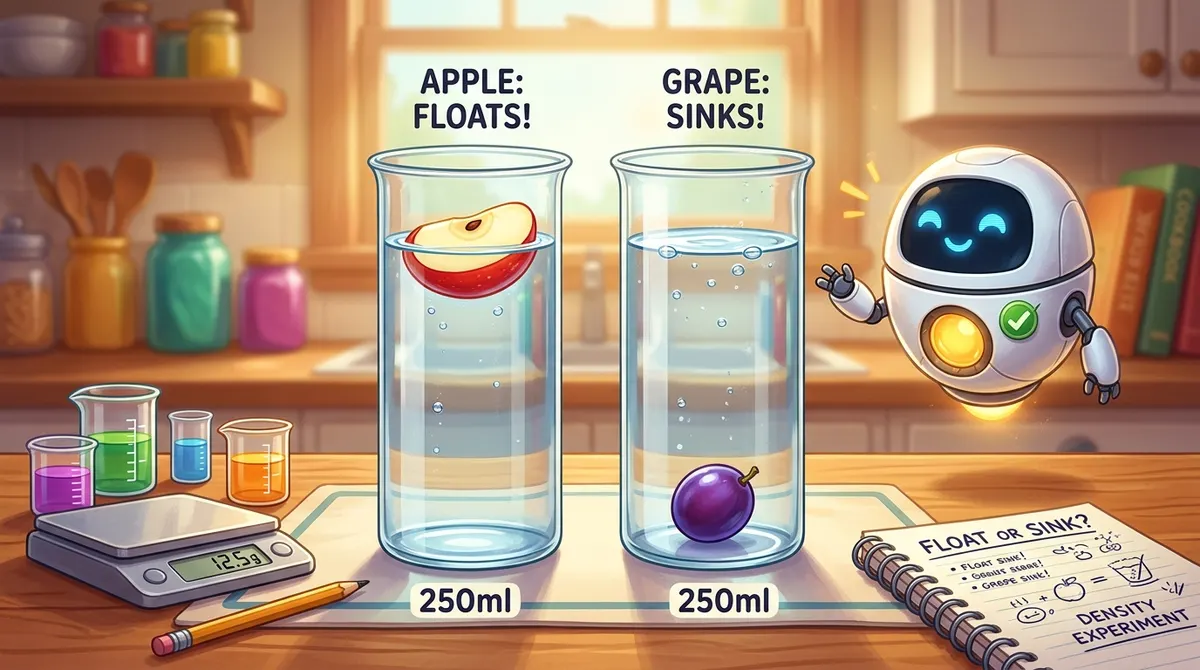 Figure 3.1: Clear glass beakers demonstrating buoyancy density: a buoyant apple slice floats on the surface while a denser grape sinks to the bottom.