Unit 3
Consequences and duties
Argue a hard choice from its outcomes and from what you owe, and see where the two ways of reasoning pull apart.
Read
The promise and the injured child
On Saturday morning Imran is walking to Mr Rao's shop. A week ago he promised to spend the morning helping Mr Rao unpack a delivery, and Mr Rao has paid a day's wage to a second helper on the strength of that promise. Halfway there, a small girl from his lane falls off her bicycle. Her knee is badly cut, she is crying, and nobody else is around. The clinic is ten minutes' walk away. If Imran takes her there, he will break his promise.
What should he do? Most people say, "Help the girl." But why? Is it because the harm to her matters more than the inconvenience to Mr Rao? Or because he has a duty to help someone in need, and that duty is stronger than the duty to keep this promise? These are two different kinds of reason. This unit is about telling them apart, using them well, and noticing where they disagree.
Two lenses
The consequences lens asks: What will happen? It judges a choice by its results for everyone it touches. A good choice is one that leads to better outcomes, with less harm and more well-being, than the alternatives. Philosophers call views like this consequentialist; Jeremy Bentham and John Stuart Mill in nineteenth-century Britain are the best-known defenders.
The duties lens asks: What do I owe? It judges a choice by whether it meets obligations: to keep promises, tell the truth, treat people fairly, respect their rights, help those in need. Some duties hold even when breaking them would give a slightly better result. Thinkers like Immanuel Kant argued this way, and so does much everyday moral talk ("a promise is a promise"). Indian traditions also talk of dharma, what is right for you to do given your role and relationships, and of Rama keeping his father's promise even at a terrible cost.
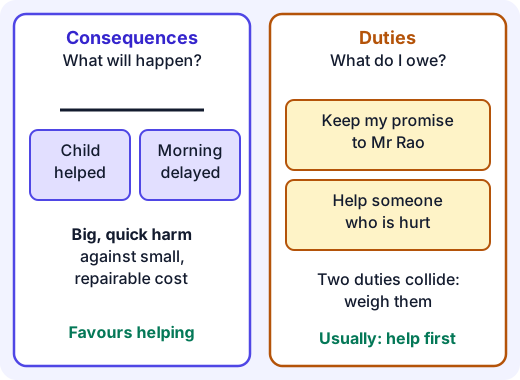
Neither lens is "right" in a way that ends the conversation. Both capture something true: outcomes matter, and so do the things we owe each other.
Using each lens well
Reasoning from consequences takes work. To do it properly you must:
- count everyone affected, not just yourself or your friends;
- compare how big each effect is and how likely it is;
- include long-term effects such as lost trust;
- admit you may be wrong about what will happen.
A common misunderstanding is that "consequences" means "whatever is good for me". It does not. The lens counts the girl, Mr Rao, the second helper and Imran, every one of them.
Reasoning from duties takes work too. You must:
- say which duty applies and why it binds you;
- ask what exactly was promised and to whom;
- notice that you may have more than one duty at once;
- decide which duty is weightier when they collide.
Another misunderstanding is that duty means "blindly following rules". Duty includes things you owe to other people, such as helping a hurt child, and the strongest duty-thinkers are the ones who argue carefully about which duty comes first.
Worked example: Imran
Consequences: If Imran takes the girl to the clinic, a child in pain is helped and her cut is treated early. The cost is a delayed morning for Mr Rao, who loses some time and must tell the second helper to start without him. That cost is small and can be repaired: Imran can run to the shop later and say sorry. If Imran keeps the promise and walks on, the girl may wait a long while, and her pain and risk of infection continue. The outcomes strongly favour helping her.
Duties: Imran owes Mr Rao his word. He also owes help to someone nearby who is hurt and cannot help herself. Two duties collide. Most people judge that the duty to help the child is weightier here, since the harm is serious and immediate and the promise concerns something that can be made up later. A duty view does not say all duties are equal; it says they must be weighed.
Result: Here both lenses give the same answer. The conflict is real but easy to settle. That also shows something important: promise-keeping is not wiped out. Imran should explain to Mr Rao, apologise, and try to make up the time, because the broken promise still leaves something owed.
Where the lenses disagree
The lenses disagree when a choice gives the best outcome but means doing something that a duty forbids. Picture four cases.
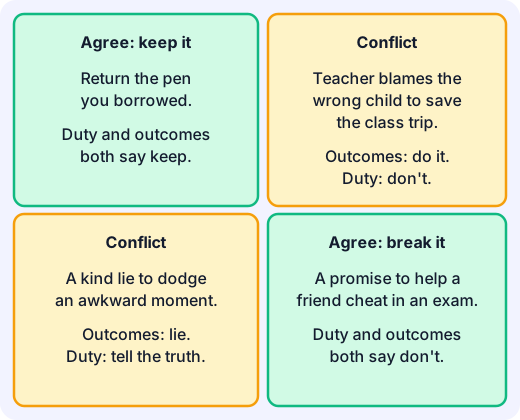
- Both say keep it: return the pen you borrowed. Outcomes and duty agree.
- Both say don't: you promised a friend to help copy answers in an exam. Cheating hurts others and breaks a duty to be honest, so the promise should be broken.
- Outcomes say do it, duty says don't: a teacher knows that falsely blaming one student for a prank would stop the whole class losing its trip. Many disappointed against one punished: the outcomes may favour blaming. The duty to be fair and honest says no.
- Duty says do it, outcomes say don't: an honest answer is awkward, such as telling a friend their poem is not good. A kind lie keeps the moment pleasant, but honesty asks for the truth, said kindly.
The teacher case is where the consequences lens looks dangerous: it seems to allow treating one person unfairly because it helps many. And the duties lens has its own weak spot: when two duties conflict, "do your duty" does not tell you which. Each lens needs the other.
What a careful thinker does
A thoughtful answer to the question "Is it right to break a promise to prevent harm?" usually does not pick a team and ignore the other. It says something like:
"A promise carries real weight, because trust depends on promises being kept. But the weight is not unlimited. When breaking it prevents serious harm and the cost of breaking is small and can be repaired, the duty to prevent harm is stronger. The bigger the promise and the smaller the harm, the more the promise should win."
Notice that the answer contains both lenses. It also gives conditions, not a blanket rule. And it keeps an eye on what is still owed afterwards.
Three traps
- "If the lenses disagree, one of them must be useless." No. They can each be giving you true information, and the disagreement is a signal to think harder.
- "Predicting results is impossible, so ignore consequences." We cannot be certain, but ignoring likely results is not wise either; a good thinker estimates.
- "A promise can never be broken." Almost nobody believes this once they see a case like Imran's. The real question is how heavy the promise is, set against what is at stake.
Try it: Think of a time you had to choose between keeping your word and doing something else. Describe it from the consequences lens, then from the duties lens. Did they agree?
Quick check
Quick check - outcomes and duties
Practise telling the two lenses apart. This is practice; your Shastrartha is what counts.
1.Match each lens to the question it asks.
- Consequences lens
- Duties lens
Match each to: What do I owe, such as honesty, promises or fair treatment? · What will happen to everyone affected?
2.'I will tell the teacher who broke the window, because I owe it to everyone to be honest.' Which lens is this reasoning from?
- The duties lens
- The consequences lens
- Neither; it has no reason
Choose one
3.'I will keep Nani's surprise party secret because she will be much happier on the day.' Which lens is this reasoning from?
- The duties lens
- The consequences lens
Choose one
4.Which of these does careful reasoning from consequences require? Pick all that apply.
- Counting everyone affected, not just yourself
- Estimating how big and how likely each effect is
- Including long-term effects such as lost trust
- Ignoring anyone you do not know
Choose all that apply
5.A friend says: 'Thinking about consequences just means doing whatever is good for me.' What is the best reply?
- Correct: that is all it means.
- No: the lens counts the good and harm to everyone affected, including people you do not like.
- No: it ignores all results.
- Correct, and that is why it is a duty view.
Choose one
6.Imran owes Mr Rao his promise and also owes help to a hurt child. What is the main difficulty for the duties lens here?
- Two duties collide, and 'do your duty' does not say which one wins; he must weigh them.
- Duties have no weight.
- He has no duties.
- The lens only cares about results.
Choose one
7.You promised a friend you would help them copy answers in an exam. Do the two lenses disagree about whether to keep this promise?
- No: both say it should not be kept, since cheating harms others and breaks a duty of honesty.
- Yes: outcomes say keep it and duty says break it.
- Yes: duty says keep it and outcomes say break it.
- Neither lens says anything about it.
Choose one
Answering and checking are for registered learners. Register to do this.
Quick check
New puzzles - weighing a choice
Use both lenses on cases the reading did not show.
1.Tara promised to keep her sister's diary secret. She sees a page showing her sister plans to meet a stranger from the internet alone tonight. Which of these are reasons FROM CONSEQUENCES for telling a trusted adult? Pick all that apply.
- Telling may stop her sister from being harmed.
- A promise is a promise, and she owes her sister her word.
- Her sister's trust may be hurt, which is a cost to count.
- She has a stronger duty to protect someone from danger.
Choose all that apply
2.A student says: 'Keep a promise unless keeping it would cause serious harm and breaking it costs little.' Which description fits best?
- A duty with an exception weighed by consequences
- A pure consequences view with no duties
- A pure duty view with no exceptions
Choose one
3.A bus driver promised to be at the depot at six. On the way she passes a road accident where she can help until the ambulance arrives; this would delay her by ten minutes and harm nobody. Do the two lenses clearly disagree?
- No: the outcomes favour helping, and so does the duty to help someone in need; the delay costs little.
- Yes: outcomes say go on, duty says help.
- Yes: duty says go on, outcomes say help.
Choose one
4.Which case best shows the two lenses pulling apart?
- Returning a borrowed pen
- A teacher falsely blaming one student for a prank so the whole class keeps its trip
- Helping a friend cheat in an exam
Choose one
Answering and checking are for registered learners. Register to do this.
Your turn
Shastrartha - the promise and the harm
The question: Is it right to break a promise to prevent harm?
Write a Shastrartha response of about 250-400 words.
- Take a clear position (pratijna), with any conditions.
- Give reasons (hetu) from the consequences lens and from the duties lens.
- Give an example of your own (udaharana) and apply it back to your position.
- State fairly the view that a promise should almost never be broken (purvapaksha).
- Check your reasoning for a trap such as "never" or "always" (hetvabhasa).
- Answer the strongest objection (tarka).
- Say what would change your mind (vada), and finish with a conclusion that follows (nigamana).
How it's judged
- Clear position (pratijna)
- Reasons (hetu)
- Examples (udaharana)
- Fairness to the other side (purvapaksha)
- Sound reasoning (hetvabhasa)
- Responding to objections (tarka)
- Openness to changing your mind (vada)
- Conclusion follows (nigamana)
Writing and submitting your answer is for registered learners. Register to do this.
Your turn
Explain - two lenses on one choice
Think of a real or imagined choice where someone must decide between keeping their word and doing something else.
- Describe the case in two or three sentences.
- Argue it from the consequences lens: who is affected and how?
- Argue it from the duties lens: what is owed, and to whom?
- Say whether the lenses agree. If they disagree, say exactly where and which one you find stronger here.
- In your own words, explain why different ethical approaches can disagree.
How it's judged
- Using the consequences lens
- Using the duties lens
- Showing agreement or conflict
Writing and submitting your answer is for registered learners. Register to do this.
Like what you see?
Register for free to answer the quick checks, do the activities and save your work. Your work is saved on your device and syncs to your account.