Unit 4
Equality and fairness
Treating everyone the same and giving everyone the same result are different things, and fairness can mean either, or something else.
Read
One price for everyone?
Rafiq runs a small clinic in a river town. A new course of medicine for a lung infection has arrived, and it costs 800 rupees. Three people come in on the same morning.
- Devi cleans offices and earns about 8,000 rupees a month.
- Hamid keeps a tea stall and earns about 20,000 rupees a month.
- Dr Anita, a visiting engineer, earns about 80,000 rupees a month.
Rafiq says, "The price is 800 for everyone. That is only fair." Devi says nothing and looks at the floor. Anita thinks it over and says, "It is the same for all of us, yes. But I'm not sure that settles it."
Our question this week is the one in the clinic: should everyone pay the same price for medicine? To think about it well, we first need to pull apart two ideas that people often squash into one word, equal.
Equal treatment and equal outcomes
Equal treatment means the same rule is applied to everyone. One price, one exam paper, one queue, one set of rules for every player. Rafiq's 800 rupees is equal treatment.
Equal outcomes means people end up in the same place. Everyone who is ill gets well. Everyone has enough to eat. Every child can read by the age of ten. An outcome is about the result, not the rule.
These two can come apart. Look at what the one price does.
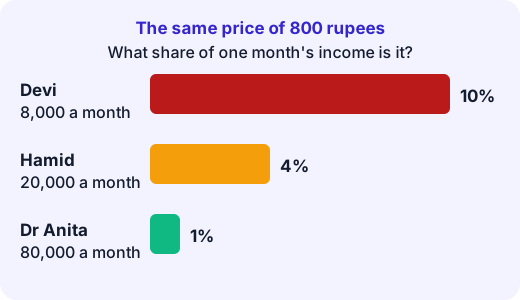
Worked example. What share of a month's income is 800 rupees for each person?
- Devi: , which is 10%.
- Hamid: , which is 4%.
- Anita: , which is 1%.
The rule is equal, but the effect is very different. For Anita it is a small bill. For Devi it is a tenth of everything she earns, so she might have to skip a month's rent or food to pay it. Equal treatment has produced a very unequal burden, and possibly a very unequal outcome: Anita gets better and Devi may not.
The first misconception: "same means fair"
Many people feel that treating everyone identically is what fairness means. Sometimes it is. We want a cricket umpire to apply the same rules to both teams, and a teacher to mark everyone's paper by the same marking scheme. Here, differences in treatment would be favouritism.
But identical treatment can be unfair when people start in different situations. A school exam with a fixed time looks equal. Now imagine one student has a broken right wrist and writes slowly with her left hand. If everybody gets 60 minutes, the rule is the same, but the test now measures her wrist as well as her knowledge. Giving her 20 extra minutes treats her differently, in order to treat her fairly: the exam is now about what it was meant to be about.
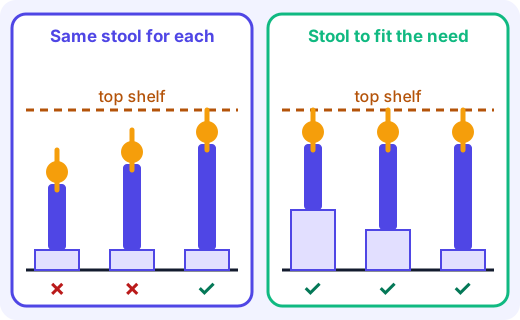
The picture makes the point: giving everyone the same stool is equal treatment, but only the tallest person reaches the shelf. Matching stools to need can let all three reach. Notice the cost, too: someone had to decide who gets which stool, and the tall person might grumble.
The second misconception: "fair means everyone ends up identical"
Now the opposite mistake. If equal treatment can be unfair, should we aim for equal outcomes at all times? That also has problems.
Suppose a class of thirty has a rule that everyone must finish with the same marks. Then no one gains from studying and no one is hurt by skipping it, so it ignores effort. Or suppose a village makes everyone's harvest exactly equal. People who work through the heat get nothing for it, and soon fewer people may want to. Even where we do want equal results, there are limits: no price or rule can guarantee that every sick person is cured, because some illnesses are not curable.
So equal outcomes are not always the aim, and when they are, they usually mean something narrower: that everyone gets what they need to reach a decent level, such as basic healthcare or school, rather than being made identical in all ways.
Fairness has more than one meaning
Here is the key idea of this unit: "fair" is not a single idea. It can mean:
- Same rule for all (equal treatment): no favourites.
- Same burden (a share of what you can afford): a tax or fee that takes the same percentage of income, so it hurts equally. Charging 1% of income would mean 80, 200 and 800 rupees.
- By need (more to those who need more): the injured student's extra time; free medicine for those who cannot pay.
- By effort or contribution (more to those who put in more).
- Equal outcome (the same end result, at least for the basics).
Different meanings fit different cases. A game needs the first. A tax system may need the second. A hospital emergency room uses the third: the person bleeding is seen before the person with a sore throat, even if the sore throat came in first. The skill is to ask "fair in which sense, and why does that sense fit this case?"
Real systems mix them. In India, Jan Aushadhi stores sell generic medicines at lower prices than many branded ones, so that the same medicine is cheaper for everyone. Some hospitals charge according to what a patient can pay. Health insurance asks many people to pay in while healthy so that the few who fall ill are looked after, which blends equal contribution with sharing by need. Each choice answers "what does fairness mean here?" differently, and each has a price that someone pays.
Looking at both sides
Back to Rafiq's clinic. Here are the two sides, stated as fairly as we can.
- For one price. It is simple and open. Nobody has to prove how poor they are, which can be humiliating. Rafiq does not have to judge people or guess at incomes. And the clinic has costs, so someone must pay them. Different prices might also tempt people to pretend to be poorer.
- For different prices. If the price keeps Devi from the medicine, then the "same" price is not treating her the same in any way that matters. Healthcare is something people need, not a luxury, so need should count. Charging more to those who can afford more (as a tax does) is a very old idea.
Both sides have a point. A careful thinker can still pick a side, perhaps "different prices, with a simple way to decide who pays what", but must say what the other side gets right and what it costs to have a different system.
Try it: Think of a rule at home or school where everyone is treated alike. Who does it help most? Who does it hurt most? Would changing it for those who are hurt be fair, or would it be favouritism? How would you tell the difference?
Remember
- Equal treatment is about the rule; equal outcomes are about the result. They can come apart.
- The same rule can place very different burdens on different people.
- Aiming for identical results can ignore effort and choice, so be clear what outcome matters.
- "Fair" has several meanings. Ask which one fits the case, and who pays for each choice.
Quick check
New puzzles
Use the difference between equal treatment and equal outcomes in situations you have not seen before.
1.A family earns 5,000 rupees a month. A school trip costs 400 rupees per child. What percentage of the family's monthly income is that, for one child?
Answer with a number
2.A bus pass costs 800 rupees for everyone. Put these people in order from the HEAVIEST burden to the LIGHTEST, as a share of monthly income.
- Bimla, income 8,000 a month
- Dalia, income 80,000 a month
- Carlos, income 20,000 a month
Put these in order
3.Match each example to the sense of fairness it is mainly using.
- Everyone entering the park pays 20 rupees
- Everyone pays 1% of their income as a fee
- The most seriously ill patient is seen first
- A programme aims for every child to read at a basic level
Match each to: by need · equal outcome for the basics · same burden · same rule for all
4.A village rule lets every household draw exactly 2 buckets of water a day from the one well. The Khan household has 3 people. The Rao household has 11. Which statement is the best criticism of the rule?
- It treats households the same, but it gives each person in a big household far less, so people end up with very different amounts.
- It is unfair because any rule about water is unfair.
- It is fair because everyone was treated exactly the same, and that settles it.
- It is unfair because the Khans should get more than the Raos.
Choose one
5.A teacher gives a student with a sprained hand 15 extra minutes in a written test. A classmate says, 'That is not fair, we all got 60.' What is the strongest reply?
- Teachers can do whatever they like.
- The extra time is a different treatment meant to make the test measure knowledge, not the sprain, so it aims at fairness.
- You are right, so everyone should be given the same extra time.
- It is fair because the student is the teacher's favourite.
Choose one
Answering and checking are for registered learners. Register to do this.
Your turn
Shastrartha - one price for medicine?
The question: Should everyone pay the same price for medicine?
Write 14 to 20 sentences, or prepare to speak for three minutes. Use all of these parts.
- Your position (pratijna). One sentence: yes, no, or "it depends", and say on what.
- Reasons (hetu). Give at least two reasons. Say which sense of fair each one uses: same rule, same burden, by need, by effort, or equal outcome.
- An example (udaharana). Use Rafiq's clinic, the extra-time exam, or a real case you know, and show how your reason applies to it.
- The other side (purvapaksha). State the strongest view that disagrees with you, in words its supporters would accept.
- Sound reasoning (hetvabhasa). Check your own reasons for false steps, for example "it is the same for everyone, so it is fair" or "some people cannot pay, so nobody should pay". Name one weak spot in your own argument.
- An objection (tarka). Answer this objection, whichever side you took: "Someone has to pay for the medicine and the clinic. If some pay less, others pay more, and that is unfair to them." Say what is true in it and give your reply.
- Open to change (vada). Say what kind of evidence or argument would make you change your mind, or what you changed while thinking this through.
- Conclusion (nigamana). Finish with a conclusion that follows from your reasons, including any conditions.
How it's judged
- Clear position and a conclusion that follows (pratijna and nigamana)
- Reasons and examples that use the right sense of fair (hetu and udaharana)
- Fair to the other side (purvapaksha)
- Sound reasoning (hetvabhasa)
- Answers the objection (tarka)
- Open to changing the view for good reasons (vada)
Writing and submitting your answer is for registered learners. Register to do this.
Your turn
Explain it - same treatment, same result?
A younger cousin says: "If you treat everyone exactly the same, that is fair. End of story."
Write what you would say back, in 8 to 12 sentences. Include:
- What equal treatment and equal outcomes mean, in your own words.
- One example, from the reading or your own, where equal treatment gives unequal results.
- One reason why simply aiming for identical results is not the answer either.
- A sentence on why "fair" can have more than one meaning.
How it's judged
- Defines equal treatment and equal outcomes
- Example where equal treatment gives unequal results
- Limits of equal outcomes, and more than one meaning of fair
Writing and submitting your answer is for registered learners. Register to do this.
Like what you see?
Register for free to answer the quick checks, do the activities and save your work. Your work is saved on your device and syncs to your account.