Unit 1
Getting good at one sport
Pick one sport, break it into skills, rules and tactics, and use deliberate practice to improve and then play a real match.
Read
Why practice beats just playing
Meera and Tariq joined the same badminton club in June. Both came three evenings a week. By September Tariq's backhand clear had become a weapon, and Meera's was still the shot she dreaded. They had played the same number of games. So what was different?
Meera spent her evenings rallying and playing matches. Tariq played too, but at the start of each session he spent fifteen minutes on one thing: hitting backhand clears from the net to the back line, aiming at a towel on the floor, and counting how many landed beyond the marked line. When it went wrong, his coach, or a friend filming on a phone, showed him that his elbow dropped. He fixed it, counted again, and tried to beat last week's number.
Getting good at a sport is not mostly about talent or about hours. It is about how the hours are spent.
What a sport is made of
Any sport has four parts that you learn together:
Part What it means Example in kabaddi Example in badminton Skills (technique) The movements you must perform well Ankle hold, raiding with a quick retreat Serve, clear, smash, footwork Rules What is allowed, how points are scored, how fouls are called A raid lasts at most 30 seconds; touching defenders and getting back scores points Rally scoring to 21; a serve must land in the diagonal box Tactics Decisions that give you an advantage Which defender to target, when to send a raider Hitting to the back corner, then dropping short Fitness The speed, stamina, strength and flexibility the sport needs Short bursts, strong legs, flexible back Quick steps, shoulder strength, endurance Check the rules against the current official rulebook of your sport, because rules are revised and local school versions vary. "Rules" also includes the spirit of the game: honest calls, respect for the other side and for officials.
Pick one sport for this unit. It can be a team game or an individual one, and it can be one you already play or one you want to try: football, kho-kho, basketball, cricket, hockey, swimming, athletics, table tennis, anything you can practise safely a few times a week.
How a skill is learned
Almost every new skill passes through three stages:
- Clumsy. You think about every part of the movement. Mistakes are big and frequent.
- Smoother. You make fewer big mistakes. You still have to concentrate, and pressure makes you slip.
- Automatic. The movement happens without thinking, so your mind is free to read the game.
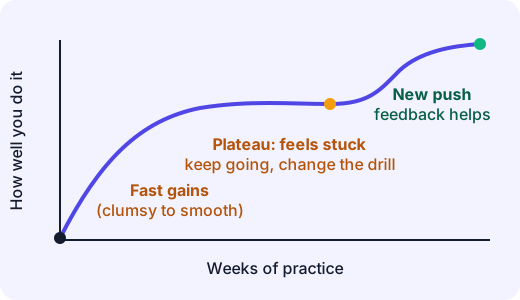
The curve is not a straight line. Early progress is fast. Then comes a plateau where nothing seems to change. Plateaus are normal. They usually mean the drill has become too easy or the feedback has run out, not that you have "reached your limit".
Deliberate practice
Deliberate practice is practice with a clear goal, full attention, a little more challenge than is comfortable, and quick feedback. It beats casual playing because most casual play repeats what you already do well.
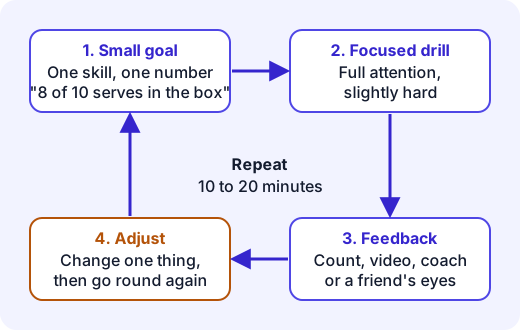
Example. Tariq's plan, written out:
- Goal: land 7 of 10 backhand clears beyond the back service line within four weeks. (Week 1 baseline: 3 of 10.)
- Drill: 3 sets of 10 clears, three evenings a week, 15 minutes each.
- Feedback: count landings; film one set a week.
- Adjust: the video shows the elbow dropping, so the next two sessions focus on "elbow up, hit high".
If he completes all twelve sessions of fifteen minutes, that is minutes of focused work, three hours, on a single shot. Meera's evenings had many more hours of playing, but almost none were aimed at her weakest stroke.
Misconception: "Practice makes perfect." Practice makes permanent. If you rehearse a faulty grip a thousand times, you will get very good at the faulty grip. What makes you better is correct, attentive practice with feedback.
Misconception: "Some people are just naturally good." Body size, age and early experience do matter, and some people start with an advantage. But in nearly every sport, players who improve most over a year are those who practise with purpose. Starting behind is not the same as staying behind.
Practise the way the game is played
Some drills are blocked: the same skill again and again (twenty serves in a row). They are excellent early on, when you are in the clumsy stage. Later, add mixed drills where you must choose the skill: a partner feeds you shots from random places, or a small game forces you to decide between passing and shooting. Mixed practice feels harder and messier, but it transfers better to real matches.
A useful pattern is whole, part, whole: play a short game, notice what went wrong, drill that part, then return to the game to test it.
Tactics and rules in practice
Skills are useless if you do not know where to use them. Learn the rules properly by reading them, then watching a match with the rulebook open. Then learn tactics through small-sided games: 3-vs-3 football, half-court basketball, singles on a half court. With fewer players and more touches, you face the same decisions again and again. Simple tactical questions work in almost every sport: Where is the space? Who is free? What is the other side weak at?
Playing the match
A match is where practice is tested, and it should be played with a plan:
- Choose one or two things from practice to try (not ten).
- Know your role and your team's plan.
- Play fairly and accept the officials' decisions. A match you win by cheating teaches you nothing about your skill.
- Afterwards, review: What worked? What fell apart under pressure? Which skill goes to the next drill list?
Staying safe and recovering
Warm up for five to ten minutes before practice and cool down afterwards. Use the right equipment (shin guards, helmets, proper shoes, water bottle), check the ground, and take extra care in hot weather. Stop and tell an adult if something hurts sharply, if you feel dizzy, or if you are injured. Rest days are part of training because the body gets stronger while resting.
Try it: Choose your sport. Write down one skill you can do, one you cannot do well yet, and one rule you are unsure about. You will use these in the activities.
If you would like help picking a sport or planning practice, a PE teacher or coach at school can guide you. They can also check that your drills suit your body and age.
Activity
Four weeks of deliberate practice
Choose one skill from your sport and practise it on purpose for four weeks (three sessions of about 15 minutes each week). You will count your results each session and keep a log. Plan a first session of 30 minutes to set up.
You'll need
- A ball, racket, bat or whatever your sport uses
- A flat, safe space and a target (a towel, chalk marks, a cone, a hoop or a line)
- Paper or a notebook for your log
- A phone or tablet for filming, if an adult agrees (optional)
- A friend, sibling, coach or PE teacher to count or watch (optional)
Steps
- Name your sport and one skill you want to improve. Examples: badminton backhand clear, football weak-foot pass, basketball free throw, kabaddi ankle hold on a cushion with a trained partner, cricket forward defence, swimming turn.
- Make the skill countable. Decide what counts as a success (for example, ball lands in the box, pass hits the cone, shot goes in) and write that definition down.
- Do a baseline: do 10 attempts, warm up first. Write down how many succeed. Do it again the next day and use the average of the two as your starting score.
- Write a goal with a number and a date, for example: from 3 out of 10 to 7 out of 10 in four weeks.
- Warm up for 5 to 10 minutes: easy jogging, arm and leg swings, a few practice attempts at half speed.
- Practise 3 sets of 10 attempts. Rest one minute between sets. Concentrate on one coaching cue only, such as 'elbow up', 'eyes on the ball' or 'knees bent'.
- After each set, write the score. Once a week, film or ask someone to watch one set and tell you one thing you did well and one thing to change.
- Change exactly one thing for the next session, and write down what you changed.
- In week 3, make the drill harder: a smaller target, a moving partner, less time, or a game situation. Keep the log.
- After four weeks, repeat the baseline test. Write down your new score, what helped, and what you would do next.
Safety
- Warm up and cool down. Stop if something hurts sharply, if you feel dizzy, or if you are injured, and tell an adult.
- Use proper equipment and shoes. Check the ground for holes, wet patches and stones.
- Drink water, and practise in the shade or at cooler times of day when it is hot.
- Contact skills (kabaddi holds, tackles) are only practised with a trained coach or PE teacher present and a trained partner, never alone or at full strength.
Keeping a log of the activity is for registered learners. Register to do this.
Activity
Play a match and review it
Put your sport's skills, rules and tactics to work in a real or small-sided match, then review what happened. Allow about an hour: 10 minutes of planning, 30 to 40 minutes of play, 10 minutes of review.
You'll need
- Your sport's equipment and a safe place to play
- Enough players for a friendly match, or a small-sided version (for example 3-vs-3 football or half-court basketball)
- An adult, coach or older student to act as the referee or umpire
- Paper and pencil for your match plan and review
Steps
- Before the match, write down three rules of your sport that you could explain to a beginner. Ask the referee or check the rulebook if you are not sure.
- Write a match plan with two parts: one skill from your practice that you will try to use at least five times, and one tactic (for example 'pass to the open player', 'hit to the back corner', 'keep my feet moving').
- Agree the rules and the length of the match with the other players and the referee. Check that everyone has the right equipment.
- Warm up together for 5 to 10 minutes.
- Play. Accept every decision the referee makes, even when you disagree, and say 'well played' to the other side at the end.
- Straight after, ask someone to tell you how many times you used your chosen skill, or count it yourself from memory and mark the number as an estimate.
- Review on paper: What worked? What fell apart when you were tired or under pressure? Did the tactic help? Which skill goes into next month's drills?
Safety
- Warm up and cool down. Take a drinks break during play and stop if anyone is hurt.
- Check the playing area and wear the proper protective gear for the sport (shin guards, helmet, gloves, mouthguard where it is normal).
- Agree on safe play and stop the game at once if a player is injured or play becomes rough.
- Stay out of the heat in the middle of the day. Tell an adult if you feel faint or sick.
Keeping a log of the activity is for registered learners. Register to do this.
Quick check
Getting good at one sport: quick check
Eight questions on skills, rules, tactics and deliberate practice.
1.Which description best fits deliberate practice?
- Watching professionals and copying them later
- Repeating a skill as fast as possible without stopping
- Playing as many matches as you can
- Working on one chosen skill with full attention, a clear target and quick feedback
Choose one
2.Which of these are features of deliberate practice? Choose all that apply.
- Getting feedback from a count, video or coach
- Repeating the same movement while thinking about something else
- A specific goal for the session
- Drills that are a little harder than comfortable
Choose all that apply
3.Put the deliberate practice cycle in order.
- Get feedback on how it went
- Change one thing and go round again
- Do a focused drill
- Set a small, countable goal
Put these in order
4.Match each example from basketball to the part of the sport it belongs to.
- Skill
- Rule
- Tactic
- Fitness
Match each to: Taking too many steps without dribbling is travelling · Passing to a free teammate near the basket · Being able to keep running up and down the court in the last quarter · Dribbling with the weaker hand
5.Ravi tests his free throws on two days. Day 1: 3 out of 10. Day 2: 5 out of 10. He uses the average as his baseline and sets a goal of twice the baseline. How many out of 10 is his goal?
Answer with a number
6.After six weeks of quick improvement, Leela's sprint start has not improved for two weeks. What is the best way to read this?
- She has reached her natural limit, so she should stop practising it
- She should repeat exactly the same drill for twice as long
- Practice does not work for sprinting
- A plateau is normal; she should change the drill or get new feedback
Choose one
7.What is the flat stretch on a learning curve, where progress seems to stop for a while, called? (one word)
Answer with a word or phrase
8.Jas plays matches six hours a week but his left-foot pass is still poor. Which change is most likely to help?
- Avoid using his left foot in matches
- Add 15 minutes, three times a week, of left-foot passing at a target, with a count and one coaching cue
- Wait until he feels like passing with his left foot
- Play more matches the same way
Choose one
Answering and checking are for registered learners. Register to do this.
Quick check
New puzzles about practice
Use what you know about skills, tactics and practice in situations you have not seen before.
1.Nadia wants to get better at catching in cricket. Which is the best practice goal?
- Get better at catching
- Practise catching as much as possible this month
- Be as good as the best fielder in the league
- Catch 8 of 10 balls thrown at chest height by the end of four weeks, counted every session
Choose one
2.A swimmer plans five weeks of turn practice, two sessions a week, 20 focused minutes each. How many minutes is that in total?
Answer with a number
3.Imran practises penalty kicks into an empty goal, always to the left corner. In matches he misses under pressure. Which change would help most?
- Kick harder every time
- Do twice as many kicks into the empty goal
- Stop practising penalties
- Add a goalkeeper and a partner who calls a random corner just before he shoots
Choose one
4.In a 3-vs-3 football game, which of these is a tactic (rather than a skill, a rule or a fitness quality)?
- Moving into an open space so a teammate can pass to you
- The ball is out when it crosses the touchline
- Being able to sprint repeatedly for 20 minutes
- Controlling a pass with the inside of the foot
Choose one
Answering and checking are for registered learners. Register to do this.
Your turn
Explain how you improved
Use your sport and your own practice log (or, if you have not done the four weeks yet, a plan for them). Write 150 to 300 words.
- Name your sport and one skill, one rule and one tactic from it.
- Describe your practice goal, drill and the feedback you used. Show your baseline and latest scores.
- Explain why the practice you did was better than "just playing more". Name one thing you changed after feedback and say what happened.
- State what you will work on next, and why.
How it's judged
- Parts of the sport
- Deliberate practice plan and evidence
- Explaining why it works
Writing and submitting your answer is for registered learners. Register to do this.
Like what you see?
Register for free to answer the quick checks, do the activities and save your work. Your work is saved on your device and syncs to your account.