Unit 2
Fitness testing
Run standard fitness tests fairly, read the numbers honestly, and set goals that show whether your training really works.
Read
Numbers that tell you if training works
Zoya and Arjun both began a six-week jumping and leg-strength routine after school. At the end of week six each said the same thing: "I feel stronger." Feeling is a start. But feelings can be wrong. Good days feel strong; a night of poor sleep makes everything feel hard. To know whether training worked, you need data: numbers collected the same way each time.
What fitness tests are for
A fitness test is a standard way to measure one part of fitness so the result can be compared over time. School and national fitness programmes use a small set of simple tests that need little equipment.
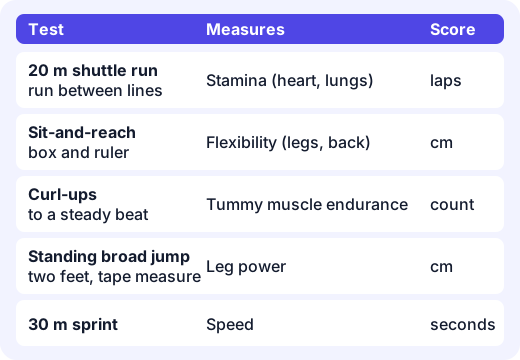
- 20 m shuttle run (beep test). You run back and forth between two lines 20 metres apart in time with beeps that get faster. The score is the number of laps you complete before you cannot keep up. It estimates aerobic fitness (stamina).
- Sit-and-reach. Sitting with legs straight, you reach forward along a ruler on a box. It measures flexibility of the back of the legs and lower back, in centimetres.
- Curl-ups. You lift your shoulders from a mat, curling up and down to a set beat, as many as you can in good form. It measures muscular endurance in the tummy muscles.
- Standing broad jump. You jump forward from a line with both feet. Distance is measured from the line to the nearest heel on landing. It measures leg power.
- 30 m sprint. Time from a standing start to the line. It measures speed.
Pick tests that match your sport and goals. Tests are not a measure of your worth or talent. They are a tool, like a ruler.
Running a test fairly
A test is only useful if you can repeat it. Keep everything the same each time:
- Same warm-up, 5 to 10 minutes.
- Same surface and shoes, same equipment, same tester if possible.
- Same time of day, and avoid testing straight after a big meal or when ill, very tired or injured.
- Same instructions: know the rules (a jump counts from the heel nearest the line; curl-ups count only when form is correct).
- Rest between different tests so one tired muscle group does not spoil the next.
Safety: do not test if you are unwell, injured, or have been told by a doctor not to exercise. Stop if you feel faint or have chest or sharp joint pain, and tell an adult. For the beep test, tell the teacher if you have asthma or a heart condition.
Reading the numbers: wobble and real change
Test the same person on three days and you will not get the same number. The results wobble from sleep, hunger, weather, mood and small differences in technique. This everyday variation is sometimes called noise.
Example. Arjun's standing broad jump on three days: 153 cm, 151 cm, 152 cm.
- Mean: cm.
- Range (biggest minus smallest): cm.
So Arjun's score naturally wobbles by about 2 cm. If he jumps 154 next week, that is not proof of anything. It is within the wobble.
A good habit is to test three times and use the mean, and to ask: is the change in the means bigger than the wobble?
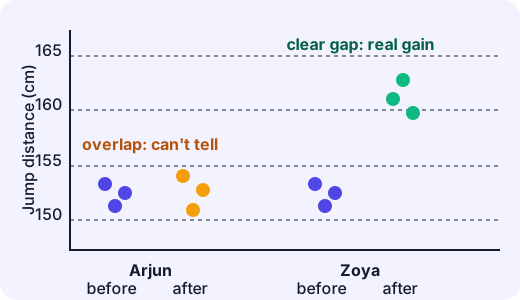
After six weeks:
Before (cm) Mean After (cm) Mean Change Arjun 153, 151, 152 152 154, 151, 153 152.7 +0.7 Zoya 153, 151, 152 152 161, 163, 160 161.3 +9.3 Arjun's change of 0.7 cm is smaller than his 2 cm wobble. The honest conclusion is "no clear change yet", not "training failed". Zoya's change of 9.3 cm is far bigger than the wobble. The evidence says her training worked.
Misconception: "One test result is the truth." A single score contains wobble. Three tests and a mean give a better picture.
Misconception: "If I didn't hit my goal, I failed." Zoya's goal was 162 cm and she reached 161.3 cm. She missed by less than 1 cm, yet she improved by more than 9 cm. The data show success. Goals are for steering, not for judging yourself.
Setting an evidence-based goal
A useful goal starts from data and can be checked by data. Use these steps:
- Baseline. Test three times and take the mean (Zoya: 152 cm, wobble 2 cm).
- Target. Choose an improvement that is bigger than the wobble and realistic. Many beginners can improve a test by several per cent in six to eight weeks if they train regularly; progress varies from person to person, so ask your PE teacher if unsure. Zoya chose +10 cm (about 6.6%, because ).
- Plan. What will you do, how often? Zoya: jump and squat routine three times a week.
- Date. Retest in six weeks, under the same conditions.
- Review. Compare the means with the wobble. Then decide what to keep, change or drop.
This is a goal with evidence: a starting number, a target number, a date and a way of checking. "Get fitter" has none of these.
Comparing with yourself
Tables of "average scores" exist, but they can hurt as much as help. Growth spurts, age and body size change results a lot at 11 to 13. The most useful comparison is you now against you before. If you want a wider comparison, discuss it with a teacher who knows how to read the tables, and treat the result as information, not a label. Fitness testing in school should never single anyone out or include weighing or body-shape comments.
Try it: Pick one test you can do safely. Choose when, where and how you will do it, then plan three test days. Write your plan before you start. The offline test-day activity in this unit takes you through it.
When you have data, bring it to a PE teacher, coach or doctor if you want help reading it. They can adjust your plan to your health and age.
Lab
Did the training work?
Test two students on the 20 m shuttle run, before and after six weeks, one result at a time. Look at the average and the wobble in each set, set a goal for the first student, and decide whether each student's change is real or could just be noise.
Your goals
- Collect at least three results before and three after for both students.
- Set a goal for Sam that is beyond the wobble and still realistic.
- Judge correctly whether each change is bigger than the wobble.
The interactive lab opens once you register. Register to do this.
Activity
Your own test day and goal
Run one standard fitness test on three days, work out your baseline and wobble, and set an evidence-based goal. Plan about 20 minutes per test day, then a retest six weeks later (you can finish the goal part now and do the retest later).
You'll need
- Tape measure or metre ruler (for a jump or sit-and-reach) or a stopwatch (for a 30 m sprint or timed curl-ups)
- Chalk, tape or a rope for a start line
- A soft mat or folded rug for curl-ups
- An adult or friend to measure and count
- Paper to record results
Steps
- Choose one test: standing broad jump, sit-and-reach, curl-ups to a steady beat, 30 m sprint, or a distance walk-run. Write down exactly how you will do it (surface, shoes, warm-up, how you count or measure).
- Do a 5 to 10 minute warm-up: easy jogging or marching, arm circles, leg swings, light stretches.
- Do the test with your helper measuring. Record your score. For a jump, take your best of two attempts and record only that one number.
- Repeat on two more days, in the same conditions and at about the same time. Record each score.
- Work out your baseline: add the three scores and divide by 3 (the mean). Then find the wobble: the biggest score minus the smallest (the range).
- Set a goal: pick a target that is bigger than your wobble and realistic for six weeks (for many beginners that is a few per cent up to about 20%; ask your teacher if unsure). Write the goal as a number and a date.
- Write a plan: what exercise or practice you will do, how many days a week.
- After six weeks, test again three times, using the same conditions, and work out the new mean. Compare the change in the means with your wobble.
- Write what you conclude: did your goal come true? Is the change bigger than the wobble? What will you do next?
Safety
- Do not test if you are ill, injured, or have been told by a doctor not to exercise.
- Warm up first, and use a clear, non-slip surface and proper shoes.
- For sprints and jumps, keep the area clear of people and obstacles, and land softly with bent knees.
- Stop and tell an adult if you feel dizzy, faint, have chest pain or a sharp pain in a joint or muscle.
- Drink water, and do not test in the hottest part of the day.
Keeping a log of the activity is for registered learners. Register to do this.
Quick check
Fitness testing: quick check
Eight questions on standard tests, fair testing and reading results.
1.Which standard test is mainly a measure of stamina (aerobic fitness)?
- Sit-and-reach
- Standing broad jump
- 20 m shuttle run
- Curl-ups
Choose one
2.Match each test to what it mainly measures.
- Sit-and-reach
- Curl-ups to a beat
- Standing broad jump
- 30 m sprint
Match each to: Muscular endurance of the tummy · Flexibility · Speed · Leg power
3.Dev's standing broad jump on three days: 141 cm, 139 cm, 143 cm. What is the mean, in cm?
Answer with a number
4.For the same three jumps (141, 139 and 143 cm), what is the range (biggest minus smallest), in cm?
Answer with a number
5.After six weeks Dev's three jumps average 143 cm (baseline mean 141 cm, wobble 4 cm). What is the fairest conclusion?
- Training clearly worked, because 143 is bigger than 141
- Training made him worse
- Fitness tests are useless
- The change of 2 cm is inside the 4 cm wobble, so we cannot tell yet
Choose one
6.Which of these are sensible safety steps on test day? Choose all that apply.
- Skip the test if you are ill or injured
- Push through sharp pain to get a good score
- Tell the teacher beforehand if you have asthma or a heart condition
- Stop and tell an adult if you feel faint
Choose all that apply
7.Meena's baseline is a mean of 20 curl-ups. Her goal is 25 curl-ups. By what percentage is the goal above her baseline?
Answer with a number
8.Which is the best evidence-based goal?
- Run every day until I feel strong
- Raise my mean shuttle-run score from 24 to 29 laps in six weeks, retested three times under the same conditions
- Get fitter this year
- Beat everyone in my class
Choose one
Answering and checking are for registered learners. Register to do this.
Quick check
New puzzles with fitness data
Use the ideas of mean, wobble and fair testing on data you have not seen before. In a sprint, a smaller time is better.
1.Kabir's 30 m sprint times before training: 6.2 s, 6.0 s, 6.1 s. After eight weeks: 5.8 s, 5.7 s, 5.9 s. By how many seconds did the mean time drop?
Answer with a number
2.In Kabir's data, the wobble (range) before training was 0.2 s. What is the fairest conclusion?
- The drop is tiny, so nothing changed
- He should test once more and use only the best time
- The drop in the mean is bigger than the wobble, so the evidence points to a real improvement
- Training cannot change sprint times
Choose one
3.Kavya did her baseline jump test on a Monday morning on a grass field, wearing sports shoes. Six weeks later she retested on a Friday after lunch, on a polished indoor floor, in socks. Why are the two results hard to compare?
- Fitness tests only work once
- She should have jumped at night
- The conditions changed (time, surface, footwear), so the difference might not be due to training
- Jumps cannot be measured in centimetres
Choose one
4.Ishaan's three standing broad jumps have a mean of 150 cm and a range of 3 cm. Which six-week goal is best?
- 210 cm, to aim as high as possible
- 160 cm, which is clearly beyond the wobble and still realistic
- No number at all, just try hard
- 151 cm, because it is a small step
Choose one
Answering and checking are for registered learners. Register to do this.
Your turn
What the data tell you
Use either your own test results or the example below. Write 150 to 300 words.
A student runs the 20 m shuttle test three times before a six-week programme: 18, 21 and 20 laps. After the programme she runs 22, 23 and 24 laps. Her goal was 25 laps.
- Work out the baseline mean and wobble (range), the new mean, and the change.
- Say whether the evidence shows that training worked, and compare the change with the wobble. Say whether she met her goal and what that tells you.
- Explain why each test should be done in the same conditions, and why three tests are better than one.
- Write a new evidence-based goal for the next six weeks.
How it's judged
- Calculations
- Reasoning from evidence
- Fair testing
- New goal
Writing and submitting your answer is for registered learners. Register to do this.
Like what you see?
Register for free to answer the quick checks, do the activities and save your work. Your work is saved on your device and syncs to your account.