Unit 5
Writing arguments
Build an argument from a claim, evidence and the reasoning that connects them, and learn why the third part is the one most writers skip.
Read
Claim, evidence and the bridge between
Imagine two students arguing about whether the school should start a vegetable garden.
Mina says: "We should have a garden. Plants need sunlight and water."
Kabir says: "Why does that mean we should?"
Mina has given a true fact, and yet Kabir is not convinced. Something is missing between her fact and her conclusion. Finding that missing piece is the main skill of argument writing at this level.
The three parts
A written argument has three parts that work together.
- Claim: the position you want the reader to accept. It must be something a reasonable person could disagree with. "The sun is a star" is a fact, not a claim. "Our school should start a vegetable garden" is a claim.
- Evidence: facts, numbers, examples, observations or expert statements that bear on the claim. Evidence should be relevant (it is about this claim), specific (it has names, numbers, places), and accurate (you could show where it came from).
- Reasoning: the sentences that explain why the evidence supports the claim. Reasoning answers the reader's question "so what?"
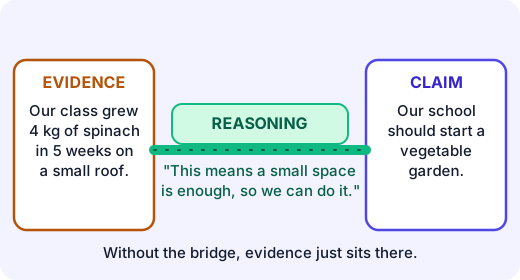
Most weak arguments fail at the bridge. The writer lists evidence, jumps straight to the claim, and expects the reader to make the connection. But readers don't share your head: you have to build the bridge in words.
A worked example
Here is Mina again, this time with all three parts. (The class details are invented for this example.)
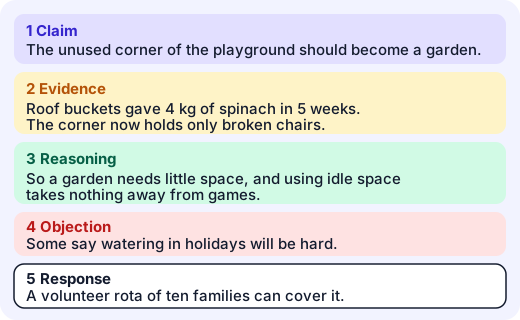
Claim. Our school should turn the unused corner of the playground into a vegetable garden.
Evidence. Last term the Class 6 science club grew spinach in six buckets on the roof. In five weeks they picked 4 kg, enough for the canteen's dal for a day. The corner I am talking about holds only a stack of broken chairs.
Reasoning. This shows that a garden does not need much space or costly equipment: six buckets were enough to feed a canteen meal. Since the corner is idle, using it takes nothing away from games, so the school would gain fresh food and lose nothing.
Take the reasoning apart. The first sentence says what the evidence means: little space is needed. The second sentence brings in the second piece of evidence (the chairs) and draws the conclusion that nothing is lost. Each link starts from a fact the reader has already seen. Kabir's "so what?" has been answered before he asks it.
Choosing evidence
Not everything true is useful. For each piece of evidence ask three questions.
- Does it bear on the claim? "Many people enjoy pizza" cannot help a claim about gardens. "Our science club grew 4 kg in five weeks" can.
- Is it a fact or only an opinion? "Gardens are wonderful" is another opinion that needs support. "The corner holds only broken chairs" is something anyone can check.
- Is it specific? "Some students grew food once" is weak. "Six buckets, five weeks, 4 kg" is strong.
A quick test for reasoning: read the evidence, then the word therefore, then your claim. If the jump feels too big, there is a missing step. Write that step down; it is your reasoning.
Sentence starters for reasoning
These openers help you write the bridge rather than skip it:
- This shows that…
- This matters because…
- In other words…
- Since this is true, it follows that…
- Without this, we would…
Answering the other side
A strong argument does not pretend that no one disagrees. After your main reasoning, add one counterargument and reply to it fairly:
Some will say that watering a garden in the holidays is too hard. A rota of ten volunteer families could share the work, and drip pipes from the school's rainwater tank would cut the effort further.
Notice the tone: the objection is stated honestly, not mocked, and the response uses a reason. This makes readers trust you. If you cannot answer an objection at all, that may mean your claim needs adjusting.
Common misconceptions
- "Evidence speaks for itself." It does not. The same fact (4 kg of spinach) can support "start a garden" or, for someone else, "buy spinach from the market, it is cheaper." Only your reasoning tells the reader which way it points.
- "More evidence is always stronger." Ten facts that don't bear on the claim don't help. Two relevant, well-explained pieces beat a pile of loose ones.
- "Reasoning means repeating my claim more firmly." "We need a garden, because a garden is needed" says nothing new. Reasoning must add an explanation that links something in the evidence to the claim.
- "A claim is a fact." If nobody could reasonably disagree, you do not need an argument.
Building an argument paragraph: a checklist
- State the claim in one clear sentence.
- Choose two pieces of evidence that are relevant, specific and accurate.
- After each piece of evidence, write a reasoning sentence that starts from the evidence and ends at the claim.
- Add one objection and a fair reply.
- End by returning to the claim in fresh words.
- Read it aloud and say "so what?" after each sentence. If you can still ask it, add a link.
Try it: Pick any claim from your own life, such as "Our class should have a reading corner." Write one piece of evidence, then write two different reasoning sentences for it. Which one convinces you more, and why?
Reasoning explains why evidence supports a claim. Without it, you have a list of facts; with it, you have an argument.
Lab
The bridge builder
Four short arguments each need two things: the evidence that really bears on the claim, and the reasoning sentence that builds the bridge. Pick both, check, and fix what the lab flags.
Your goals
- Choose the relevant evidence for each of the four claims.
- Choose the reasoning sentence that explains why that evidence supports the claim.
- Finish all four rounds.
The interactive lab opens once you register. Register to do this.
Quick check
Quick check on arguments
Think about claim, evidence and reasoning. The situations are invented for practice.
1.Which of these is a claim that a writer could argue for?
- The Ganga flows through Varanasi.
- Our school should switch off the corridor lights at lunchtime.
- A kilometre is 1,000 metres.
- Last Tuesday it rained.
Choose one
2.Claim: "Our colony should set up a book-swap shelf." Which is the best piece of evidence?
- Books are wonderful.
- In our lane, 23 of the 30 households said they have books they have already read and would swap.
- Many people like reading.
- I would use it.
Choose one
3.Claim: "Our school should start a cycling club." Which TWO pieces of evidence bear on the claim?
- Eighteen students in Class 6 already cycle to school.
- The school canteen sells samosas.
- A local shop has offered to repair club bikes for free.
- Cycling was invented in the nineteenth century.
Choose all that apply
4.Claim: "Our class should recycle paper." Evidence: "Our class threw away 12 kg of paper last month, and a recycler nearby collects paper for free." Which sentence is the best reasoning?
- Recycling is important, so we should do it.
- That is a lot of paper.
- Since we produce so much paper and collection costs nothing, recycling keeps waste out of the bin at no cost to us.
- 12 kg is more than 10 kg.
Choose one
5.Put these sentences in the order of a clear argument.
- So closing on Sundays shuts out most of the families the library is meant to serve.
- In a survey, 41 of 60 families said Sunday is the only day they are free.
- The library should open on Sundays.
Put these in order
6.Match each sentence to the part of the argument it plays.
- Bicycles should get their own lane on our road.
- Last year, 14 cyclists were hurt on this 3 km stretch.
- This shows that sharing the road with cars is dangerous, so separating them would prevent injuries.
- Some argue a lane would cost too much, but it is cheaper than the hospital bills.
Match each to: Reasoning · Counterargument and reply · Claim · Evidence
7.In the survey of 60 families, 41 said Sunday is the only day they can visit the library. To the nearest whole number, what percentage is that?
Answer with a number
8.A writer says, "My argument is strong because I have ten facts." Which reply is most accurate?
- Yes, more facts always make an argument stronger.
- Not necessarily. Facts that do not bear on the claim, or that are not explained, do not strengthen it.
- No, an argument should have only one fact.
- Facts do not matter in an argument; only opinions do.
Choose one
Answering and checking are for registered learners. Register to do this.
Quick check
New puzzles on arguments
Use claim, evidence and reasoning in situations you have not met before.
1.Two students argue for the claim "School should start thirty minutes later." **Student 1:** "A survey of our class found that 28 of 36 students wake at 6 a.m. and say they feel sleepy in first period. Teachers say the first lesson is when most mistakes happen." **Student 2:** "A survey of our class found that 28 of 36 students wake at 6 a.m. and say they feel sleepy in first period. This matters because tired students pay less attention, so an extra thirty minutes of sleep would help them learn in the lesson when they struggle most." Which is the stronger argument and why?
- Student 1, because it has two pieces of evidence.
- Student 2, because it explains how the evidence supports the claim.
- They are equally strong because they cite the same survey.
- Student 1, because it mentions teachers.
Choose one
2.Claim: "Our street should be closed to cars on Sunday mornings so children can play." Objection: "Shopkeepers will lose customers." Which reply is the best?
- Shopkeepers are selfish.
- Children matter more than shops, end of story.
- Most customers on Sunday morning come on foot, and a car-free street often brings more walkers past the shop windows.
- That objection is silly, so let us ignore it.
Choose one
3.Claim: "The pond behind school is polluted." Which evidence is strongest?
- "My cousin says it smells bad."
- "Everyone knows it is dirty."
- "Our science club tested water from three spots on 5 March and found oil on the surface and a pH of 9.5 at all three."
- "Ponds are usually polluted."
Choose one
4.A class of 36 students argues that walking to a museum would be better than taking a bus. The bus costs ₹25 per student. How many rupees would the class save in total by walking? (This number is the evidence the class will use.)
Answer with a number
Answering and checking are for registered learners. Register to do this.
Your turn
Build and explain an argument
-
Explain the idea. In your own words, explain the difference between evidence and reasoning, using the example "evidence: a school canteen sold 120 plastic cups a week; claim: the canteen should switch to steel cups". Why is the evidence not enough on its own?
-
Repair this paragraph. A student wrote: "Our school should plant a neem tree in the yard. Neem trees are green. Many people live in India. Last year it was hot." Name two things wrong with it, then rewrite it as a short argument paragraph (4 to 6 sentences). You may invent two believable details, but say that they are invented.
-
Write your own. Choose a claim about your school or neighbourhood (for example: a quiet reading hour, a safer crossing, a new bin). Write one argument paragraph with a clear claim, at least two pieces of specific evidence, a reasoning sentence after each, and one objection with a reply. Underline or label each part.
How it's judged
- Understanding evidence and reasoning
- Repairing the paragraph
- Own argument
- Clarity
Writing and submitting your answer is for registered learners. Register to do this.
-
Like what you see?
Register for free to answer the quick checks, do the activities and save your work. Your work is saved on your device and syncs to your account.