Unit 6
Explanatory writing
Explain a process or an idea so clearly that a reader never has to stop and wonder what you meant, using definitions, examples and transitions.
Read
Explaining so it sticks
Has anyone ever explained a board game to you and lost you in the first minute? "You roll, then you move, unless you land on a blue square, but if the card says... oh, you'll get it as we go." You didn't get it. The explainer knew the game so well that they forgot what it feels like not to know it.
Explanatory writing has one job: to give a reader an understanding they did not have before. It does not try to win an argument, and it does not tell a story. It shows how something works or what something means. The skill that separates a good explanation from a confusing one is anticipating confusion: imagining where a reader will get stuck, and putting something there to help.
The three tools
- Definition: a short statement of what a word or idea means, in words the reader already knows.
- Example: a concrete case that makes the idea visible.
- Transition: a word or phrase that tells the reader how one step connects to the next.
Definitions
A good definition names the group the thing belongs to and then says what makes it different from others in that group. "A habitat is the natural place where an animal or plant lives." The group is place; the difference is where it naturally lives.
The most common mistake is a circular definition: "Evaporation is when water evaporates." This uses the word to explain itself, so a reader who didn't know the word still doesn't. Better: "Evaporation is when liquid water warms and turns into a gas called water vapour."
Define a term the first time it appears, and keep the definition short enough to read in a breath. Don't define words your reader certainly knows; that is also a way of losing them.
Examples
An example turns an abstract idea into something you can picture. Compare these two sentences about the mean (the average):
- "The mean is the sum of the values divided by their number."
- "The mean is the sum of the values divided by their number. For example, if four friends score 4, 6, 8 and 10 runs, the sum is 28, and , so the mean is 7."
Both are correct. Only the second lets a reader try it. Good examples are small, concrete and from the reader's world. They sit right after the idea they illustrate.
Transitions
Transitions are signposts. They tell the reader what kind of step is coming.
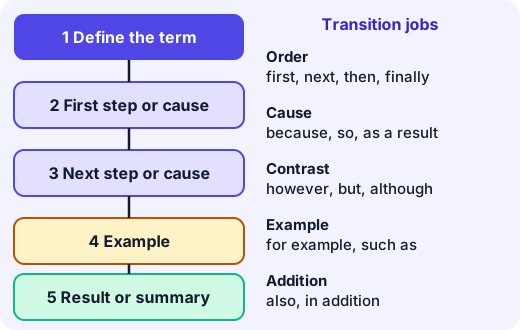
Job Examples Tells the reader Order first, next, then, finally "This is the following step" Cause because, so, as a result, therefore "This happened because of that" Contrast however, but, although "Here comes something different" Example for example, for instance, such as "Here is a case" Addition also, in addition "One more point of the same kind" A transition has to be true to the logic. "However" must introduce a contrast; "because" must introduce a cause. A misplaced transition is worse than none, because it tells the reader the wrong thing about how the ideas connect.
A worked example: the monsoon
Suppose we want to explain to a classmate how the summer monsoon brings rain to India. Here is a first draft.
The monsoon happens because of heating. The wind moves and then rain comes down. It is caused by the sea and land being different.
Every sentence is true, and none helps. The word monsoon is not defined. "Heating" of what? "Different" how? The steps are missing, so the reader cannot follow how heating leads to rain. Revised:
The monsoon is a seasonal wind that changes direction and brings a long rainy season. It begins with a simple difference: in summer, land heats up much faster than the sea. As a result, the air over the land becomes warm and rises, leaving a region of low pressure behind. Next, cooler, moist air from the Indian Ocean flows in to fill the gap. When this moist air reaches land and is pushed upward, it cools. Because cool air holds less water vapour, the vapour condenses, which means it turns back into tiny droplets, forming clouds. Finally, the clouds release the droplets as heavy rain.
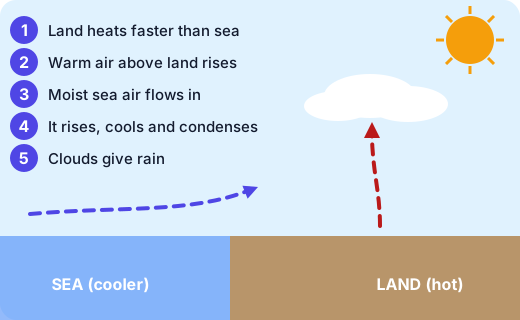
What changed, step by step?
- Defined the key term in the first sentence (monsoon), and a second term (condenses) at the moment it was needed.
- Put the steps in cause-and-effect order, each one leading to the next: land heats → air rises → low pressure → sea air flows in → cools → condenses → rain.
- Used transitions that match the logic: as a result and because for causes, next and finally for order.
- Left no step out. The draft said "the wind moves." The revision says why it moves: air rushes in to fill a low-pressure gap.
Try it: Take any paragraph you have written that explains something. Underline each term a reader might not know. Circle each transition. Which underlines have no definition, and which steps have no circle?
Anticipating confusion
Before you write, ask your reader's questions for them.
- What words might they not know? Define them, or choose simpler ones.
- Where might they picture the wrong thing? Address a common misunderstanding directly: "You might think the Sun heats the air directly, but much of the heat in the air near us comes from the ground, which the Sun warms first."
- Which step feels obvious to me, but isn't? Experts skip steps. Write the step down.
- Where would a picture or a small example help most? Put one there.
A useful trick: read your draft as a friend in a lower class would, with a finger moving along the page. Stop at every place where you would ask "what does that mean?" or "why?". Those are the spots to fix.
Common misconceptions
- "More technical words make me sound clever." In explanation, they make you less clear. Use the simplest word that is accurate, and define technical terms.
- "An example is enough; I don't need to explain." An example shows one case. The explanation says what the case is a case of.
- "A definition just repeats the word." If it does, it is circular. Say what the thing is, using words that don't contain it.
- "Transitions are decoration." Each one makes a promise about how two ideas connect. Make sure the promise is true.
A planning checklist
- Who is my reader, and what do they already know?
- What is the one thing I want them to understand?
- Which terms need a definition? Write each in plain words.
- List the steps or ideas in order.
- Which step needs an example?
- Draft, adding transitions that match the logic.
- Read as a beginner and fix every place you get stuck.
Explaining well means anticipating confusion. The writer who has pictured the reader's face while reading is the one who explains best.
Lab
The explanation fixer
Repair a confusing explanation in three steps: put the steps in order, fill each gap with the transition that matches the logic, and choose a definition that really defines. The lab flags anything that still needs work.
Your goals
- Put the six monsoon sentences in the order that makes the cause-and-effect chain clear.
- Choose the transition that fits each of the five gaps in a passage about the mean.
- Choose the definition that truly defines each of three terms, and reject the circular ones.
The interactive lab opens once you register. Register to do this.
Quick check
Quick check on explaining
Think about definitions, examples, transitions and what a reader needs.
1.Which is the best definition of "habitat" for a reader who has never met the word?
- A habitat is a habitat for animals and plants.
- A habitat is the natural place where an animal or plant lives.
- A habitat is a lovely place.
- A habitat is a house.
Choose one
2.A draft says: "Evaporation is when things evaporate." What is wrong with it?
- It is circular: it uses the word to explain the word, so a reader learns nothing.
- It is too long.
- It has no transitions, so it is not a definition.
- Nothing, because short definitions are always best.
Choose one
3.Which TWO words or phrases mainly show order in a process?
- Next
- However
- Finally
- For example
- Because
Choose all that apply
4.Match each transition to the job it does.
- Because
- However
- For instance
- Finally
Match each to: Shows a cause · Marks the last step · Introduces an example · Shows a contrast
5.Put these sentences about a seed in the order that makes the process clear.
- Finally, the first leaves open and begin making food.
- First, the seed soaks up water and swells.
- Next, the seed coat splits and a root grows downward.
- Then a shoot pushes up toward the light.
Put these in order
6.You are explaining what a fraction is to a seven-year-old. Which approach best anticipates confusion?
- State the formal definition using numerator and denominator, with no example.
- Say "A fraction is a part of a whole, like one slice of a pizza cut into four equal slices," then show the slice.
- Tell them it is hard, but they will understand when they are older.
- List ten fractions without explanation.
Choose one
7.A writer explaining how air near the ground is warmed wants to head off a common mistake. Which sentence does that?
- The Sun is a very large star.
- You might think the Sun heats the air directly, but much of the heat in the air near us comes from the ground, which the Sun warms first.
- Heat is something everyone has felt.
- Some people like summer more than winter.
Choose one
8.A writer uses the word "ratio" in her second sentence, and her readers are classmates who have not met it. What is the best fix?
- Use a longer, more impressive word.
- Add a short definition and a small example right where the word first appears.
- Move the word to the last sentence so fewer people notice.
- Leave it as it is, because readers can look it up.
Choose one
Answering and checking are for registered learners. Register to do this.
Quick check
New puzzles on explaining
Use what you know about definitions, examples and transitions in new situations.
1.You are explaining why we see lightning before we hear thunder. Which paragraph explains best?
- Lightning and thunder happen at the same moment, but light travels about a million times faster than sound, so the flash reaches your eyes almost instantly while the sound takes longer. For example, if a storm is 3 km away, the sound takes about 9 seconds to arrive.
- Thunder is the acoustic consequence of rapid atmospheric expansion; photons simply outpace the pressure wave.
- Lightning is very bright. Thunder is very loud. They both happen in storms.
- It is a well-known fact that nobody should worry about the order of lightning and thunder.
Choose one
2.Choose the transition that best fills the gap: "Rice grows best in flooded fields. ______, wheat prefers drier soil."
- Therefore
- For example
- However
- First
Choose one
3.Put these sentences about rainwater harvesting in the order that makes the process clear.
- Next, a pipe carries the water from the gutter to a filter.
- Finally, the clean water is stored in a tank for later use.
- Then the filter removes leaves and dirt.
- First, rain falls on the roof and runs into the gutter.
Put these in order
4.A writer is explaining the seasons. Many readers believe summer happens because Earth is closer to the Sun. Which sentence best anticipates that confusion?
- The seasons are interesting.
- Earth goes around the Sun once a year.
- Many people think summer happens because Earth is closer to the Sun, but it is the tilt of Earth's axis that matters, because tilt decides how directly sunlight strikes each place.
- Summer is hot and winter is cold.
Choose one
Answering and checking are for registered learners. Register to do this.
Your turn
Write and improve an explanation
-
Diagnose. A student wrote: "The water cycle is when water cycles. It goes up and comes down. Evaporation happens. Rain." Name three problems with this draft (think about definitions, missing steps and transitions).
-
Rewrite. Rewrite it as one explanation of 5 to 8 sentences for a reader in Class 4. Define at least two terms in plain words, include one small example, and use at least four transitions that match the logic. (Correct science only: the Sun warms water, water evaporates, vapour rises and cools, condenses into clouds, falls as rain or snow, and collects again in rivers, seas and the ground.)
-
Your own topic. Choose a process or idea you know well (a game, a recipe, a festival tradition, a school routine, a science idea). Write a paragraph of 100 to 150 words explaining it to someone who has never met it. Then, in one or two sentences, say which confusion you tried to head off and how.
How it's judged
- Diagnosing the draft
- Definitions and examples
- Order and transitions
- Anticipating confusion
Writing and submitting your answer is for registered learners. Register to do this.
-
Like what you see?
Register for free to answer the quick checks, do the activities and save your work. Your work is saved on your device and syncs to your account.