Unit 4
Analysing non-fiction
Find the central idea of an article, see how key sentences build it, and name what the author is trying to do to you.
Read
How non-fiction is built
Read this short article once, quickly, and then ask yourself one question: what is it really about?
The Mangrove Wall
(1) Along the muddy shores of the Sundarbans, trees stand with their roots in salt water twice a day. (2) These mangroves look fragile, but they form one of the best natural defences a coast can have. (3) Their tangled roots slow incoming waves, so a storm surge loses much of its force before it reaches the village. (4) The roots also trap mud, which slowly builds up the shore instead of letting the sea wash it away. (5) Young fish and prawns shelter among the roots, which is why fishing families have long depended on the forest.
(6) Yet mangroves have been cleared in many places for fish farms and building. (7) When the trees go, villages lose their shield and their fishing grounds together. (8) Protecting the mangroves is therefore not a luxury; it is cheaper and safer than rebuilding after every cyclone.
If you said "mangroves", you named the topic. That is a start, but it is not yet an understanding. The article says something about mangroves, and that something is what you are looking for. A fiction writer plans a story before writing it. A non-fiction writer plans too: every sentence is placed to do a job. Your task as a reader is to see the plan.
Topic, central idea, summary
Word What it is For "The Mangrove Wall" Topic The subject, in a word or phrase mangroves Central idea What the author wants you to understand about the topic, in one sentence Mangroves protect coasts and the people who live there, so they are worth saving. Summary The central idea plus the few key points that support it, in your own words Mangrove roots slow waves, build up the shore and shelter fish. Clearing them removes both protection and livelihood, so the author argues for keeping them. A central idea is a complete thought with a verb in it. "Mangroves" is a topic; "Mangroves are worth protecting because they shield and feed coastal communities" is a central idea. A good test: if you can ask "so what does the author say about it?", you have only found a topic.
Key sentences and supporting details
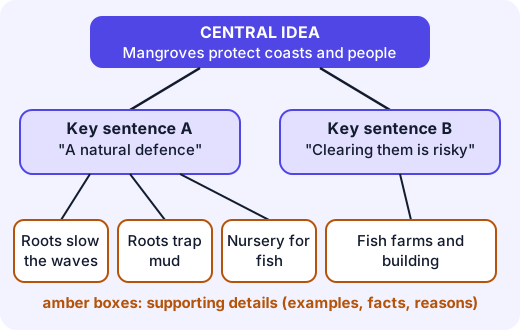
Look back at the article. Sentence 2 makes a claim: mangroves are "one of the best natural defences a coast can have". Nothing before it proves that; it is a key sentence, a sentence that carries an important point. Sentences 3, 4 and 5 are supporting details: they show how roots slow waves, trap mud and shelter fish. Take away sentence 4 and the article still stands, though it is a little poorer. Take away sentence 2 and the reader no longer knows what sentences 3 to 5 are evidence for.
Some useful habits for finding key sentences:
- Check the ends of paragraphs. Writers often state the point first or last. Here sentence 2 is early and sentence 8 is the closing key sentence.
- Look for the sentence others lean on. If three sentences all explain one sentence, that one is probably key.
- Watch the turning words. But, yet, however, therefore mark a change or a conclusion. Sentence 2 turns on "but"; sentence 6 on "yet"; sentence 8 on "therefore".
Example. Suppose we ask: How does sentence 6 develop the article's ideas? Step by step: sentences 1 to 5 tell us what mangroves do. Sentence 6 begins with "Yet" and introduces a threat. Sentence 7 spells out the consequence of that threat. So sentence 6 is where the article turns from describing the mangroves to worrying about them, and that turn makes sentence 8's conclusion necessary. The sentence earns its place by creating the problem that the ending answers.
Try it: In the article, find one sentence you could delete without changing the central idea. Then find one you could not. What is different about them?
Author's purpose
Authors write for a reason, and the reason shapes the choices on the page. Four common purposes are shown below, with the clues that give them away.
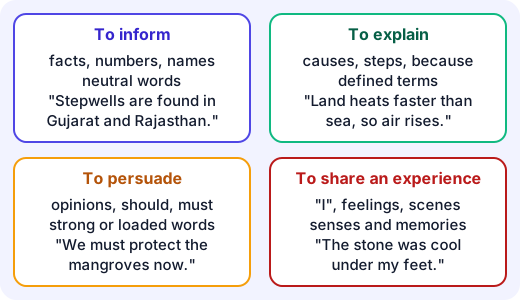
Now judge "The Mangrove Wall" by its clues. It states facts (roots slow waves) and explains causes (they trap mud). But look at sentence 8: "not a luxury", "cheaper and safer", "Protecting the mangroves is therefore...". That is the language of someone who wants you to agree. So the purpose is mainly to inform, with a second purpose of persuading. Texts very often have more than one purpose; the skill is to name the main one and to point to the words that tell you.
Misconceptions to avoid
- "The first sentence is always the main idea." Sentence 1 here only sets the scene. In many articles the point comes at the end, or builds across several paragraphs.
- "The central idea is the most interesting fact." The prawn nursery is lovely, but it is one detail, not the whole point.
- "A summary can include my opinion." A summary says what the text says. "Mangroves are beautiful" may be true, but the article never says it, so it does not belong in a summary.
- "Non-fiction is neutral." Even factual writing chooses which facts to include, and in what order. Asking why this fact, here? is how you notice the author's purpose.
A method you can reuse
- Read the whole text once without stopping.
- Name the topic in a word or two.
- Mark the key sentences: claims, turns, conclusions.
- Sort the rest: which sentences support which key sentence?
- Write the central idea as one complete sentence, in your own words.
- Name the purpose and quote two or three words that show it.
- Test your central idea: does every key sentence connect to it? If one does not, revise.
Non-fiction is built as carefully as fiction. Once you can see the beams, you can judge whether the building stands up.
Lab
The article surgeon
Open up a short article about river dolphins. Give every sentence a job, choose the central idea, then decide the author's main purpose. The lab tells you which answers need another look.
Your goals
- Give each of the eight sentences its correct job in the article.
- Choose the sentence that states the central idea.
- Name the author's main purpose and pick the words that show it.
The interactive lab opens once you register. Register to do this.
Quick check
Quick check on non-fiction
Read this passage, then answer the questions. The sentences are numbered. (1) Before taps and pipes, many towns in Gujarat and Rajasthan stored water in stepwells. (2) A stepwell is a well with a staircase that lets people walk down to the water as it rises and falls with the seasons. (3) The deep shaft stays cool, so people also gathered there to rest in the heat. (4) Carvings on the walls show that builders treated these places as more than plain tanks. (5) Today many stepwells are dry or filled with rubbish, but some have been cleaned and now collect rainwater again. (6) Stepwells show how a useful structure can also be a beautiful public space.
1.Which statement is the best central idea of the passage?
- Stepwells.
- Stepwells were practical water stores that were also valued as shared, beautiful places.
- Stepwells in Rajasthan are the most beautiful buildings in India.
- Water is cooler underground.
Choose one
2.Which sentence is the strongest key sentence, the one that sums up the whole passage?
- Sentence 1
- Sentence 3
- Sentence 5
- Sentence 6
Choose one
3.Which TWO sentences give evidence that stepwells were more than plain storage tanks?
- Sentence 1
- Sentence 2
- Sentence 3
- Sentence 4
- Sentence 5
Choose all that apply
4.What is the author's main purpose?
- To inform readers about what stepwells are and why they mattered
- To persuade readers to donate money to a cleaning fund
- To entertain readers with an invented adventure
- To teach readers how to dig a well
Choose one
5.Suppose sentence 4 were deleted. What would the passage lose?
- The definition of a stepwell
- The evidence that builders valued stepwells as more than tanks
- The information that some stepwells are dry today
- Nothing at all, because every sentence is a key sentence
Choose one
6.Which sentence number begins with a word that moves the reader from the past to the present day?
Answer with a number
7.Which is the best one-sentence summary opening?
- I think stepwells are the most wonderful buildings ever made.
- The passage is about stepwells in India.
- Stepwells in Gujarat and Rajasthan stored water, offered cool places to gather and were decorated, which shows a useful building can also be beautiful.
- Some stepwells are dry.
Choose one
8.Match each sentence to the job it is doing.
- "Stepwells are found mainly in western India."
- "The monsoon arrives because land heats faster than sea."
- "Every school must plant a tree this year."
- "I still remember the cool stone under my feet."
Match each to: Explains a cause · Shares a personal memory · Persuades the reader · Gives a fact
Answering and checking are for registered learners. Register to do this.
Quick check
New puzzles on non-fiction
Two new texts, both different from the readings. Work out how each is built. **Text A** (1) The bell rings and the corridor floods with noise. (2) Shoes squeak, lockers bang, and for ten minutes nobody can hear anyone. (3) Ms. Okafor, the new head, wants to try a one-minute "quiet walk" between lessons. (4) Her hope is that a calmer corridor will lead to calmer classrooms. **Text B** (1) A honeybee that finds flowers cannot tell the hive in words. (2) Instead she returns and dances on the honeycomb. (3) The angle of her waggle run shows the direction of the flowers relative to the sun, and the length of the run shows how far away they are. (4) Other bees watch, then fly straight to the spot. (5) A tiny brain, it turns out, can pass on a map.
1.Text A. Which statement best gives the central idea?
- Corridors are noisy.
- A quiet walk between lessons might calm the whole school day.
- Ms. Okafor dislikes noise and wants to punish students.
- Lockers should be removed.
Choose one
2.Text A opens with a noisy scene, then describes a plan. Which are the author's purposes? Choose all that apply.
- To inform readers about a school's plan
- To make readers picture the problem the plan answers
- To teach readers how to build a locker
- To tell a joke about shoes
Choose all that apply
3.Text B. Which statement is the central idea?
- Honeybees are the most intelligent insects.
- Honeybees pass on where food is by dancing.
- Flowers could not survive without bees.
- Bees dance because they enjoy it.
Choose one
4.In Text B, which sentence develops sentence 2 by explaining what the dance tells the other bees?
- Sentence 1
- Sentence 3
- Sentence 4
- Sentence 5
Choose one
Answering and checking are for registered learners. Register to do this.
Your turn
Take an article apart
Read this short article.
Rain on the Roof
(1) When the monsoon ends, many Indian cities run short of water within weeks. (2) Yet each year, millions of litres of rain simply run off roofs and down the drain. (3) Rainwater harvesting changes that by catching the water in a tank or letting it soak into the ground. (4) In Chennai, a rule made in 2003 required buildings to have harvesting systems, and groundwater levels in some neighbourhoods rose afterwards. (5) A roof, a pipe and a tank are not expensive. (6) Every household that installs them helps its whole neighbourhood.
Write answers to all four parts in your own words.
- Write the topic in a few words, and the central idea as one complete sentence.
- Copy the key sentence you think matters most. Explain how two other sentences develop it.
- Name the author's main purpose. Quote two or three words from the article that show it.
- Someone says: "A summary should say whether rainwater harvesting is a good idea." Explain, using this article, why a summary should or should not include your own opinion.
How it's judged
- Central idea
- Key sentence and development
- Purpose with textual evidence
- Summary versus opinion
Writing and submitting your answer is for registered learners. Register to do this.
Like what you see?
Register for free to answer the quick checks, do the activities and save your work. Your work is saved on your device and syncs to your account.