Unit 7
Narrative writing
Choose whose eyes the story is told through, and decide where to slow down and where to skip ahead.
Read
Whose eyes, how fast?
Here is one small event, told twice.
Telling A. My tray tipped before I understood it was falling. Dal, rice, a steel cup ringing on the tiles. Every head in the canteen turned. I stared at my shoes and hoped the floor would swallow me.
Telling B. Ishaan saw the tray tip. Tanvi went completely still, as if standing very still might undo it. The steel cup rang on the tiles, and then the whole canteen was looking at her. He could not decide whether to laugh with the others or look away.
Same tray, same cup, same floor. Yet Telling A is about shame and Telling B is about a boy who is unsure what to do. The events did not change. What changed is point of view: who is telling the story, and how much that person can see, hear and know. A good narrative writer chooses this on purpose.
Point of view is a lens
Think of the narrator as a camera that also has a mind. There are three common set-ups.
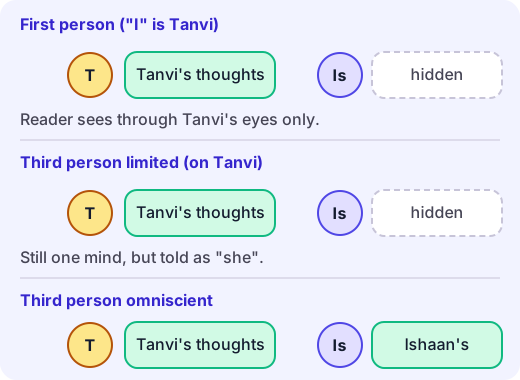
Point of view Pronouns What the narrator can know First person I, me, my, we Only what "I" see, hear, think and remember. Other people's feelings must be guessed from their faces and words. Third person limited he, she, they Everything about one chosen character, and only what that character could notice. Third person omniscient he, she, they The thoughts of any character, and sometimes facts nobody in the story knows. Telling A is first person. Telling B is third person limited, attached to Ishaan. We can see Tanvi's stillness, but we cannot read her mind. Only Ishaan's thoughts are open to us.
Keeping the lens steady
The most common mistake in a first narrative is head-hopping: slipping into another character's mind without warning.
Tanvi felt her face burn. Ishaan thought she looked ready to cry.
If the story is limited to Tanvi, the second sentence is a leak. Tanvi cannot know what Ishaan thinks. She can only notice what his face shows, or guess.
Tanvi felt her face burn. Ishaan was looking at her, and his eyebrows had drawn together. Was he sorry for her? She could not tell.
The fix does not take away Ishaan. It shows him from outside, through what Tanvi can observe. This is often more interesting than stating his thoughts, because the reader has to guess too.
Misconception. "First person lets the narrator know everything because it is my story." No. A first-person narrator knows only what a real person could know. "Behind the wall, my brother was thinking about the lost match" is impossible unless the narrator is told, or guesses. Writing "I guessed he was thinking about the lost match" is fine.
A checklist for a steady lens:
- Pronouns. One set of narrator pronouns, all the way through.
- Knowledge. Every thought and feeling belongs to a character the narrator can reach.
- Voice. The words sound like the narrator. A shy eleven-year-old would say "everyone stared", not "the assembled company regarded her."
- Tense. If you begin in the past ("the cup rang"), stay there. Switch only when time truly changes.
Try it: Take Telling A and rewrite it in third person limited on Tanvi. You will change "I" to "she" and "my" to "her", and nothing else about what she knows. Then rewrite it limited on a boy at the next table. What can you no longer say?
Pacing: how fast the story moves
A story is not a clock. A six-hour afternoon can take one line, and ten seconds can take a page. The speed at which the reader moves through the story's time is its pacing.
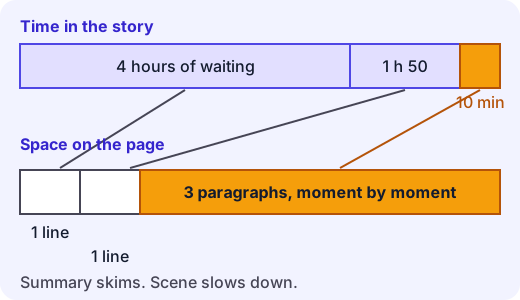
Writers have two main gears.
Summary covers a lot of time in few words. It uses time markers and general statements: "For three weeks Tanvi ate lunch on the library steps." Summary is quick and cheap. It tells the reader what happened without making them live it.
Scene slows time until it almost matches real time. It uses specific moments, dialogue, senses and short beats:
The tray tilted. Tanvi grabbed at it. Too late. The cup bounced once, twice, and rang.
Tools that slow the story: sensory detail, dialogue exchanged line by line, short sentences that break one action into pieces, the character's thoughts in the moment. Tools that speed it up: time jumps ("By Friday..."), summary, and leaving out the boring middle. The white space between two scenes is also a way to skip.
Example. A writer has this flat draft:
The match was close. Tanvi was nervous. She hit the last shot and won.
The most important moment, the last shot, takes seven words. Rework the pacing: skip what does not matter, slow down at what does.
The match went to a final point, as these things do. Tanvi bounced the shuttle once on her racquet. Twice. The hall had gone so quiet that she could hear the ceiling fans. She tossed it up, watched it hang there against the lights, and swung.
The setup is compressed into one sentence ("as these things do"), and the final point stretches into four. Notice the order of the choices: decide what the reader should feel, then give those moments the room.
Misconception. "More detail makes a story better." Detail everywhere is like a whole film in slow motion: tiring, and nothing stands out. Pace works by contrast. A fast stretch makes the slow moment feel important.
Putting the two together
Point of view and pacing work as a pair. Whose eyes decide what is noticed in a slow moment. A nervous player notices the fans and the silence. A bored spectator might notice a sweet wrapper on the floor.
When you plan a narrative, decide:
- Whose story is it? Pick the narrator and the pronouns.
- What is the moment that matters? Plan to slow down there.
- What can be summarised? Compress it, or skip it.
- Is every thought reachable? Check that the lens never slips.
Short stories are written this way: not by telling everything, but by choosing what the reader is allowed to see and how long to let them look.
Lab
Lens and speed workshop
Two quick rounds. First decide which sentences a first-person narrator could truthfully write. Then decide which sentences slow a story down and which speed it up.
Your goals
- Sort eight sentences into those a first-person narrator can and cannot write.
- Sort eight sentences into those that slow the pace and those that speed it up.
The interactive lab opens once you register. Register to do this.
Quick check
Point of view and pacing check
Eight questions on narrators, what they can know, and how fast a story moves.
1.Which sentence is told in the first person?
- Meera stepped onto the bridge.
- We stepped onto the bridge, and the boards groaned under us.
- You step onto the bridge.
- The bridge groaned as everyone crossed.
Choose one
2.A story is told in third person limited, staying with Dev. Which sentence breaks that point of view?
- Dev's knees shook as the bus pulled away.
- Dev noticed that his sister's smile had gone stiff.
- His sister thought Dev was being dramatic and wished he would hurry.
- Dev wondered whether she was angry.
Choose one
3.Which of these slow a story down? Pick all that apply.
- Sensory detail about a single second
- A time jump such as "Years later"
- Short sentences that break one action into steps
- Dialogue given line by line
- A summary of several weeks in one sentence
Choose all that apply
4.Match each term to what it means.
- Scene
- Summary
- Head-hopping
- Omniscient narrator
Match each to: Slows time to one moment, with detail and dialogue · Slipping into a second character's mind without warning · Can reveal the thoughts of many characters · Covers many days in a few words
5.What is the one-word name for how quickly a story moves through its time?
Answer with a word or phrase
6.The narrator is a girl telling the story as "I". Which sentence could she NOT truthfully write?
- I heard a soft sound behind the wall, like someone crying.
- My brother, behind the wall, was thinking about the lost match and wishing I would go away.
- I guessed that he was upset.
- I saw his shoes by the door.
Choose one
7.A writer wants the reader to feel how long a character waits outside the exam hall. Which choice fits best?
- One sentence: "She waited for an hour."
- A few small details: the second hand, a cough, a tapping shoe, the door staying shut.
- A time jump to the next day.
- A general statement about how she felt.
Choose one
8.Why can the same event feel quite different in two tellings?
- Because narrators are allowed to change the facts.
- Because each narrator notices and knows different things.
- Because third person is always more accurate.
- Because pacing does not affect what readers feel.
Choose one
Answering and checking are for registered learners. Register to do this.
Quick check
New puzzles with point of view and pacing
Use what you know about narrators and pacing in situations the reading did not show.
1.Arjun tells the story as "I". In the dark garden he has taken off his glasses, and without them everything far away is a blur. Which sentence fits his narration best?
- I could tell it was a crow only because it cawed; to my eyes it was a black smudge in the neem tree.
- Every feather of the crow's wing shone sharp and clear in the neem tree.
- Across the field, Meena was secretly pleased that I had lost my glasses.
- Arjun could not see the crow in the neem tree.
Choose one
2.The story stays inside Rohan (third person limited). His grandmother, Dida, is worried about his exam. Which sentence shows her worry without breaking the point of view?
- Rohan saw Dida twist her dupatta round her fingers, and he guessed she was worried.
- Dida's heart pounded with worry about Rohan's exam.
- Dida worried all morning, and Rohan thought she was being silly.
- I saw Dida was worried.
Choose one
3.Put these from the fastest pace to the slowest.
- That week, Anika walked to school in a borrowed raincoat two sizes too big.
- Anika stepped into the puddle. Cold water filled her left shoe, then crept up her sock.
- The monsoon came and went.
Put these in order
4.A writer has three pages for a girl's day-long climb up a mountain and the thirty seconds she spends at the top. Which plan best uses pacing?
- Give each hour of the climb equal space.
- Summarise most of the climb quickly, then spend most of the pages on the thirty seconds at the top.
- Describe every step of the climb in detail and skip the summit.
- Describe the summit in one sentence so the story moves fast.
Choose one
Answering and checking are for registered learners. Register to do this.
Your turn
Fix the lens, choose the speed
Write your answers in your own words.
Part 1: fix the lens. This paragraph is meant to be third person limited, staying with Nia. It slips once.
Nia stood at the edge of the pool, toes curled over the tiles. The water looked very far down. Her coach, Mr Dutta, was sure she would dive well and was proud of her already. Nia took a breath.
Rewrite the paragraph so the point of view never slips. Keep Mr Dutta in the scene.
Part 2: choose the speed. Here is a flat draft: "The race lasted two minutes. Nia was tired. In the last few metres she caught the girl in the next lane and won." Rewrite it in 4 to 8 sentences so the pacing matches how important each part is.
Part 3: explain. In 3 to 5 sentences, say (a) which sentence you changed in Part 1 and why it was a problem, and (b) what you slowed down and what you compressed in Part 2, and why.
How it's judged
- Consistent point of view
- Deliberate pacing
- Explanation
Writing and submitting your answer is for registered learners. Register to do this.
Like what you see?
Register for free to answer the quick checks, do the activities and save your work. Your work is saved on your device and syncs to your account.