Unit 3
Reading drama
Read a play script like a director: use dialogue and stage directions together to see how a character is built.
Read
Words made to be performed
Imagine a story with no narrator at all. Nobody tells you what a character feels or why. You only get what an audience in a theatre would get: what people say, what they do, and what the stage looks and sounds like. That is a play, and reading one is a different skill from reading a story. A play is written to be performed, so the page is a set of instructions and clues, and the reader has to imagine the performance.
The parts of a script
A script is the written text of a play. Most scripts share the same parts.
- Title and cast list. The characters, sometimes with a few words about each.
- Scene. A section of the play set in one place and time. Plays are often divided into acts, and acts into scenes. A scene heading names the setting.
- Dialogue. The words characters speak, each line labelled with the speaker's name.
- Stage directions. Instructions that are not spoken: where people move, how a line is said, what the set looks like, what the lights and sounds do. They are usually in brackets or italics.
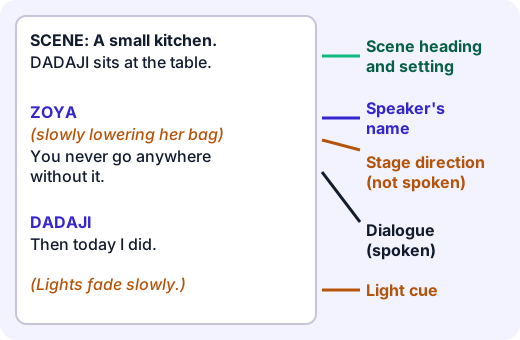
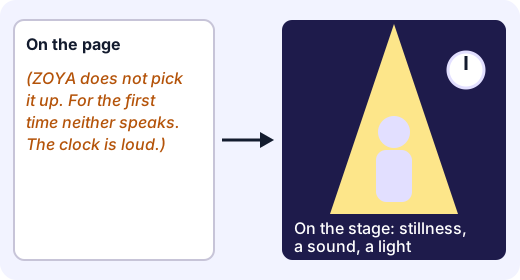
Stage directions are not decoration, and they are not the writer's narration. The audience never reads them. They have to be turned into things the audience can see and hear: an actor's movement, a light, a sound. This is why you must read them as carefully as the speeches.
A scene to read
Read this original scene aloud, with a friend if you can. Try different voices.
THE SPARE KEY

Characters: ZOYA, a girl of twelve
            DADAJI, her grandfather, in his seventies

SCENE: A small kitchen, early evening. A calendar hangs slightly crooked on
the wall. DADAJI sits at the table with a cup of tea that has gone cold.
In front of him lie a spare key, a train ticket and a folded note.

ZOYA (bursting in, schoolbag still on her back): Dadaji! Why didn't you
answer your phone? I rang four times!

DADAJI (not looking up; straightening the key so it lies exactly parallel
to the ticket): The phone was in the other room.

ZOYA (slowly lowering her bag): You never go anywhere without it.

DADAJI: Then today I did. (He pushes the cup an inch away, then pulls it
back.) Sit. Your tea is ready.

ZOYA: It's your tea. And it's cold. (She touches the cup, then looks at the
ticket.) That's a train ticket. For Saturday. To Pune.

DADAJI (a pause longer than a breath): Your uncle has a spare room.

ZOYA (quietly): You hate Pune.

DADAJI (with a small laugh that does not reach his eyes): Hate is a big word
for a city. (He slides the key across the table.) Keep this. In case you
forget yours.

(ZOYA does not pick it up. She sits down opposite him. For the first time,
neither speaks. The kitchen clock is very loud.)

ZOYA: Then I'm coming to Pune too.

(Lights fade slowly. DADAJI finally looks up.)
How the scene builds its characters
A reader who treats a play like a short story will miss most of it. Here is how to read for character.
Stage directions show what people do. Dadaji straightens the key until it is "exactly parallel" to the ticket, and pushes the cup away, then pulls it back. These are small, nervous, controlling actions. He is a man who is trying to keep everything tidy because something in his life is not. Nobody says he is anxious; the actions say it.
Dialogue shows what people say, and what they avoid. Dadaji answers every question with something next to the truth: "The phone was in the other room," "Your uncle has a spare room." He never says "I am going away." Zoya, by contrast, asks short, direct questions: "You hate Pune." Her speeches are plain and her stage directions ("slowly lowering her bag," "quietly") show her alarm growing.
What is not said is called subtext. Dadaji says "Hate is a big word for a city" while his laugh "does not reach his eyes." The words are light, the direction tells you they are not, and the gap between the two is the character. When a character's words and actions disagree, trust the actions.
Silence is part of the script. "A pause longer than a breath" and "the kitchen clock is very loud" are instructions for what the audience should hear: the absence of speech.
Example. Claim: Dadaji is trying to protect Zoya from worry. Evidence: the stage direction "(He slides the key across the table.)" and the line "In case you forget yours." Explanation: He prepares for her to be alone, giving her a key, but he speaks as if it were a small household matter, which suggests he cares and does not want to burden her with the real reason.
The claim, quote, explain method from analysing stories works just as well here. The new thing is that your evidence can be a stage direction as well as a line of speech.
From page to stage
The script is not the play. It is a blueprint. Two companies can stage "The Spare Key" and make different plays. One Dadaji might hide his sadness; another might be brusque. The words stay the same, and the performance changes the meaning. That is why drama is called a collaborative art: the writer, director, actors, and designers all complete the work.
Plays are very old and very widespread. The ancient Indian treatise on performance, the Natyashastra, attributed to Bharata Muni, described acting, music and staging. Kalidasa wrote Sanskrit plays, such as Abhijnanashakuntalam. Shakespeare's plays have few stage directions, though one is famous: "Exit, pursued by a bear." Street theatre (nukkad natak) in India performs short plays in public squares with no sets at all. In every tradition the script works the same way: speech plus instructions for performance.
Reading tips
- Read it aloud. Plays are written for the ear. Say the lines the way a character might.
- Read the directions as part of the character. Ask what each action tells you.
- Ask what each character wants in the scene. Dialogue is usually people trying to get something.
- Look for gaps. What does a character avoid saying? What does the pause hold?
- Imagine it staged. Where would you place the actors? What would you hear?
Common mistakes
- Skipping the stage directions because they are "not part of the story." They are often the best evidence.
- Reading a speech as the whole truth. Characters lie, hide, and joke to cover feelings.
- Treating directions as narration. A direction can only describe what an audience could see or hear. "(She remembers her mother.)" cannot be staged unless an actor, a sound, or a light shows it.
- Thinking there is one correct performance. There are many valid ones; every one must still fit the words and directions.
Try it: Choose any two lines from "The Spare Key." Write two different stage directions for each, so that the same line shows a different feeling. What changes?
Remember
Plays are written to be performed. Read the dialogue and the stage directions together, ask what the audience would see and hear, and use both as evidence for what a character is like.
Lab
The director's chair
First sort the lines of a script into scene headings, stage directions and dialogue. Then take the director's chair: for four fixed lines, choose the stage direction that shows what the character is really like.
Your goals
- Sort six script lines into scene heading, stage direction and dialogue.
- Choose the stage direction that achieves each character goal in four scenes.
The interactive lab opens once you register. Register to do this.
Quick check
Drama quick check
Eight questions about reading a play script.
1.Match each term to its meaning.
- Script
- Dialogue
- Stage direction
- Scene
Match each to: A section of a play set in one place and time · The written text of a play · The words that characters speak to each other · An unspoken instruction about movement, tone, setting, light or sound
2.A script reads: "(MIRA slams the door.) MIRA: I'm perfectly calm." What does the stage direction tell us?
- Mira really is calm.
- Her actions contradict her words, so she is probably upset.
- Mira is leaving the house for good.
- The door is broken.
Choose one
3.Which of these is a stage direction?
- FARID: Where were you?
- (FARID turns his chair to face the window.)
- NEENA: I was only gone ten minutes.
- Characters: FARID and NEENA
Choose one
4.Which of these can a stage direction tell the actors and director?
- How a line should be said
- Where a character moves or stands
- What the lights or sounds do
- What a critic will write about the play
- Whether the audience will like the character
Choose all that apply
5.Which line, with no stage direction at all, most clearly shows the speaker is bossy?
- BINA: Sit there. No, not there. Hand me that. Faster!
- BINA: Could you possibly help me when you have time?
- BINA: Oh.
- BINA: The weather is nice today.
Choose one
6.Put these parts of a script in the order a reader meets them, first to last.
- Scene heading and setting
- First line of dialogue
- Title of the play
- List of characters
Put these in order
7.Rohan says, "I loved the gift. Really. It's... very colourful." The script says he "smiles too widely" as he speaks. What is the best reading?
- He truly loves the gift.
- He is being polite but does not really like it.
- He is angry with the giver.
- He has forgotten what the gift is.
Choose one
8.A stage direction reads "(She hears distant thunder and remembers her mother.)" Why is the second half hard to perform?
- Thunder cannot be shown on a stage.
- An audience cannot see a memory, so the actor, sound or lighting must find a way to show it.
- Stage directions are never allowed to mention mothers.
- It is too short.
Choose one
Answering and checking are for registered learners. Register to do this.
Quick check
New puzzles
Use what you know about scripts in situations you have not seen.
1.A first draft says "(She is nervous.)" Which rewrite is best for a stage?
- (She feels very anxious inside.)
- (She picks at the hem of her sleeve and drops the pen twice.)
- (She thinks about all her fears.)
- (She is a nervous person.)
Choose one
2.A character says "I don't care." Which stage direction makes the audience believe she DOES care?
- (She laughs.)
- (She keeps glancing back at the door as she says it.)
- (She yawns.)
- (She checks her watch and smiles.)
Choose one
3.A script gives one character the line "Fine." with no stage direction. Which clues help an actor decide how to say it?
- The punctuation and what the character says just before and after
- How the other characters respond
- What the character wants in the scene
- The font the script is printed in
- How many pages the script has
Choose all that apply
4.A novel says: "Anil was furious but tried to hide it." Which is the best way to show this in a play?
- ANIL (jaw tight, speaking too evenly): Of course. Take it.
- NARRATOR: Anil was furious but tried to hide it.
- ANIL: I am furious but trying to hide it.
- ANIL (furious): Of course. Take it. (He is furious.)
Choose one
Answering and checking are for registered learners. Register to do this.
Your turn
Read a scene and write one
Read this scene.
SCENE: The roof terrace at dusk. Washing lines. KABIR (13) sits against the water tank with a folded paper in his fist. His sister LEELA (16) climbs the ladder and stops when she sees him.
LEELA: There you are. Amma's calling you for dinner.
KABIR (not turning): I'm not hungry.
LEELA (crossing, sitting a careful arm's length away): That's the first time that's ever been true.
(KABIR almost smiles, then flattens his mouth. He tucks the paper deeper into his fist.)
LEELA: Is that the result?
KABIR: It's just a paper. (He turns it over so the writing faces his knee.)
LEELA: Kabir. I failed maths in Class 8. Twice, if you count the retest. (Pause.) Papa still thinks it was once.
KABIR (finally looking at her): You never told me that.
LEELA: You never needed it before. (She holds out her hand, palm up, and waits.)
(Slowly, KABIR opens his fist. The paper is damp and creased. He puts it in her hand.)
- Choose two stage directions. For each, quote it and explain what it shows about Kabir or Leela.
- Choose one line of dialogue and explain what the character is really saying (the subtext).
- Write four to six lines of your own script (with stage directions) in which a character is embarrassed about a gift but tries to hide it. Do not use the word "embarrassed" or any narration.
How it's judged
- Using stage directions as evidence
- Dialogue and subtext
- Your own script
Writing and submitting your answer is for registered learners. Register to do this.
Your turn
Why plays are different
A friend says: "A play is just a story with the narrator taken out. I can read it exactly like a novel."
Write 150 to 200 words in reply.
- Explain two ways reading a play is different from reading a story. Use the words stage directions and dialogue.
- Use an example from "The Spare Key" (for instance Dadaji straightening the key, or the pause before "Your uncle has a spare room").
- Say what you would do differently when reading the next play you meet.
How it's judged
- Differences explained
- Example from the scene
- Reading strategy
Writing and submitting your answer is for registered learners. Register to do this.
Like what you see?
Register for free to answer the quick checks, do the activities and save your work. Your work is saved on your device and syncs to your account.