Unit 8
Research and citation
Find sources, decide which ones to trust, and credit them so a reader can check your work.
Read
Who says so?
Kavya is writing a short report for science class. Her question: how many hearts does an octopus have?
She types the question into a search engine and gets a hundred answers. A blog says "nine!" A shop page says "three". A forum says "I think two?" Kavya cannot copy all of them. She has to decide whom to believe, and later she has to tell her teacher where each fact came from.
That is what research is: asking a question, gathering evidence from sources, judging how far each one can be trusted, and showing your reader where your information came from. This chapter covers each step.
Step 1: Start with a question and several sources
A source is anywhere information comes from: a book, an article, a website, a museum label, an interview, a data table, a scientific paper. A good question is narrow enough to answer. "Octopuses" is a topic. "How many hearts does an octopus have, and why?" is a question.
Plan to use more than one source. One source can be wrong, out of date, or one-sided. Two or three that agree give you a much stronger base. When you take notes, write down the source as you go: its author, title and date. Finding them again later is slow and sometimes impossible.
Step 2: Judge credibility
Credibility means how far a source deserves to be trusted. A page can look neat and still be wrong. Ask five questions of every source.
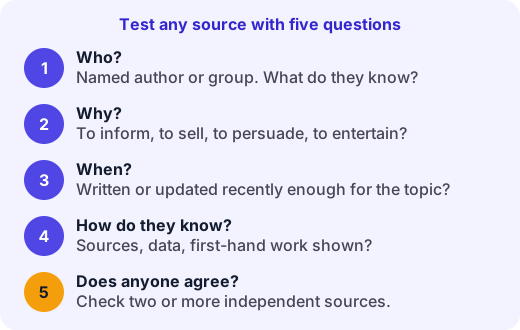
- Who? Is there a named author or organisation? Do they have knowledge or experience on this topic? A marine biologist writing about octopuses is better placed than an unnamed blogger.
- Why? Was it written to inform, to sell, to persuade, or to entertain? A shop wants you to buy a toy. That does not make it a liar, but it is not a good place to learn biology.
- When? Was it written or updated recently enough? A 2005 page on smartphones is stale. A 2005 page on how octopus hearts work may be fine, because that science changes slowly.
- How do they know? Does the source show its own sources, data, or first-hand work? "Scientists say" with no names is a weak sign.
- Does anyone agree? Check whether two or more independent sources say the same. If a surprising claim appears only on one page, be careful.
Example. Kavya finds three results.
Source Who Why When How they know "Octo-Fan 99" blog: "NINE hearts!!!" unnamed clicks and ads no date no sources Toy shop page: "an octopus has three hearts" unnamed to sell toys 2023 no sources Article by Dr Lena Fischer on a museum site (a made-up example for this lesson) a named marine biologist to inform updated 2024 lists two books and a journal paper Dr Fischer's article is the strongest. The shop page happens to give the right number but gives Kavya no reason to believe it. Kavya also finds a school textbook that agrees with Dr Fischer (three hearts: two serve the gills and one serves the rest of the body). Two independent, credible sources agree, so she can use the fact.
Misconception. "A web address ending in .org (or .edu, or .com) tells me if a source is reliable." No. Almost anyone can register a .com or .org address, and an ending says nothing about whether one particular page is accurate. Look at the author, purpose and evidence instead.
Misconception. "The first search result is the best one." Search engines rank by many things, including how popular and how well optimised a page is. Rank is not the same as truth.
Encyclopedias, including online ones, are useful for getting an overview and finding keywords. Check their reference lists, and take your facts from the sources they point to.
Step 3: Use sources without copying
When you use a source, you have three choices.
- Quote: copy the exact words, inside quotation marks. Use this when the wording itself matters, and keep it short.
- Paraphrase: explain the idea fully in your own words and your own sentence structure.
- Summarise: shrink a longer passage to its main point.
All three need credit. Using someone's words or ideas as if they were yours is plagiarism.
Suppose the original says: "Octopuses have two hearts that pump blood through the gills and a third that sends blood to the rest of the body."
- Weak (just swapped a few words): "Octopuses have two hearts that push blood through their gills and one that sends blood around the body." This copies the sentence's shape, and it has no credit.
- Good: "Two of an octopus's three hearts serve its gills, while the third supplies the rest of its body (Fischer, 2024)."
The good version rebuilds the idea in new words and says where it came from.
Step 4: Cite your sources
A citation is a short note that tells the reader exactly where a fact came from. It has two parts:
- An in-text citation in brackets right after the fact: (Fischer, 2024).
- A reference list at the end, in alphabetical order by author, giving the full details.
There are many official formats. For this course we use one simple format. For a web page or article:
Author last name, First name. "Title of the page or article." Website or publisher, day month year. Web address
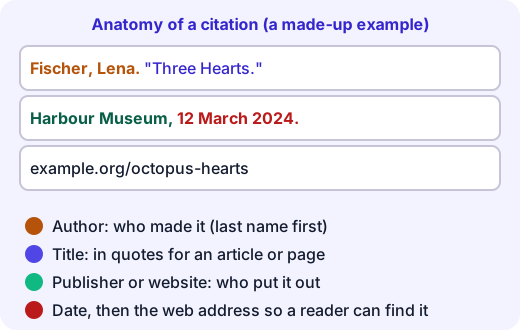
For a book, the title is not in quotes, and there is no web address:
Rao, Meena. Life in the Tide Pool. Greenleaf Books, 2022.
In a typed document, the title of a book is shown in italics. When you handwrite, underline it. (These examples are made up. Never cite a source you have not actually read.)
If there is no named author, start with the organisation. If there is no date, write "n.d." (no date), which is also a small sign that the source may be weak.
Why bother? Citing lets readers check your work. A reader who doubts "three hearts" can go straight to Dr Fischer's article and see for themselves. Citations also credit people for their work, and they show that your claims rest on something real.
A short research routine
- Write a narrow question.
- Find at least three sources.
- Test each with the five questions. Drop the weak ones.
- Take notes in your own words and record each source immediately.
- Check that important facts appear in at least two independent sources.
- Paraphrase or quote; cite in the text; end with a reference list.
Try it: Pick a question you really want answered. Find three sources and write one line on each, answering Who, Why, When. Which one would you trust most? Which would you drop?
Lab
Source detective
Eight sources turned up for the question "How many hearts does an octopus have?" (they are invented for this lab). Decide which to trust, then put the pieces of two citations in order.
Your goals
- Judge eight sources as worth using or needing care, using who, why, when and how they know.
- Build a web-page citation and a book citation by putting their parts in the right order.
The interactive lab opens once you register. Register to do this.
Quick check
Research and citation check
Eight questions on judging sources and crediting them.
1.You are researching why the Moon shows phases. Which source is the best place to start?
- An explainer by a named astronomer on a university physics department site, updated this year, with references at the end
- An anonymous video called "Moon SECRETS they don't tell you"
- A mobile phone advert that says "see the Moon like never before"
- A forwarded message with no names or links
Choose one
2.Which questions help you judge whether a source is credible? Pick all that apply.
- Who wrote it, and what do they know about the topic?
- How many likes or shares does it have?
- Why was it made: to inform, to sell, to persuade?
- Is it recent enough for this topic?
- Is the page nicely designed?
- Does a second, independent reliable source agree?
Choose all that apply
3.The original says: "Banyan trees send down aerial roots from their branches, which thicken into trunks and let a single tree spread over a very wide area." Which is a proper paraphrase with credit?
- Banyan trees send down aerial roots from their branches, which thicken into trunks and let one tree spread over a wide area.
- A banyan can cover a large area because roots dropping from its branches grow thick and act as extra trunks (Gill, 2020).
- Banyans are big.
- Banyan trees spread by dropping aerial roots that become trunks.
Choose one
4.Put the parts of this web-article citation in the order our format uses.
- "How Bridges Bear Weight."
- example.org/bridges
- Science Weekly,
- Okafor, Ada.
- 4 May 2023.
Put these in order
5.What is the word for using someone else's words or ideas as if they were your own, without credit?
Answer with a word or phrase
6.What is the main reason to cite your sources?
- It makes the report longer.
- It lets readers find the source and check your work, and it credits the author.
- It proves that every source is correct.
- It lets you copy the source's sentences.
Choose one
7.Match each warning sign to the question it fails.
- No author or organisation is named
- The page exists to sell a product
- A page from 2008 about a fast-changing technology
- A surprising claim that no other source repeats
Match each to: Does anything back it up? · Who wrote it? · Why was it written? · When was it written?
8.The reference list has "Rao, Meena. Life in the Tide Pool. Greenleaf Books, 2022." Which in-text citation matches it?
- (Meena, 2022)
- (Rao, 2022)
- (Greenleaf, Rao)
- (Life in the Tide Pool)
Choose one
Answering and checking are for registered learners. Register to do this.
Quick check
New puzzles with research and citation
Use the five questions in situations that were not in the reading.
1.A site called "Wow Facts Daily" says cheetahs can run at 200 km/h. It names no author. What is the best next move?
- Use it, because it is a surprising fact readers will like.
- Look for the same fact in a zoo, wildlife institute or textbook, and use only what reliable sources confirm.
- Ask three friends whether it sounds right.
- Ignore the topic of cheetahs completely.
Choose one
2.Put the parts of this book citation in order.
- Orient Hill Press,
- Rivers of the Deccan.
- Menon, Latha.
- 2019.
Put these in order
3.Which student has plagiarised?
- Ria copies a paragraph from an article, changes three words, and gives no source.
- Tomás copies one sentence inside quotation marks and adds the author and year.
- Wen explains an idea in her own words and cites the book it came from.
- Sara reads three sources, writes her own summary of what they agree on, and lists all three.
Choose one
4.Which statement is true?
- A .org web address guarantees a page is accurate.
- A web address ending is at most a small clue. Check the author, purpose and evidence as well.
- Pages ending in .com are always weak.
- A page with many photos must be reliable.
Choose one
5.Two websites contain the very same sentence about a study and neither names the study. Do they confirm each other?
- Yes, two sources agreeing is always enough.
- Not necessarily. One may have copied the other, so look for the original study or an independent source.
- No, because nothing online can ever be confirmed.
- Yes, if both pages have adverts.
Choose one
Answering and checking are for registered learners. Register to do this.
Your turn
Judge, paraphrase and cite
Your research question is: "Do electric buses help make city air cleaner?" Three invented sources turned up.
- Source A. An article by Dr Priya Nair, an environmental engineer, "Buses and the Air We Breathe", on the website of the Coastal City Transport Research Group, published 9 February 2024, at example.org/buses-air. It describes measurements taken along three bus routes and lists its data and references.
- Source B. A post by a company that sells electric buses, titled "Why Every City Needs Our Buses", dated 2024, no author, at example.com/our-buses.
- Source C. A comment on a video: "my uncle says it makes no difference at all".
Part 1. Rank the three sources from most to least credible. For each, use at least two of the five questions (who, why, when, how do they know, does anyone agree) to explain your ranking.
Part 2. Write the reference-list citation for Source A in the course format.
Part 3. This sentence is from Source A: "Along the electric routes, the average level of fine dust fell by about a fifth compared with the diesel routes." Write one sentence that paraphrases it in your own words and includes an in-text citation. Then explain, in one or two sentences, why changing only a few words of the original would not be enough.
How it's judged
- Judging credibility
- Citation
- Paraphrase and credit
Writing and submitting your answer is for registered learners. Register to do this.
Like what you see?
Register for free to answer the quick checks, do the activities and save your work. Your work is saved on your device and syncs to your account.