Unit 3
Folk art patterns
Meet Warli, Madhubani and rangoli patterns, find what repeats, and make your own.
Read
Patterns people have made for a long time
Before a festival, Asha's grandmother sweeps the front step and sprinkles coloured powder in a pattern: dots, then lines, then a flower. By evening, the doorway is glowing. "My grandmother made this pattern," she says, "and her grandmother made it before her."
Patterns like this are called folk art. They are made by ordinary families and passed down from person to person, year after year.
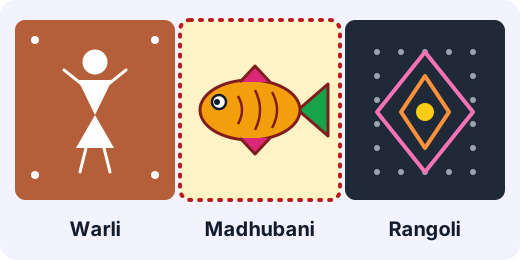
Three folk arts from India
Warli comes from the Warli people of Maharashtra. They paint on the mud walls of their houses with white rice paste, using only a few simple shapes: circles, triangles and squares. A person is a circle for the head and two triangles for the body. Whole villages of these little people dance, plant rice and celebrate in long lines.
Madhubani comes from the Mithila region of Bihar. Families, especially the women, paint fish, peacocks, flowers and the sun in bright colours with fine lines and patterns in every space. Fish are painted for good luck.
Rangoli is drawn on the floor at the doorway, often at festivals such as Diwali. People use rice flour, coloured powder or flower petals. Different places have their own names and styles: kolam in Tamil Nadu, alpana in Bengal and muggu in Andhra Pradesh and Telangana.
What repeats?
A pattern is something that repeats. A small picture that is used again and again is called a motif. The group of motifs that starts over each time is the part that repeats.
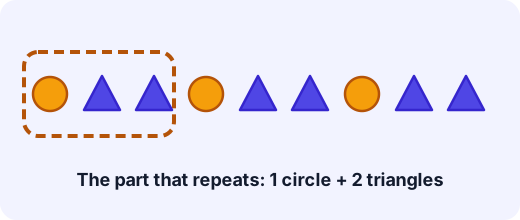
In the row above, the motifs are a circle and a triangle. The part that repeats is circle, triangle, triangle: three motifs. Then it starts again.
Example. Look at this row: square, circle, square, circle, square, circle. The part that repeats is square, circle. That is two motifs.
To find what repeats, ask: "Where does it start over?"
Try it: Look at a border on a sari, a rug or a plate. Put your finger on the first motif. Move along until you see the same one again with the same neighbours. What is in between? That is the part that repeats.
A pattern from another country
Patterns are made all over the world. In Japan there is an old pattern called seigaiha, which means "blue ocean waves". It is made of rings that overlap like fish scales, row after row, each row shifted a little to the side. You can find it on kimonos, plates and paper.
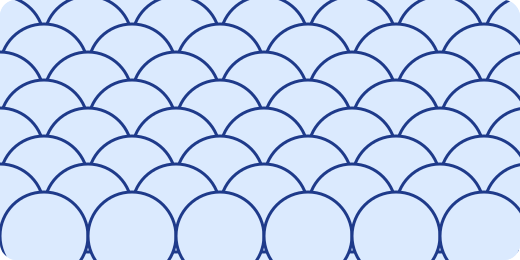
The pattern looks different from Warli, but it works in the same way: one shape, used again and again.
Why do patterns matter?
Folk patterns carry the traditions of the people who make them. A Warli wall tells you how the Warli people live. A rangoli says "welcome". When you learn a pattern and make it, you take part in something people have been doing for a very long time. Always say where a pattern comes from, and make it with respect.
For the grown-up helping
Let your child look at real examples: a rangoli at your door, a printed fabric, a tile floor. Ask them to find and say the part that repeats. Making a pattern from another culture is a good chance to look up where it comes from together. If your family has a tradition of its own, ask an elder to show it. Do not worry if your child's lines are wobbly; hand-made patterns are never perfectly even.
Lab
The border maker
Make a border pattern in a Warli or rangoli style. Pick the shapes, watch them repeat along the strip, then say how many shapes are in the part that repeats.
Your goals
- Make one pattern with a repeating part of 2 shapes and one with a repeating part of 3 shapes, each using at least two different shapes.
- For each pattern, say how many shapes are in the part that repeats.
The interactive lab opens once you register. Register to do this.
Activity
Make two patterns
Your child makes a pattern in an Indian folk-art style and a second pattern from another culture, and says what repeats in each. About 40 minutes.
You'll need
- Dark paper or card (brown, red or black) for Warli, and plain paper for the second pattern
- A white crayon, chalk or white paint with a thin brush
- Coloured pencils or crayons
- Optional, for rangoli: a tray of dry rice flour or sand
- A picture of a folk-art pattern (a book, a photo, or a real piece of cloth)
Steps
- Look together at a real example of Warli, Madhubani or rangoli. Ask: What shapes do you see? Where does it start over?
- Pattern 1 (India): on the dark paper, make a Warli-style border using circles, triangles and squares in white. Or on plain paper make a rangoli with dots and lines. Or draw a Madhubani-style fish with patterns inside its body.
- Make it repeat: a border with one small group of shapes repeated at least four times.
- Pattern 2 (another culture): look at a picture of a Japanese seigaiha wave pattern, or another pattern you choose together. Try making a small piece of it, using rows of overlapping half circles.
- For each pattern, ask your child to point to the part that repeats and say how many shapes are in it.
- Ask: Where does this pattern come from? Who makes it? Say the name of the place and the people.
Safety
- Use non-toxic chalk or paint. Keep rice flour and paint away from small children who might put them in their mouths.
- Rice flour or sand on a tray is easy to wipe up; do not blow it near the face.
Keeping a log of the activity is for registered learners. Register to do this.
Quick check
Folk patterns check
Six questions about folk patterns and what repeats.
1.Which folk art is painted with white rice paste on mud walls, using circles, triangles and squares?
- Warli
- Madhubani
- Rangoli
Choose one
2.Match each folk art to what it is known for.
- Warli
- Madhubani
- Rangoli
Match each to: Fish, peacocks and flowers with fine patterned lines · Patterns on the floor at the doorway · Little people made from circles and triangles
3.What shape comes next in this pattern?

- Circle
- Triangle
- Square
Choose one
4.How many shapes are in the part that repeats in that row (circle, triangle, triangle, circle, triangle, triangle, ...)?
Answer with a number
5.What do we call a small picture or shape that is used again and again in a pattern?
- A motif
- A frame
- A blot
Choose one
6.Why do families keep making the same folk patterns for many years?
- The patterns carry the traditions of the people who make them
- Nobody is allowed to invent a new pattern
- Shops only sell paper with these patterns
Choose one
Answering and checking are for registered learners. Register to do this.
Quick check
New puzzles
Use what you know about patterns in new places.
1.A floor has tiles in this order - red, blue, red, blue, red, blue, red. What colour is the next tile?
- Red
- Blue
- Green
Choose one
2.A border goes diamond, dot, dot, diamond, dot, dot, diamond, dot, dot. How many dots are in each part that repeats?
Answer with a number
3.A seigaiha pattern comes from Japan and looks like waves made of overlapping rings. What makes it a pattern?
- The same ring shape repeats in rows
- It is blue
- It has only one ring
Choose one
4.Priya copies a Warli pattern into her book. What is the kindest and most honest thing to do?
- Write that it is Warli art from Maharashtra, India
- Say she invented it
- Hide it so nobody knows where it is from
Choose one
5.A rangoli border goes flower, leaf, flower, leaf, flower, leaf. How many motifs are in the part that repeats?
Answer with a number
Answering and checking are for registered learners. Register to do this.
Activity
Tell it back
Your child tells you about a folk pattern they made, what repeats in it, and where it comes from. Three minutes.
Steps
- Put one of the patterns your child made in front of them.
- Ask: What is this pattern called? Where does it come from?
- Ask: What repeats? Can you show me the part that starts over?
- Ask: Why do you think people keep making this pattern?
- Write down what your child says in their words. Do not correct them.
Keeping a log of the activity is for registered learners. Register to do this.
Like what you see?
Register for free to answer the quick checks, do the activities and save your work. Your work is saved on your device and syncs to your account.