Unit 4
Rhythm and beat
Find the steady beat inside any song, clap rhythms back, and play loud, soft, fast and slow.
Read
The tick inside the song
Put your hand on your chest. Can you feel it? Thump... thump... thump... It is your heart, and it never forgets its place. Each thump comes at just the right time, again and again.
Music has a heartbeat too. We call it the beat.
The beat
The beat is the steady tick that you can tap your foot to. A clock tick-tocks. A train goes chhuk-chhuk-chhuk. A dhol player keeps a steady thump while the dancers move. These are all beats.
A beat is steady. The ticks are the same distance apart, like footsteps in a march.
Try it: Stand up and march on the spot. Left, right, left, right. Now sing "Twinkle, Twinkle, Little Star" while you march. Your feet are keeping the beat.
The rhythm
Now clap the words of the song instead of marching: "Twin-kle, twin-kle, lit-tle star". Some claps are long and some are quick. That pattern of long and short sounds is the rhythm.
- The beat is the steady tick. It stays the same.
- The rhythm is the pattern of sounds. It changes from song to song.
You can have the same beat with a different rhythm on top, like the same road with different cars on it.
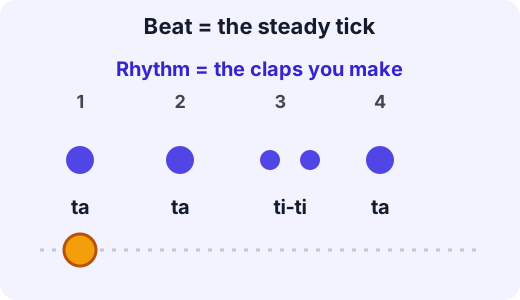
Saying rhythms out loud
Musicians have little words for rhythms. They are easy to say and clap.
Word What you do Claps in one beat ta one clap 1 ti-ti two quick claps 2 (silence) a rest: no sound, but the beat goes on 0 Example. The rhythm in the picture is ta, ta, ti-ti, ta. It is four beats long. How many claps? One, one, two, one: that is 5 claps in 4 beats. Count the claps and the beats separately. They are not always the same number!
A rest is a silent beat. You still feel the tick; you just keep your hands apart. Try ta, rest, ta, ta. The beat counts 1, 2, 3, 4, but you only clap on 1, 3 and 4.
Loud, soft, fast, slow
You can play the same rhythm in different ways.
- Loud is a big sound. Soft is a quiet sound. A lullaby is soft. A festival drum can be loud.
- Slow means the beats are far apart. Fast means they come close together.
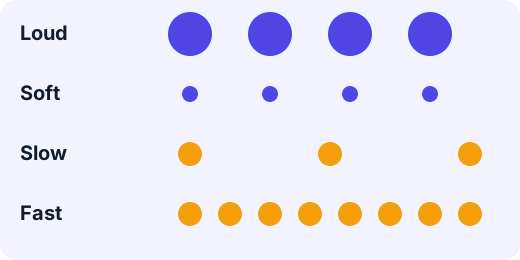
A common mix-up: loud does not mean fast, and soft does not mean slow. A drum can be slow and loud, or fast and soft. They are different things you can change.
Clap it back
A good game is echo clapping. One person claps a short rhythm and the other claps it back exactly. Listen first, with your eyes closed if you like. Then clap. Music needs good listening, even before good clapping.
For the grown-up helping
Keep the beat first, then the rhythm. Marching, patting knees or tapping a drum all work. A steady beat is hard for many six-year-olds, and it is fine if it wobbles. Start with the activity "Clap it back" and use rhythms of two to four beats. Praise careful listening as much as accuracy.
Lab
The clap-back machine
Build the rhythm you see, press Play to hear and see it, and try it slow and fast. Turn the sound on if you can, or watch the bouncing light.
Your goals
- Build three rhythms by matching the pattern shown (ta, ti-ti and rests on four beats).
- Play your rhythm at a slow speed and at a fast speed.
The interactive lab opens once you register. Register to do this.
Activity
Clap it back
Find the beat, then echo-clap rhythms and play loud, soft, fast and slow. About 15 minutes.
You'll need
- Your hands, feet and voices
- Optional - a pot and wooden spoon, or any drum
Steps
- Play a song you both know. March on the spot to its beat. Stop and start the song and see if you can keep the beat going on your own.
- Tap the beat on your knees while the grown-up says "ta, ta, ta, ta". Count four beats. Do it three times.
- The grown-up claps "ta, ta, ti-ti, ta" while saying the words. Your child claps it back. Then swap, and your child leads.
- Try a rest. Clap "ta, rest, ta, ta" and keep the beat going while the hands rest. Say "shh" on the rest beat.
- Play the same rhythm four ways - loud, soft, fast and slow. Ask your child which one is a lullaby and which one is for a festival dance.
- Make up one rhythm of four beats together. Clap it five times without stopping.
Safety
- Keep it gentle on the ears. Play drums and pots softly, and stop if anyone covers their ears.
- If you use a drum or pot, play on the top only and keep spoons away from faces.
Keeping a log of the activity is for registered learners. Register to do this.
Quick check
Rhythm and beat check
Seven questions. Look at the pictures and clap along in your head.
1.This rhythm is four beats long. How many claps are there in all?
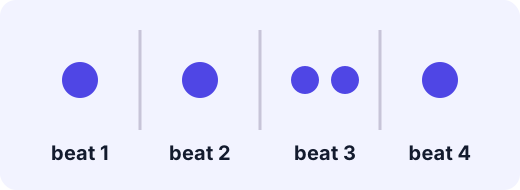
Answer with a number
2.The dashed circle is a rest (a silent beat). How many claps are there?
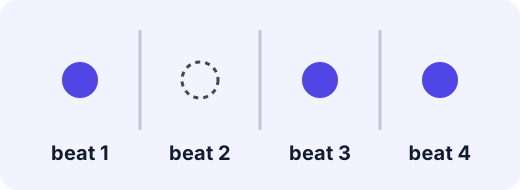
Answer with a number
3.What is the beat of a song?
- The steady tick you can march or tap to
- The words of the song
- How loud the singer is
Choose one
4.Which of these have a steady beat?
- A ticking clock
- Friends marching in time
- Someone tapping at random, stopping and starting anywhere
- A ball bouncing again and again at an even speed
Choose all that apply
5.Pappu taps his drum quietly, then hits it hard. What changed?
- How loud it is
- How fast the beat is
- He added a rest
Choose one
6.Match each word to what it means for music.
- Loud
- Soft
- Fast
- Slow
Match each to: A big sound · Beats close together · A quiet sound · Beats far apart
7.Nisha is marching to a drum. The drummer plays the beat faster. What should Nisha do to stay with the beat?
- Step faster
- Keep stepping at the same speed
- Step slower
Choose one
Answering and checking are for registered learners. Register to do this.
Quick check
New puzzles
Rhythm and beat show up in new places. Can you use what you know?
1.Rani claps four beats - ta, ti-ti, ta, ti-ti. How many claps does she make in all?
Answer with a number
2.Your friend claps ta, ta, ti-ti, ta. You clap one clap on every beat, four claps in all. What did you miss?
- The two quick claps in beat 3
- How loud it was
- Nothing, it was the same
Choose one
3.A dhol player plays a lullaby for a baby and then a dance for a festival. Which is the best way?
- Lullaby: slow and soft. Dance: faster and louder
- Lullaby: fast and loud. Dance: slow and soft
- Both exactly the same
Choose one
4.Rain drips on a tin roof - drip... drip... drip - then the drops come quicker and quicker. What is changing?
- The beat is getting faster
- The beat is getting softer
- Nothing is changing
Choose one
5.A song has 3 lines. Each line has 4 beats. You clap once on every beat. How many claps in the whole song?
Answer with a number
Answering and checking are for registered learners. Register to do this.
Activity
Tell it back
Your child explains in their own words what a beat is and how it is different from a rhythm. Three minutes.
Steps
- Play or sing a favourite song and tap its beat together.
- Ask "What is the beat? How do you know when you have it?" Let your child show you.
- Ask "How is the rhythm different from the beat?" They can clap the words of the song to show.
- Write down what your child says in their own words. Do not correct it; just ask "Can you show me?"
Keeping a log of the activity is for registered learners. Register to do this.
Like what you see?
Register for free to answer the quick checks, do the activities and save your work. Your work is saved on your device and syncs to your account.