Unit 1
Line and texture
Draw lines that feel soft, sharp, bumpy or fuzzy, and use rubbings to catch the feel of real things.
Read
Lines that feel
Ishaan's grandmother has a woollen shawl, a clay water pot and a rough old brick wall in her garden. Ishaan runs his hand over each one. The shawl is soft. The pot is smooth and cool. The wall is scratchy.
"Can you draw how they feel?" asks Grandmother. "Not only how they look."
Ishaan thinks that is a strange question. But it is a good one. Artists ask it all the time.
What is a line?
A line is the mark a pencil, crayon or brush leaves when it moves. Lines can be long or short, thick or thin, straight or curly. Different lines make us feel different things.
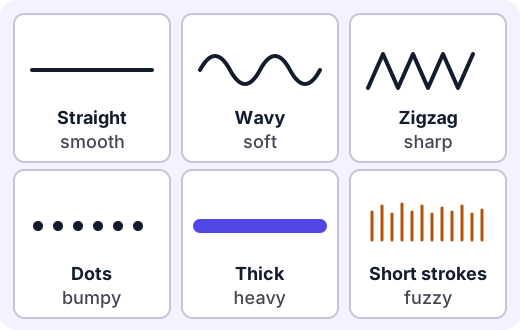
Look at the picture. A wavy line feels gentle, like a soft hill. A zigzag has points, so it feels sharp. Tiny short strokes look fuzzy, like grass or fur.
What is texture?
Texture is how a surface feels when you touch it: smooth, rough, bumpy, soft, prickly, hairy. An artist can show texture with lines, even on flat paper.
Try it: Draw a prickly hedgehog back. Which lines will you use? Short, sharp strokes that point outward work well. Now draw a smooth pebble. Which line now? One slow, round line.
Catch a texture with a rubbing
Some textures are hard to draw, like the pattern on a leaf or the bumps on a coin. A rubbing lets the real thing draw itself.
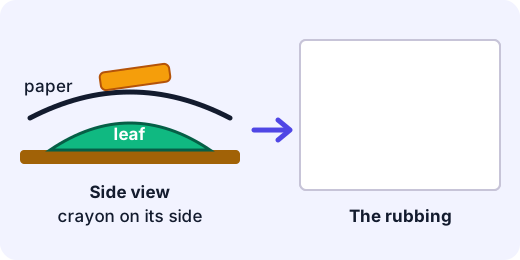
- Put a flat, bumpy thing on the table, such as a leaf or a coin.
- Cover it with thin paper.
- Hold the paper still with one hand.
- Rub the side of a crayon or pencil across the paper.
The raised bumps catch more colour than the flat parts, so the pattern appears, line by line. Thick paper hides the bumps, and a sharp pencil tip can tear the paper. Use thin paper and the side of the crayon.
Mix them together
Ishaan makes a drawing of the garden. For the wall he rubs a real brick. For the shawl he draws soft wavy loops. For the pot he draws one smooth, round line. Now you can nearly feel the picture.
Example. To draw a cat, you might use short soft strokes for the fur, long thin lines for the whiskers, and one smooth curve for the tail.
A mistake to watch for
Many children think texture only means "rough". But smooth is a texture too, and so is fluffy or slippery. Every surface has a texture.
For the grown-up helping
Let your child touch things first and find words for how they feel. Then ask, "What kind of line would feel like that?" There are no wrong answers; the line only has to match the feeling. For rubbings, hold the paper still for them if it slides, and praise the pattern that shows up, even if it is faint.
Activity
Texture hunt and rubbings
Your child hunts for bumpy and patterned things around the home, makes four rubbings and tears them into a picture. About 30 minutes.
You'll need
- Thin paper (printer paper or newspaper margins)
- Crayons with the paper wrappers peeled off, or soft pencils
- Flat bumpy things such as a leaf, a coin, a woven mat, a comb, tree bark, a brick or a textured wall
- A glue stick and a sheet of card
- Blunt children's scissors (optional; tearing by hand works too)
Steps
- Go on a texture hunt together. Touch things and say how they feel, such as rough, bumpy, smooth or ridged. Find at least six.
- Choose four that are flat enough to go under paper.
- Lay the first one on a table and cover it with thin paper. Hold the paper still.
- Rub the side of a crayon across the paper, back and forth, until the pattern shows. Do this for all four things, using a new piece of paper for each.
- Ask, "Which one feels the roughest? Which looks the softest?" Write the name of the thing on each rubbing.
- Tear or cut the rubbings into shapes and glue them on the card to make a picture, such as a bark tree, a leaf roof or a coin sun.
Safety
- Use blunt scissors only, with an adult nearby. Tearing the paper by hand is fine too.
- Do not use anything sharp, rusty or dirty as a rubbing surface.
- Keep coins away from younger children who might put them in their mouths.
- Wash hands after handling leaves or bark from outdoors.
Keeping a log of the activity is for registered learners. Register to do this.
Activity
Draw how it feels
Your child chooses lines to show how four things feel, then makes a drawing that mixes them. About 25 minutes.
You'll need
- Plain paper
- A pencil or black marker
- Four safe things to touch, such as a soft cloth, a smooth stone, a soft-bristled brush and a cotton ball
Steps
- Fold the paper into four boxes. Write a name in each box, such as cloth, stone, brush and cotton.
- Let your child touch the first thing with eyes closed. Ask, "How does it feel? What line would feel like that?"
- In the first box, draw lines to show that feeling. Do not draw the object, only the lines. Repeat for the other three boxes.
- Look at the four boxes together. Ask your child to point to the softest, the sharpest and the bumpiest.
- On a new sheet, draw a simple animal, such as a hedgehog, a fish or a sheep. Use a different kind of line for each part, such as spiky, scaly, smooth or curly.
- Ask, "Which part feels softest in your drawing, and how can I tell?"
Safety
- An adult checks every object first. Nothing should be sharp, dirty or breakable.
- Keep small objects such as cotton balls away from children who still put things in their mouths.
Keeping a log of the activity is for registered learners. Register to do this.
Quick check
Line and texture check
Six questions about lines, textures and rubbings.
1.You want to draw a prickly cactus. Which lines show "prickly" best?
- Short, sharp strokes with points
- Long, smooth, gentle curves
- Soft round loops
Choose one
2.Which line pattern best shows a soft, fluffy cloud?
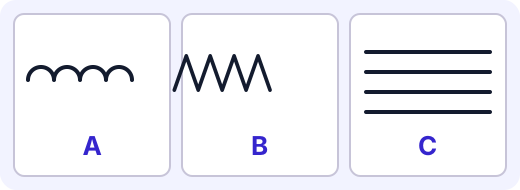
- A
- B
- C
Choose one
3.Put the steps of making a leaf rubbing in the best order.
- Hold the paper still
- Cover it with thin paper
- Lay the leaf flat on the table
- Rub the side of a crayon across the paper
Put these in order
4.Which of these would make a good rubbing?
- A coin with a raised picture
- A leaf with raised veins
- A woven grass mat
- A smooth, flat window pane
Choose all that apply
5.Why should the paper for a rubbing be thin?
- So the bumps underneath can show through
- So the crayon dries faster
- So the paper costs less
Choose one
6.Match each line to the thing it would best show.
- Wavy lines
- A zigzag
- Many tiny short strokes
Match each to: Fur or grass · A bolt of lightning · Ripples on a pond
Answering and checking are for registered learners. Register to do this.
Quick check
New puzzles
Lines and textures turn up in new places. Can you use what you know?
1.Tara is drawing a hairy caterpillar. How can she show the hair?
- Lots of tiny short strokes sticking out from its body
- One long straight line along its back
- A single big dot on its head
Choose one
2.Omar wants to make a rubbing. Which thing will give the plainest, least interesting rubbing?
- A smooth, shiny floor tile
- Rough tree bark
- A woven basket
Choose one
3.Lena's rubbing keeps coming out blurry because the paper slides about. What should she do?
- Hold the paper still with her other hand and rub gently with the side of the crayon
- Press as hard as she can with the tip of the crayon
- Use thicker paper
Choose one
4.Match what you want to draw to the line that shows how it feels.
- A rough rock
- Calm water
- A woolly sheep
Match each to: Bumpy, jagged lines · Small curly loops · Long, gentle waves
Answering and checking are for registered learners. Register to do this.
Activity
Tell it back
Your child explains, in their own words, how lines can show what something feels like. Two minutes.
Steps
- Put your child's drawings and rubbings in front of them.
- Ask: Pick one line or rubbing. What does it feel like, and how can I tell from the lines?
- Ask: If you wanted to draw something soft, what lines would you use? And something sharp?
- Write down what your child says in their own words. Do not correct them.
Keeping a log of the activity is for registered learners. Register to do this.
Like what you see?
Register for free to answer the quick checks, do the activities and save your work. Your work is saved on your device and syncs to your account.