Unit 2
Printing
Press leaves, vegetables and blocks into paint and print the same picture again and again to make a repeating design.
Read
One stamp, many pictures
In many parts of India, cloth is printed by hand. In Rajasthan and Gujarat, printers carve flowers and leaves into wooden blocks, dip them in colour and press them on cloth. One block can print the same flower hundreds of times. No one has to draw each flower again.
You can do the same thing with a leaf, an okra or half a potato.
What is a print?
A print is a picture made by pressing something that has colour on it onto paper or cloth. The thing you press is a stamp or block. When you lift it, the shape stays behind.
The big idea: a print lets you repeat an image. Draw a flower once and you have one flower. Carve a flower stamp and you can have fifty.
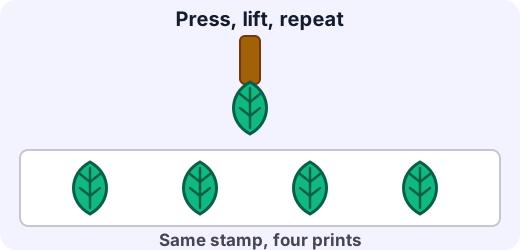
How to print
- Choose a stamp. A leaf with raised veins, half an okra, a cut potato, a piece of cardboard glued to a block.
- Add a thin layer of paint to the stamp. Use a brush or press it on a pad of paint.
- Press it down on the paper. Rub the back gently.
- Lift straight up so it doesn't smudge.
- Print again beside the first one.
Too much paint makes a blob and the shape is lost. Thin paint shows the little details, such as the veins of a leaf.
Repeating designs
When you print the same shape again and again in an order, you make a repeating design, also called a pattern. The part that repeats is called the unit.
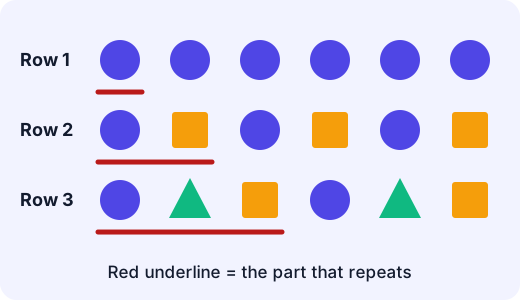
- Row 1 repeats one shape: ● ● ● ● ● ●
- Row 2 repeats two shapes: ● ■ ● ■ ● ■
- Row 3 repeats three shapes: ● ▲ ■ ● ▲ ■
Example. Row 2 has 6 prints. The unit is circle, square. It repeats 3 times, so there are 3 circles and 3 squares.
You can also change the colour: red flower, blue flower, red flower, blue flower. Printing the same stamp in two colours makes a new pattern.
Prints turn round!
If you carve a letter or a word, it prints as a mirror image. The stamp is pressed face down, so the picture flips. A letter P carved forward prints as a backwards P. If you want the print to read the right way, carve the letter backwards.
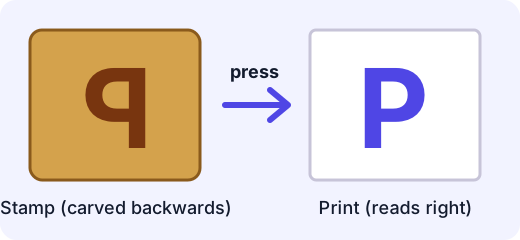
Pictures that are the same on both sides, like a round leaf or a circle, do not seem to flip.
A mistake to watch for
Some children think each print must be perfect. But small differences are part of the charm of hand printing. A slightly different print each time shows that a person made it. Only worry if the shape is lost in a blob.
For the grown-up helping
Let your child choose the stamps, and cut the potato or okra yourself, since a knife is involved. Ask, "What comes next?" while they print, so they hear the repeating. If the prints blob, say "Let's try a thinner layer of paint", not "that's wrong." Mixing up left and right in a mirror print is normal at this age.
Lab
The printing studio
Pick a stamp and a colour, then press a square to print. Fill three rows to make three repeating designs.
Your goals
- Make row 1 from the same print six times.
- Make row 2 a pattern that alternates two different prints.
- Make row 3 a pattern that repeats three prints (the first three prints come back in the last three squares).
The interactive lab opens once you register. Register to do this.
Activity
Print wrapping paper
Your child makes stamps from leaves and vegetables and prints a repeating design on a sheet of paper. About 40 minutes.
You'll need
- Big sheets of plain paper, newspaper or an old cloth bag
- Washable, non-toxic poster paint or fabric paint in two or three colours
- A shallow plate or lid for each colour, and a soft brush or sponge
- Things to print with, such as a leaf with raised veins, an okra, half a potato, a cork or a piece of cardboard glued to a block
- Old newspaper to cover the table, and an apron or old shirt
- Water and a cloth for cleaning up
Steps
- Cover the table with newspaper. Put a little paint on each plate and spread it thin.
- An adult cuts the okra across or cuts the potato flat. For a potato, carve a simple shape standing out, such as a star or a circle, or just use the flat cut.
- Dip a leaf (veined side down), brush paint on it, or press the okra or potato into the paint. Dab off extra paint on newspaper first.
- Press the stamp on the paper and rub the back gently. Lift straight up.
- Print the same stamp again beside the first one. Make a row of five or more.
- Make a second row that alternates two stamps or two colours, such as red, blue, red, blue.
- Make a third row that repeats three prints in a set. Say the pattern aloud as you print.
- Let the paper dry flat. Ask your child to point to the part that repeats.
Safety
- An adult does all the cutting of vegetables, using a safe board and a sharp knife away from the child.
- Use washable non-toxic paint only, and keep it away from mouths and eyes.
- Check for food allergies before touching vegetables, such as potato or okra, and wash hands afterward.
- Wash hands after printing. Wipe up spills so nobody slips.
Keeping a log of the activity is for registered learners. Register to do this.
Quick check
Printing check
Six questions about prints and patterns.
1.What does a print let you do that one drawing does not?
- Make the same image again and again
- Use more colours
- Make the paper shine
Choose one
2.Put the steps of printing in the best order.
- Press the stamp down on the paper
- Lift it straight up
- Print again next to the first print
- Spread a thin layer of paint on the stamp
Put these in order
3.Which of these can make a good stamp?
- A leaf with raised veins
- An okra cut across
- A potato cut flat with a shape standing out
- A puddle of water
Choose all that apply
4.Look at the row. What shape comes next?

- Circle
- Square
- Triangle
Choose one
5.A row has 10 prints that go circle, square, circle, square, and so on, starting with a circle. How many circles are in the row?
Answer with a number
6.A stamp is carved with a backwards P, the way a P looks in a mirror. You press it on paper. What letter will you see on the paper?
- A normal P
- A backwards P
- No letter at all
Choose one
Answering and checking are for registered learners. Register to do this.
Quick check
New puzzles
Printing and patterns turn up in new places. Can you use what you know?
1.Bina prints one bird stamp 3 times in a row. She makes 4 rows like that. How many bird prints are on her paper?
Answer with a number
2.Ravi wants to carve the word EAT so it reads correctly when printed. How should he carve it?
- As a mirror image of the word, the way it would look in a mirror
- Normal, the same way it should read
- Upside down
Choose one
3.Which row of prints is a repeating design?
- Circle, triangle, square, circle, triangle, square
- Circle, triangle, square, square, circle, triangle
- Circle, triangle, square, star, heart, moon
Choose one
4.Sana's leaf prints come out as dark blobs and you can't see the veins. What should she change?
- Use a thinner layer of paint
- Use even more paint
- Use a bigger sheet of paper
Choose one
Answering and checking are for registered learners. Register to do this.
Activity
Tell it back
Your child explains, in their own words, why printing is different from drawing and what makes a repeating design. Two minutes.
Steps
- Put the printed paper in front of your child.
- Ask: How is a print different from drawing the same picture over and over?
- Ask: Show me the part that repeats in one of your rows. What would come next?
- Write down what your child says in their own words. Do not correct them.
Keeping a log of the activity is for registered learners. Register to do this.
Like what you see?
Register for free to answer the quick checks, do the activities and save your work. Your work is saved on your device and syncs to your account.