Unit 3
Human services
Plan and run a real service, such as a meal for a group, a repair or a help desk, by starting from the person you serve.
Read
Start with the person you serve
Aarav and his friends once ran a tea-and-biscuit stall at their school's annual day. They planned everything: a big pot of masala chai, three kinds of biscuits, a bright banner. The stall looked wonderful. But the first visitors were grandparents who could not stand in a long queue, a few toddlers who could not drink hot tea, and two teachers who did not take sugar. The queue was long, the tea was too sweet and too hot, and half the biscuits came back untouched.
What went wrong? They planned a stall. They did not plan for the people who would come to it.
This unit is about that difference. In Making & Enterprise 6 you have worked with living things and with machines and materials. The third kind of project is human services: work whose product is not an object but help given to a person.
What is a service?
A service is work done for someone else that meets a need. Cooking a meal for a group, mending a torn bag, answering questions at a help desk, reading aloud to younger children, running a library counter: each is a service. The person who receives it is the person served. Sometimes there is one (a tailor and a customer), sometimes there are dozens (a community lunch).
A service differs from a thing you make in three ways:
- It happens at the moment it is given. You cannot fix a late meal tomorrow.
- It is judged by the person served, not by you. A beautiful meal that the guest cannot eat has failed.
- The person is in the room. How you speak, wait and listen is part of the product.
The big idea. Service work is about the person served. Every choice in your plan, from menu to seating to opening time, should trace back to something they need.
The four steps of a service
Good service teams, from a roadside dhaba to a hospital help desk, follow a loop.
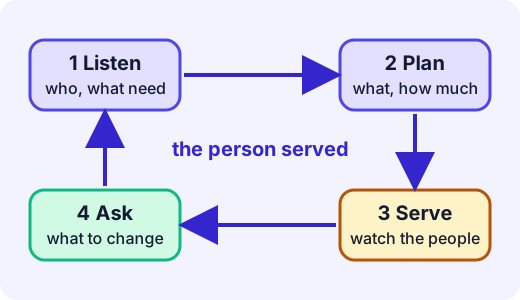
- Listen. Find out who the people are and what they need. Ask them, or someone who knows them. How many? Any who cannot eat certain foods? Any who need extra time, a seat or large print?
- Plan. Turn needs into decisions: what you will offer, how much, who does which job, what time each job starts.
- Serve. Run the plan, but keep watching the people. Plans meet reality, so be ready to adjust.
- Ask. Afterwards, ask how it went and write down what to change. The answers feed the next round of listening.
The most common mistake is jumping from an idea straight to step 3. That is what Aarav's team did.
Step 1 in practice: listening
Suppose your class will host a snack for twelve elderly neighbours. Before you decide anything, you want to know:
Question Why it matters How many are coming? Quantities and seating Can anyone not eat certain foods (peanuts, onion and garlic on a fasting day, spicy food)? Safety and respect Can everyone climb stairs and sit on a floor mat? Where and how to serve What time of day suits them? Many older people dislike late evenings Notice that none of these questions is about you. A useful rule: if you have not asked, you are guessing.
Step 2 in practice: planning a meal for a group
Planning has three parts: quantities, jobs and time.
Quantities. Most home recipes serve about four. To serve more, multiply every ingredient by the same factor.
Example. A poha recipe for 4 uses 1 cup of flattened rice, 2 potatoes and 1 onion. How much for 12 guests? The factor is . So: 3 cups of flattened rice, potatoes, 3 onions.
What about 14 people, if 12 guests are joined by two helpers who will eat too? The factor is , so you need cups of rice and 7 potatoes. Count everyone who will eat.
Misconception. "A bit extra is wasteful, so I'll make exactly the number of servings." Running out is a failure of service, while a small, planned margin (say one extra serving) is part of good planning. Leftovers can be shared with a neighbour or packed for helpers.
Jobs. Write down every job and give each a name: someone to wash hands and tables, cook (with an adult), serve, greet, clear plates. Everyone should know their job and their partner's.
Time. Plan backwards from the moment the service starts.
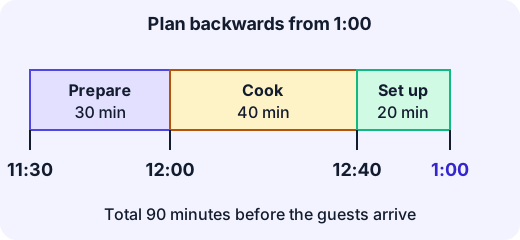
Example. Lunch is at 1:00 p.m. Setting up tables and plates takes 20 minutes. Cooking takes 40 minutes. Chopping and measuring takes 30 minutes. Work backwards: set-up must begin at . Cooking begins at . Preparation begins at . The whole job needs minutes before serving.
Add a few minutes of slack for the things that always go wrong: a missing spoon, a late helper.
Other kinds of service
The same four steps work everywhere.
- A repair service (for example mending a torn school bag or a button). Listen: what is broken, when is it needed, is there anything the owner does not want changed? Plan: do you have the right thread, patch and needle? Serve: show the owner the finished repair. Ask: "Does it hold? Is it the right size?"
- A help desk (for example at a school fair). Listen: who will come, and what will they ask? Likely questions are where is the toilet, where is the stall for X, where is the lost-and-found. Plan: a map, a printed list, a seat for visitors. Serve: look up, smile, and speak slowly. Ask: which questions did you not know the answer to?
Respect is part of the work
Serving is not doing something to people; it is doing something with them in mind. A few habits matter in every service:
- Ask before you assume. "Would you like a chair?" is better than quietly deciding the elder cannot stand.
- Offer choices where you can. A guest who cannot eat one dish should still have a full plate, not just the leftovers.
- Keep things clean and safe. Wash hands, keep hot things away from the edges of tables, and have an adult handle knives and stoves.
- Keep your word. If you promise a repair by Friday, say Friday only if you can deliver.
- Keep private things private. What people tell you at a help desk stays there.
Step 4: asking how it went
After the service, collect feedback: a short chat, or a tick sheet with three questions: What did you like? What was hard? What should we change? If three of twelve guests leave the chutney untouched, do not blame them. Ask why: too spicy? Too much? Not enough bread to go with it? Feedback is the way you listen again.
Summary
- A service is work done for someone to meet their need; the person served judges whether it worked.
- Follow the loop: Listen, Plan, Serve, Ask.
- Plan quantities (multiply by the same factor, count everyone), jobs (each person has one) and time (plan backwards, add slack).
- Choices should trace back to a need: if you cannot say whose need a choice meets, reconsider it.
Activity
Plan and run a small service
Plan and run a real service for at least three people, such as a snack for neighbours or family elders, a repair stall for torn bags and buttons, or a help desk at a school or society event. Allow one session to plan (about 45 minutes), the service itself (30 to 60 minutes) and 15 minutes to ask for feedback.
You'll need
- Paper and pen for notes and a feedback sheet
- Whatever your service needs (for a snack, a simple recipe and ingredients; for repairs, needles, thread, patches and buttons; for a help desk, a table, chairs, a hand-drawn map and a list of likely questions)
- A clock or phone for timing
- A grown-up who agrees to be your adult helper
Steps
- Choose your service and your people. Write one line: 'I will serve ___ (who) by ___ (what).'
- Listen first. Ask the people (or someone who knows them) at least three questions: how many, what they need or cannot have, and what time and place suit them. Write down the answers.
- Write a plan on one page: (a) quantities, multiplying a recipe or counting supplies for everyone including helpers; (b) jobs, one name beside each job; (c) a backwards timeline from the start time, with a few minutes of slack.
- For each main choice in your plan, write the need it meets, such as 'no peanuts because Mrs Rao is allergic'. Cross out any choice that meets nobody's need.
- Check the plan with your adult helper, especially anything involving a stove, a knife, a needle or hot water.
- Run the service. Greet each person, ask before you assume, and watch for small signs (someone standing too long, someone not eating, someone looking lost). Adjust and note what you changed.
- Ask for feedback straight afterwards: What did you like? What was hard? What should we change? Write down their words, not yours.
- Write three lines: what worked, what you would change next time, and one thing you learned about the person served.
Safety
- An adult does every step that uses a stove, hot oil, boiling water, a sharp knife or a sewing machine. Needles and pins are counted in and counted out.
- Ask about food allergies before cooking. If someone has a serious allergy, keep that food out of the kitchen entirely and tell the adult in charge.
- Wash hands with soap before touching food. Keep raw and cooked food apart and serve hot food hot and cold food cold.
- Serve and talk with people in a public part of the house or school, with an adult nearby. Do not go to a stranger's home alone.
- Never promise a repair or service you cannot finish safely.
Keeping a log of the activity is for registered learners. Register to do this.
Quick check
Service check
Eight questions on planning and running a service.
1.Your class will serve snacks to a group of neighbours. What should you do first?
- Choose the snacks you like best
- Find out who is coming and what they need
- Make a banner
- Buy ingredients
Choose one
2.Put the four steps of a service in order.
- Listen to the people served
- Ask how it went and note what to change
- Serve and watch the people
- Plan quantities, jobs and time
Put these in order
3.A recipe for 4 people uses 3 potatoes. How many potatoes for 12 people?
Answer with a number
4.10 guests are coming and 2 helpers will eat too. A recipe for 4 uses 2 cups of rice. How many cups for everyone?
Answer with a number
5.Lunch is at 1:00. Set-up takes 20 minutes, cooking 40 minutes and chopping 30 minutes. How many minutes before 1:00 must chopping begin?
Answer with a number
6.A guest says she cannot eat onion or garlic. Which responses put the person served first? Pick all that apply.
- Offer her a dish made without onion and garlic
- Tell her the recipe cannot be changed
- Ask her what else she would like to eat
- Serve it anyway and say nothing
Choose all that apply
7.Match each service to what the person served most needs from it.
- A community lunch
- Mending a torn bag
- A help desk at a fair
Match each to: Clear directions given patiently · Safe food in the right amount, with allergies known · A repair that holds, ready on the promised day
8.After the snack, three of twelve guests left the green chutney untouched. What is the best response?
- They are fussy, so ignore it
- Ask them why, and write it down for next time
- Make double the chutney next time
Choose one
Answering and checking are for registered learners. Register to do this.
Quick check
New puzzles
Use the service loop in situations the reading did not show.
1.A nimbu pani recipe makes 6 glasses and uses 4 lemons. You need glasses for 15 people. How many lemons?
Answer with a number
2.At a school fair help desk, a grandfather says he cannot read the small print on the map. What is the best help?
- Tell him to look more carefully
- Ask where he wants to go and show him, or walk him there
- Ask him to wait for the next visitor
Choose one
3.A classmate asks you to sew back a button on her uniform by tomorrow, but you have no matching thread. What is the service-minded thing to do?
- Use any thread, whatever the colour, and say nothing
- Tell her what thread you have, and agree on a plan she is happy with
- Say you cannot help and walk away
Choose one
4.A bake sale opens at 10:00. Setting up stalls takes 25 minutes, baking the last tray takes 35 minutes, and you want 10 minutes of slack at the end. How many minutes before 10:00 should baking begin?
Answer with a number
Answering and checking are for registered learners. Register to do this.
Your turn
Whose need was it?
Think about your own service project, or about one you have received (a tailor, a canteen, a school help desk). Answer in your own words.
- Who was the person served, and what did they need? Name at least two specific needs.
- Pick three decisions in the plan (for example the menu, the seating, the time, the jobs). For each, say which need it met.
- What went well, and what did the person served say or do that told you? What is one thing you would change, and why?
- In two or three sentences, explain what "service work is about the person served" means to you.
How it's judged
- Knowing the person served
- Linking decisions to needs
- Reflecting with evidence
Writing and submitting your answer is for registered learners. Register to do this.
Like what you see?
Register for free to answer the quick checks, do the activities and save your work. Your work is saved on your device and syncs to your account.