Unit 3
Times tables
Learn every product up to 10 × 10 by building hard facts from easy ones, then make them stick.
Read
Making the facts yours
Kabir runs the ticket counter at a school fair. Every group of friends buys tickets, and every ticket costs ₹7. Eight friends want a ticket each. If Kabir has to count on his fingers every time, the queue gets long. If he knows that , he can say "₹56, please" at once and look up at the next customer.
That is why we learn the times tables: not to win a race, but to free your mind. When the small facts are quick and sure, your thinking has room for the big question, such as how many tickets, how much money, how much cloth.
The goal of this unit is to know every product from up to . That sounds like 100 facts, but you will see that it is much less to learn.
Fewer facts than you think
Look at the whole table.
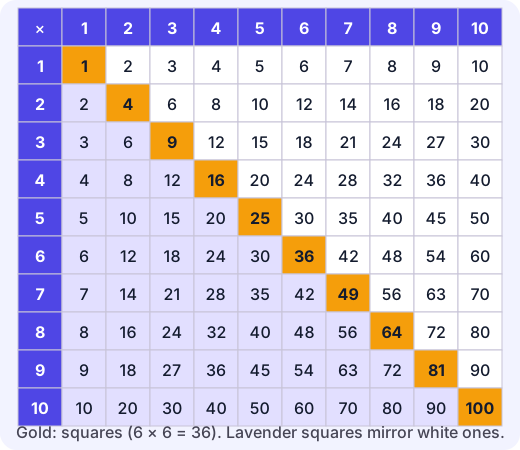
- The table is a mirror. and both make 21, so every fact you learn gives you two. Only 55 different facts are left in the whole table.
- The 1s, the 2s, the 5s and the 10s are easy. That clears out a big strip.
- Several other tables are built from these easy ones.
Try it: Cover the top-right half of the table with your hand. Can you still find using the bottom-left half? How?
Tricks that come from meaning
Every one of these tricks is just thinking about equal groups.
Table How to think Example ×2 double : ×10 each group is ten: put a 0 after the number ×5 half of ten groups : half of 80 is 40 ×4 double, then double again : , then ×3 two groups, plus one more : ×6 five groups, plus one more : ×9 ten groups, minus one : ×8 double the ×4 fact : , so Skip counting is the engine under all of them. To find , make seven jumps of 6:
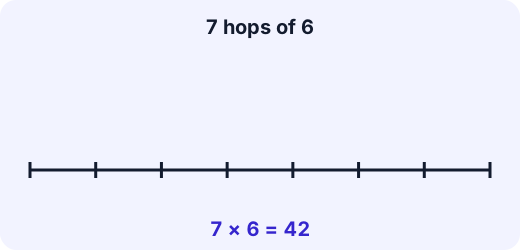
Each hop is one more group. After seven hops you land on 42.
Worked examples
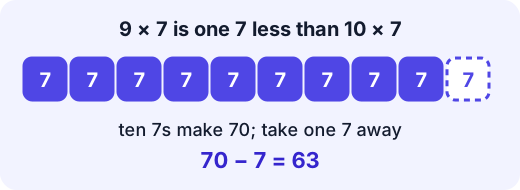
Example 1. Find .
- Ten groups of 7 is 70.
- Nine groups is one group fewer: .
- So .
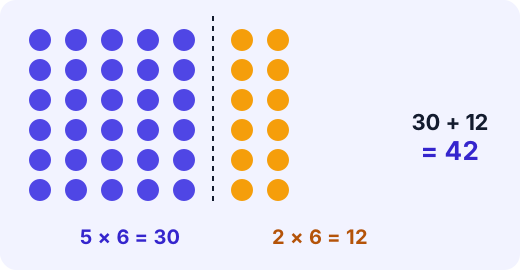
Example 2. Find by splitting.
- Split the 7 groups into 5 groups and 2 groups.
- and .
- , so .
Example 3. Find , the one many people find hardest.
- (double 14, or four sevens).
- is double that: .
- A memory hook: the numbers 5, 6, 7, 8 line up as .
From thinking to knowing
Tricks get you the answer. Practice makes the answer arrive on its own. Short, frequent practice beats one long session: five minutes a day, mixing tables, and going back to the facts you miss. When you get a fact wrong, do not just copy the answer. Find the trick that works for you and say it out loud once, then try the fact again later.
A common mistake is to learn tables only as a chant, from the start each time ("seven sixes... seven sevens..."). Chanting helps the sound, but a fact you only know in order breaks when someone asks for it out of order. Mix the order, and always keep the picture in your mind: is seven groups of six.
Quick summary
- Know all products to so your mind is free for problems.
- Swapping the numbers gives the same product, so there are only 55 products to learn.
- Use easy facts to build harder ones (double, half, ten groups plus or minus one group, splitting).
- Practise a little every day, mixing the order, and revisit the facts you miss.
Lab
The fact map
Answer multiplication facts to turn squares of the table green. Each answer fills two squares. Use hints whenever you like; there is no timer.
Your goals
- Turn at least 36 squares of the map green by answering facts correctly.
- If you miss a fact, read its strategy hint and try again when it comes round (the page shows each fact you missed again until you get it right).
The interactive lab opens once you register. Register to do this.
Activity
Fact cards and strategy talk
Make fact cards and play a pairs-and-explain game with a friend or family member. About 20 minutes.
You'll need
- 20 small pieces of paper or card
- A pencil
- A friend or family member (or play alone)
Steps
- On 10 cards write a fact without its answer (for example 7 × 6). Choose the facts you find hardest, plus a few you know.
- On the back of each card write the answer.
- Shuffle the cards. Turn one over and say the product. Then check the back.
- If you were right, say the trick you used in a few words (for example "5 × 6 is 30, plus 6 more"). Put the card in the "know it" pile.
- If you were wrong, say the correct trick and put the card at the bottom to try again later.
- Play until every card is in the "know it" pile. Then shuffle the whole pile and try once more with the answers swapped (turn the 7 × 6 card into a 6 × 7 question).
Safety
- Use blunt-ended scissors if you cut cards, and ask an adult for help with cutting.
Keeping a log of the activity is for registered learners. Register to do this.
Quick check
Times tables check
Eight questions on facts and strategies.
1.What is 6 × 7?
Answer with a number
2.What is 9 × 8?
Answer with a number
3.Which calculation helps you find 9 × 7?
- 10 × 7 − 7
- 10 × 7 + 7
- 9 + 7
- 9 × 10 − 7
Choose one
4.Use double, then double again. What is 4 × 9?
Answer with a number
5.Match each fact to its product.
- 7 × 7
- 6 × 8
- 8 × 8
Match each to: 64 · 49 · 48
6.Which of these products equal 24?
- 3 × 8
- 6 × 4
- 5 × 5
- 7 × 4
Choose all that apply
7.8 × ___ = 56
Answer with a number
8.Put these facts in order from the smallest product to the largest.
- 5 × 7
- 6 × 6
- 3 × 9
- 4 × 8
Put these in order
Answering and checking are for registered learners. Register to do this.
Quick check
New puzzles
Four puzzles that use the tables in new places.
1.A weaver makes 7 rugs every week. How many rugs does she make in 8 weeks?
Answer with a number
2.Find the number that is both 6 × 6 and 4 × 9.
Answer with a number
3.Ravi wrote 7 × 8 = 54. Use 5 × 8 = 40 and 2 × 8 = 16 to find the correct product.
Answer with a number
4.One of these facts is wrong. Which one?
- 9 × 6 = 54
- 8 × 4 = 32
- 7 × 7 = 47
- 6 × 5 = 30
Choose one
Answering and checking are for registered learners. Register to do this.
Your turn
My strategies and why they matter
- Choose three multiplication facts you find hard (for example , , ). For each one, write a strategy that builds it from an easier fact, and show the steps and the answer.
- Explain why knowing also tells you , and why that means there are fewer facts to learn than it first seems.
- In two or three sentences, say why it helps to know your times tables by heart, using an example of a real problem where it saves you time.
How it's judged
- Strategies for hard facts
- Swapping the factors
- Why facts matter
Writing and submitting your answer is for registered learners. Register to do this.
Like what you see?
Register for free to answer the quick checks, do the activities and save your work. Your work is saved on your device and syncs to your account.