Unit 5
Problems with two steps
Find the hidden question, solve in two steps, and use an estimate to catch wrong answers.
Read
The hidden question
Arun goes to the school shop. Three notebooks cost ₹18 each. He pays with a ₹100 note. The shopkeeper hands back some coins and Arun wonders: is that the right change?
Look at the question the shop's sign would ask: How much change does Arun get? But you cannot answer that yet. You do not know how much he spent. The question about the change has a smaller question hiding inside it: How much do the three notebooks cost?
That is a two-step problem. You cannot get to the answer in one go. First you answer the hidden question, and then you use that answer to solve the question that was asked.
Find the hidden question
When a problem has more than one number and you cannot see how to start, ask yourself:
- What is the problem asking me to find out? (The last step.)
- What do I need to know first, to be able to find that? (The hidden question.)
- Can I find that from the numbers I have? If yes, that is step 1.
For Arun, the question is "How much change?" To find change we need to know how much he spent. We can work that out from "3 notebooks at ₹18 each". So step 1 is multiplication and step 2 is subtraction.
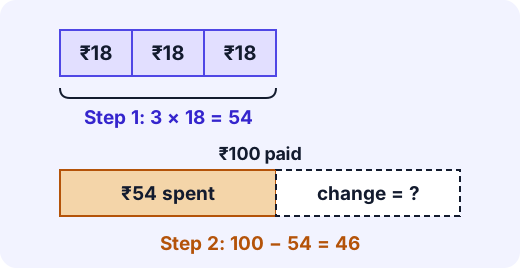
Step 1: . (Split it: .)
Step 2: .
Arun should get ₹46 back.
A picture like the bars above is called a bar model. Draw one whenever you are stuck: boxes for equal groups, one long bar for the whole, and a dashed part for what you do not know.
Estimate first
Here is a trick that catches mistakes before they happen. Before you start, do a quick, rough calculation with easy numbers. That is an estimate.
For Arun: ₹18 is close to ₹20. Three notebooks at ₹20 would cost ₹60. So the change from ₹100 would be about ₹40. When we then work out 46, we compare: 46 is close to 40, so it makes sense. We say the answer is reasonable.
What if Arun got confused and added instead, ? His estimate says "about ₹40 change". Then 154 stands out at once. It is more than the ₹100 he handed over, which cannot be right. The estimate rings the alarm.
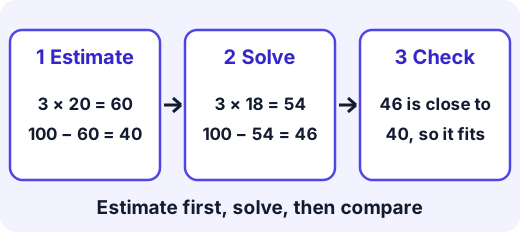
So there are three habits to build: estimate first, solve in steps, check against the estimate.
Worked examples
Example 1 (multiply, then subtract). A baker bakes 8 trays with 12 buns on each tray and sells 75 buns. How many buns are left?
- Hidden question: How many buns did the baker bake? .
- Question asked: buns left.
- Check: is close to 100, and . 21 is close to 25, so it is reasonable.
Example 2 (add, then divide). Ravi has 45 stickers. His uncle gives him 15 more. He shares all of them equally among 5 friends. How many does each friend get?
- Hidden question: How many stickers does Ravi have now? .
- Question asked: stickers for each friend.
- Check: . Yes. Division can always be checked by multiplying back.
Example 3 (a wrong order). Mira has ₹90. She buys 4 pens at ₹15 each. How much money is left?
- Hidden question: How much do 4 pens cost? .
- Question asked: . She has ₹30.
- A common mistake is to calculate and stop, or to go straight to . Both use the numbers but skip the hidden question. The estimate says 4 pens at about ₹15 each cost about ₹60, so about ₹30 is left. Then 75 and 86 stand out as far too big.
Common mistakes
- Doing the first operation you see. The order the numbers appear in the story is not always the order you must use them.
- Stopping after step 1. You found the cost of the pens, but the question asked for the money left. Re-read the last sentence.
- Never checking. An answer that is bigger than what you started with, when things were taken away, cannot be right. Ask: does this answer make sense in the story?
Quick summary
- A two-step problem has a hidden question that you must answer first.
- Draw a bar model to see the steps.
- Estimate first with easy numbers, then solve in two steps.
- Compare your answer with the estimate. If they are far apart, look for a mistake.
Lab
The two-step workshop
Solve four two-step stories in the right order - estimate, find the hidden question's answer, then give the final answer - and then play detective on three answers that other people gave. There is no timer.
Your goals
- Estimate first, then answer the hidden question, then give the final answer for each of four problems.
- Decide whether three other people's answers are reasonable, using a quick estimate.
The interactive lab opens once you register. Register to do this.
Quick check
Two-step problems check
Seven questions. Think about the hidden question, and ask yourself if each answer makes sense.
1.Rohan has ₹85. He buys 3 pens at ₹12 each. How much money does he have left?
Answer with a number
2.Which is the best estimate for 6 × 19 − 12?
- About 20
- About 100
- About 140
- About 230
Choose one
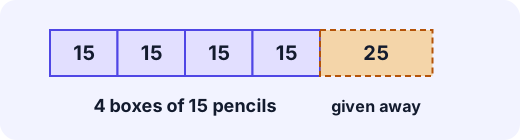
3.The bar shows 4 boxes of 15 pencils. Then 25 pencils are given away. How many pencils are left?
Answer with a number
4.Aman buys 3 packets of 9 biscuits and eats 5. Put the steps in the order that estimates first, solves, and then checks.
- Find the total: 3 × 9 = 27
- Take away the 5 eaten: 27 − 5 = 22
- Check that 22 is close to the estimate of 25
- Estimate: 3 × 10 − 5 is about 25
Put these in order
5.Ravi has 50 marbles. He gives 8 marbles to each of 3 friends. How many marbles does he have left? What is the hidden question?
- How many marbles did he give away altogether?
- How many friends does he have?
- What is 50 ÷ 8?
- How many marbles does each friend get?
Choose one
6.36 children go on a trip. 4 more children join them. Each bus holds 8 children. How many buses are needed?
Answer with a number
7.Anil has 7 boxes with 9 pencils in each. He gives away 20 pencils. He says he has 83 pencils left. Is his answer reasonable?
- Yes, 83 is close to the number he started with
- No, he started with only about 63 pencils, so he cannot have 83 after giving some away
- No, because 83 is too small
Choose one
Answering and checking are for registered learners. Register to do this.
Quick check
New puzzles
Hidden questions can hide in new places. Find them, solve, and check that your answer makes sense.
1.A farm packs 5 baskets with 12 apples in each basket. The farm had 100 apples. How many apples are not packed?
Answer with a number
2.A ticket costs ₹35. Kavya buys 2 tickets and pays with a ₹100 note. How much change does she get?
Answer with a number
3.Pooja makes 8 strings of 6 beads each. She needs 100 beads in all. How many more beads does she need?
Answer with a number
4.A shop has 3 bags of 19 oranges and 9 loose oranges. Which total makes sense?
- 31
- 47
- 66
- 513
Choose one
Answering and checking are for registered learners. Register to do this.
Your turn
Write a two-step problem and check it
- Write your own two-step story problem. The first step must be a multiplication and the second step must be a subtraction (or an addition). Use a setting you know, such as a market, a bus or a school.
- Solve it. Write down the hidden question, then the two steps, then your answer.
- Show how you estimated first and say whether your answer is reasonable.
- A friend solved your problem and got an answer that is much too big. Explain how an estimate could have helped your friend notice.
How it's judged
- The problem and its hidden question
- Solving in steps
- Using an estimate
Writing and submitting your answer is for registered learners. Register to do this.
Like what you see?
Register for free to answer the quick checks, do the activities and save your work. Your work is saved on your device and syncs to your account.