Unit 4
Split a hard fact into easy ones
Turn an array around, or cut it in two, and a hard multiplication fact becomes two easy ones.
Read
Turn it, or cut it
Zara has a sheet of stickers: 7 rows with 8 stickers in each row. She wants to know how many stickers there are, and she cannot quite remember . But she knows her 5s very well, and she knows too.
So she takes a pair of scissors and cuts the sheet between the fifth and sixth sticker in every row. Now she has two smaller sheets. One has 7 rows of 5. The other has 7 rows of 3. She does not need to remember a hard fact any more, because she has two easy ones.
That is the big idea of this unit: you can split a hard product into easy ones. There are two rules behind it. Mathematicians gave them long names, but you already use both of them.
Rule 1: turn it around
Here is an array of 3 rows with 7 dots in each row.
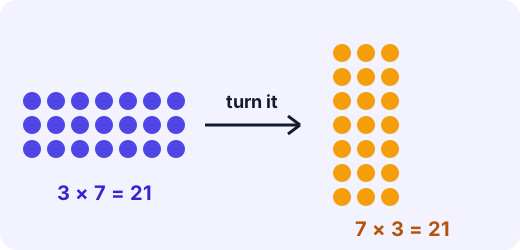
Turn the page on its side and the rows become columns. Now you see 7 rows with 3 dots in each row. Nothing was added or taken away, so the number of dots is the same:
This rule is called the commutative property. It says that the order of the two numbers does not change the product. If you know , you also know . Every fact you learn is really two facts.
Try it: You find easier than . Which fact would you use to find ? Why can you do that?
A warning. This only works for multiplication (and addition). It does not work for division or subtraction: , but is not 4. Do not swap the numbers in a division.
Rule 2: cut it in two
Now look at Zara's stickers as an array and watch what happens when we cut it.

The cut does not change how many dots there are. The whole is the two parts together, so:
This rule is the distributive property. It says that when you split one of the numbers into two parts, you multiply each part by the other number, and then add. Look closely at what happens to the 7. It stays the same in both products. Only the 8 was split, into .
You can cut an array anywhere you like. Smart people cut where the pieces are facts they already know. Cutting off a 5 or a 10 is often a good idea, because the 5s and 10s are so easy.
Worked examples
Example 1. Find .
- Split the 9 into . (A 5 is easy.)
- and .
- Add: .
- So .
Example 2. Find when the 8s feel hard.
- Keep the 8 and split the 7 into . (Or turn it around first: .)
- and .
- Add: .
- So . We got the same answer as Zara, in a different way. That is a good check.
Example 3. The rule also works beyond the times tables. Find .
- Split 13 into .
- and .
- Add: .
- So .
Example 4. Going the other way. A hall has 8 rows of 4 chairs on the left and 8 rows of 6 chairs on the right. How many chairs?
- Left: . Right: . Total: .
- Or notice that the two blocks make one array of 8 rows with chairs in each row: .
Common mistakes
- Forgetting to multiply one part. is wrong. The 3 must also be multiplied by 7: .
- Multiplying the two pieces together. is not . After the cut, you add the two parts.
- Splitting both numbers at once. Cut one number at a time. It is the easiest way to keep track.
Quick summary
- Turning an array around shows that . This is the commutative property.
- Cutting an array in two shows that . This is the distributive property.
- To find a hard fact, split one number into two parts that make easy facts, then add the two products.
- Always check: the parts must add up to the original number, and every part is multiplied by the same other number.
Lab
Cut the array
Each challenge shows an array of dots. Cut it into two blocks where you like, work out the two small products, and add them to find the whole. You can turn the array on its side whenever you want. There is no timer.
Your goals
- Cut each of the five arrays into two blocks and find the two partial products.
- Add the two products to find the whole product, and try turning the array to see that the total stays the same.
The interactive lab opens once you register. Register to do this.
Quick check
Properties of multiplication check
Seven questions about turning arrays and cutting them in two.
1.You know that 6 × 9 = 54. Which other fact do you know for free?
- 9 × 6 = 54
- 6 + 9 = 54
- 9 × 9 = 54
Choose one
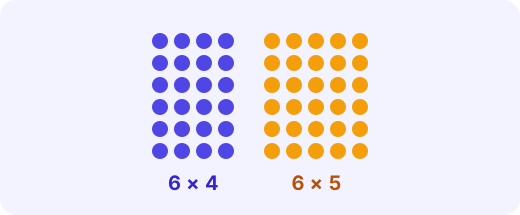
2.This array of 6 rows with 9 dots in each row is cut into 4 columns and 5 columns. What is 6 × 9?
Answer with a number
3.7 × 8 = 7 × 5 + 7 × ?
Answer with a number
4.Which one is a correct way to split 8 × 6?
- 8 × 6 = 8 × 3 + 8 × 3
- 8 × 6 = 8 × 3 + 3
- 8 × 6 = 8 × 3 + 8 × 2
- 8 × 6 = 8 × 3 × 8 × 3
Choose one
5.Use 4 × 8 + 3 × 8 to find 7 × 8.
Answer with a number
6.Which of these are true? Pick all that apply.
- 5 × 9 = 9 × 5
- 12 ÷ 3 = 3 ÷ 12
- 6 × 8 = 6 × 4 + 6 × 4
- 6 × 8 = 6 × 4 + 4
Choose all that apply
7.Match each sum of easy facts to the product it makes.
- 5 × 8 + 2 × 8
- 5 × 8 + 3 × 8
- 5 × 8 + 4 × 8
Match each to: 72 · 64 · 56
Answering and checking are for registered learners. Register to do this.
Quick check
New puzzles
The two rules turn up in places the reading did not show. Can you use them?
1.A school hall has a left block of 6 rows with 7 chairs in each row, and a right block of 6 rows with 5 chairs in each row. How many chairs are there altogether?
Answer with a number
2.Nandini finds 14 × 3 hard. Use 10 × 3 + 4 × 3 to work it out.
Answer with a number
3.Rani knows that 6 × 7 = 42. What should she do to find 7 × 7?
- Add 6 to 42
- Add 7 to 42
- Double 42
- Multiply 42 by 7
Choose one
4.Tom wrote "4 × 15 = 4 × 10 + 5 = 45". His answer is wrong because he did not multiply the 5 by 4. What is 4 × 15?
Answer with a number
Answering and checking are for registered learners. Register to do this.
Your turn
Split it, and say why it works
- Find in two different ways. For each way, split one number into two parts, and show every step.
- A friend says: ", and must be a different fact, so I need to learn it separately." Explain, using an array or a picture in words, why your friend does not need to.
- Another friend works out like this: . Say what is wrong, then find the right answer.
How it's judged
- Splitting a product
- Explaining swapping
- Finding the mistake
Writing and submitting your answer is for registered learners. Register to do this.
Like what you see?
Register for free to answer the quick checks, do the activities and save your work. Your work is saved on your device and syncs to your account.