Unit 14
Area of triangles and polygons
Cut, slide and double shapes you already know to discover the area formulas for parallelograms, triangles and trapeziums.
Read
New shapes from old
A farmer has a field shaped like a slanted rectangle, a parallelogram. Its long side is 60 m and she walks across it at right angles to that side: 40 m. How much land does she own? Multiplying the two sides she measured by hand, , sounds reasonable. It is. But the other side of the field, the slanted one, measures 50 m, and multiplying would be wrong. Why does the first work and the second not? Here is the idea of this unit: you do not need to memorise area formulas. You can make them, by cutting a new shape into pieces and rearranging them into a shape you already know.
You already know one formula: a rectangle with sides and has area . Everything else here comes from that.
Base and height
For any of these shapes pick a side and call it the base, . The height, , is the perpendicular distance from the base to the opposite side or opposite corner. It is not the slanted side.
Misconception. "The height of a parallelogram is its slanted side." The slanted side is longer than the height (unless the shape is a rectangle). The height is measured at a right angle to the base, shown by the dashed line in the pictures below.
Parallelogram
Cut a right-angled triangle off one end of a parallelogram and slide it to the other end. The slanted sides disappear and a rectangle appears.
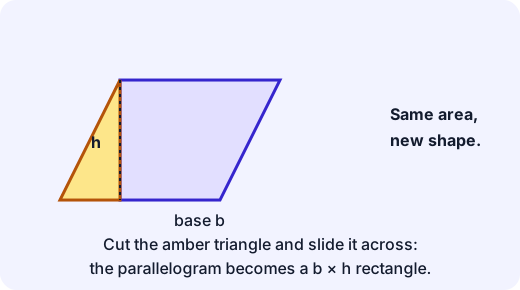
No area was added or lost: the pieces were only moved. The rectangle has width and height , so
Back to the field: . The slanted side of 50 m never matters. Push the top of a parallelogram sideways (keeping base and height the same) and the area does not change at all, only the slant does.
Example. A parallelogram has base 9 cm, height 5 cm and slanted side 7 cm. Area . The 7 is a distraction.
Triangle
Take any triangle and a copy of it. Turn the copy half a turn and fit the two together along one side. They always make a parallelogram.
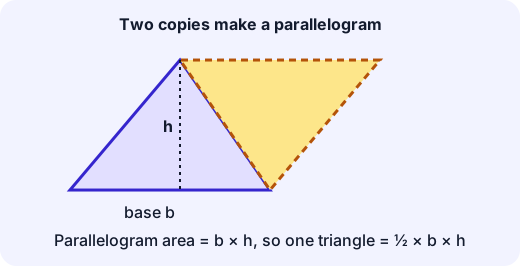
The parallelogram has area , and the triangle is half of it:
It works for any of the three sides as the base, as long as is the perpendicular distance to the opposite corner. That means for a given triangle, gives the same value whichever side you choose.
Example. A triangle has base 12 cm and height 7 cm. Area .
Example (working backwards). A triangular flag has area and base cm. Then , so and cm.
Misconception. Forgetting the half. If you compute for a triangle, you have found the area of the parallelogram made from two copies. Check: a triangle whose top corner is above its base fits inside the rectangle around it, and it fills exactly half.
Here is a surprise. Draw a triangle with a fixed base, and slide its top corner anywhere along a line parallel to the base. The height never changes, so the area never changes, even though the triangle looks very different.
Trapezium
A trapezium has one pair of parallel sides, and , at distance apart. (In US usage this shape is called a trapezoid.) Take a copy, turn it half a turn, and join it to the original along a slanted side. The two make a parallelogram.
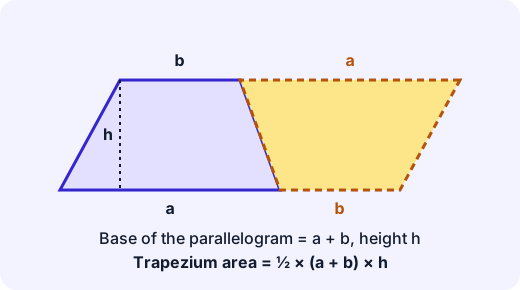
The parallelogram has base and height . The trapezium is half of it:
You can read the formula as "the average of the two parallel sides, times the height."
Example. A trapezium has parallel sides 6 cm and 10 cm, with 4 cm between them. Area .
Example (working backwards). A trapezium has area , parallel sides 5 cm and 13 cm. Then , so cm.
Composite shapes
Many real shapes are made from the pieces above. Split them, find each area, then add (or subtract a piece you cut away).
Example. A kite has one diagonal 10 cm long and the other 6 cm, crossing at a right angle. The long diagonal splits the kite into two triangles with base 10. Their heights are the two parts of the other diagonal; call them and , where . So the area is , however the 6 cm is shared out.
Example (subtracting). A square of side 8 cm has a corner cut off, a triangle with legs 3 cm and 5 cm. The remaining area is .
Which formula, and what to check
Shape Area What means Rectangle the other side Parallelogram perpendicular distance between the two parallel sides Triangle perpendicular distance from the base to the opposite corner Trapezium perpendicular distance between the parallel sides Before you multiply, ask: is this number a perpendicular height, or a slanted side? Area is always in square units: cm², m², and so on.
Summary
- Formulas can be derived: cut, slide and double shapes into ones you know.
- Parallelogram: . Triangle: . Trapezium: .
- The height is perpendicular to the base. The slanted side is never used.
- Shapes with the same base and height have the same area, however they lean.
- Split complicated shapes into pieces, or subtract a piece, to find their area.
Lab
The area rearranger
Shapes are drawn on a grid of unit squares. Slide the base, top, height and lean, and press the rearrange switch to see the cut-and-move that gives each formula. Then build the shapes the six tasks ask for, using what you have learned about the formulas.
Your goals
- See how a parallelogram, a triangle and a trapezium rearrange into shapes you know.
- Notice that the lean of a shape does not change its area.
- Build all six shapes with the area each task asks for.
The interactive lab opens once you register. Register to do this.
Quick check
Area check
Eight questions on the areas of parallelograms, triangles and trapeziums. Lengths are in centimetres.
1.A parallelogram has base 9 cm, perpendicular height 6 cm and a slanted side of 7 cm. What is its area in cm²?
Answer with a number
2.A triangle has base 10 cm and perpendicular height 7 cm. What is its area in cm²?
Answer with a number
3.A trapezium has parallel sides 7 cm and 13 cm, and they are 5 cm apart. What is its area in cm²?
Answer with a number
4.A triangle has area 36 cm² and base 9 cm. What is its height in cm?
Answer with a number
5.To find the area of a parallelogram, which measurement do you NOT need?
- The length of the base
- The perpendicular height
- The length of the slanted side
Choose one
6.A trapezium has area 60 cm² and parallel sides 4 cm and 11 cm. How far apart (in cm) are the parallel sides?
Answer with a number
7.Which triangles have an area of 24 cm²? Pick all that apply.
- Base 8 cm, height 6 cm
- Base 12 cm, height 2 cm
- Base 6 cm, height 8 cm
- Base 24 cm, height 1 cm
- Base 4 cm, height 12 cm
Choose all that apply
8.Match each shape to its area formula.
- Rectangle
- Parallelogram
- Triangle
- Trapezium
Match each to: ½ × base × height · ½ × (a + b) × height · base × height · length × width
Answering and checking are for registered learners. Register to do this.
Quick check
New puzzles with area
Use what you know about cutting and rearranging in situations that are new.
1.A rhombus-shaped kite has diagonals of 12 cm and 9 cm that cross at right angles. Split it into two triangles along the 12 cm diagonal. What is the area of the kite in cm²?
Answer with a number
2.A field is a trapezium. Its parallel sides are 40 m and 60 m long and the distance between them is 30 m. What is its area in m²?
Answer with a number
3.Triangle P has base 12 cm and area 30 cm². Triangle Q has the same base, and its top corner lies on a line parallel to the base that passes through the top corner of P. What is the area of Q in cm²?
Answer with a number
4.A square sheet of side 10 cm has a corner cut off as a right-angled triangle with legs 4 cm and 6 cm. What area of the sheet is left, in cm²?
Answer with a number
Answering and checking are for registered learners. Register to do this.
Your turn
Explain the formulas
Write in your own words. Describe any sketch you make.
- Explain, using cutting and sliding, why the area of a parallelogram is base × height. Say why the slanted side is not used.
- Explain why the area of a triangle is by making a parallelogram from two copies. Then answer: two triangles share the same base of 10 cm, one with height 6 cm and one with height 6 cm but leaning far over to one side. Do they have the same area? Explain.
- A trapezium has parallel sides and and height . Show how two copies make a parallelogram and use it to get . Then use the formula on a trapezium with parallel sides 8 cm and 14 cm, height 5 cm.
How it's judged
- Parallelogram to rectangle
- Triangle and same-base triangles
- Trapezium
Writing and submitting your answer is for registered learners. Register to do this.
Like what you see?
Register for free to answer the quick checks, do the activities and save your work. Your work is saved on your device and syncs to your account.