Unit 13
Symmetry
Find the mirror lines and turns that leave a shape looking the same, and use them to design rangoli and tile patterns.
Read
Same after a change
Look at the kolam or rangoli drawn at a doorway at festival time. Turn your head, or imagine turning the whole floor pattern a quarter of the way round. It looks exactly as it did. Now imagine a mirror standing across the middle: the pattern on one side is the picture of the other. Nobody had to measure anything. The pattern simply stays the same when you do something to it.
That is the whole idea of symmetry: a shape is symmetric when some change leaves it looking exactly the same. In this unit the changes are two: reflecting (flipping over a line) and rotating (turning about a point).
Reflection symmetry
A shape has reflection symmetry (also called line symmetry or mirror symmetry) if there is a line, the line of symmetry or mirror line, such that flipping the shape over that line puts it exactly on top of itself.
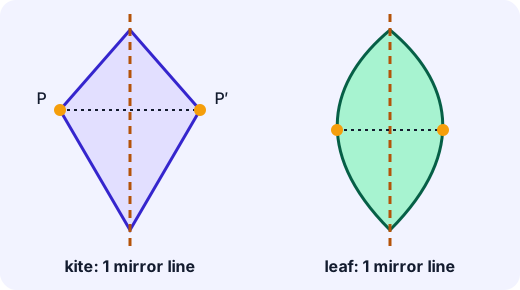
What a reflection does is simple and exact:
- Every point is sent to a point on the opposite side of the line.
- The point and its image are the same distance from the line.
- The segment joining them meets the line at a right angle.
In the picture, and are matching points: the line cuts the segment exactly in half, at a right angle.
Try it: Draw a big capital letter on paper and fold along the line you think is its mirror line. If the two halves land on each other, you were right. Which of A, B, E, H, F, K, M, S and T fold perfectly? (Use a simple, plain style of letters.)
Rotational symmetry
A shape has rotational symmetry if turning it about a fixed point (the centre) by less than a full turn puts it exactly on top of itself. A full turn does that for every shape, so it doesn't count.
The order of rotational symmetry is the number of different positions, including the starting one, in which the shape looks the same during one full turn. The smallest turn that works is the angle of rotation, and
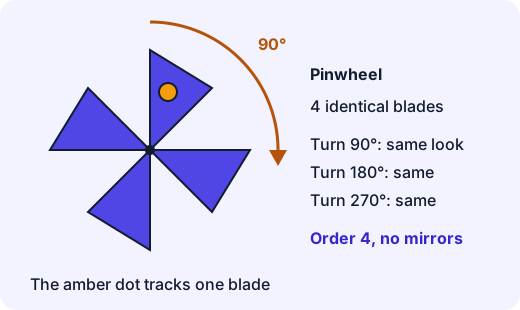
The pinwheel has four identical blades. Turn it , or and it looks the same, so its order is 4 and . The amber dot in the picture is the proof: it moves, but the shape does not change.
Example. A wheel has 9 identical spokes spaced evenly. Its order is 9, and the smallest turn that leaves it looking the same is .
Example. A shape that looks the same after has order .
A shape can have rotational symmetry without any mirror line. The pinwheel's blades all curve the same way. Flip it over a line and the blades curve the wrong way, so it doesn't match. Letters like S, N and Z have the same property: they look the same upside down (a half turn, order 2), but no mirror line works.
Misconception. "Every shape with rotational symmetry must have a line of symmetry, and every shape with a line must have rotational symmetry." Neither is true. The pinwheel and the letter Z have turns but no mirror lines. An isosceles triangle (two equal sides, one different) has one mirror line but no turn that works.
Regular polygons
A regular polygon has equal sides and equal angles. A regular polygon with sides has exactly lines of symmetry and rotational symmetry of order .
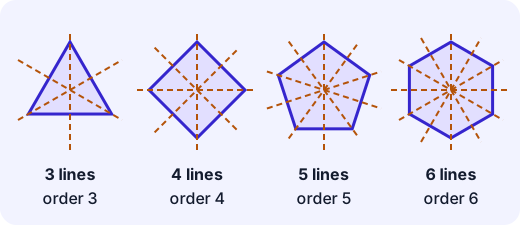
Shape Lines of symmetry Order Smallest turn Equilateral triangle 3 3 Square 4 4 Regular pentagon 5 5 Regular hexagon 6 6 Circle infinitely many infinite (any turn) any angle Other shapes you know sit between these:
Shape Lines Order Rectangle (not a square) 2 2 Rhombus (not a square) 2 2 Parallelogram (no right angle, unequal sides) 0 2 Kite (not a rhombus) 1 1 Isosceles triangle (not equilateral) 1 1 Scalene triangle 0 1 An order of 1 simply means "no turn other than the full turn works."
Notice something: for each shape above that has both kinds, the number of lines equals the order. A shape with mirror lines (when is 2 or more) also has rotational order : reflecting over one line and then over the next is a turn.
Counting every symmetry
Think of each "way to fit a shape onto itself" as one symmetry, counting the do-nothing move too. A square has 4 turns (, , , ) and 4 reflections, so 8 symmetries in all. A regular hexagon has . In general a regular -gon has .
Designing with symmetry
Rangoli, kolam, jaali screens, floor tiles and block prints all begin from one small motif, repeated by symmetry.
- Draw a motif in one wedge of the circle.
- For order rotation, repeat it times around the centre, each copy turned by .
- If you also want mirror lines, flip the motif to make a mirrored partner in each wedge.
With 6 motifs and no flipping you get a six-bladed swirl (order 6, no lines). Flip each motif as well and you get a snowflake or lotus pattern (order 6, 6 lines). Choosing whether to flip changes the character of the design.
Misconception. "The Z shape (and the letter N) isn't symmetric at all." It is: a half turn about its centre brings it back onto itself. Symmetry is not only mirrors.
Example: symmetry in a word. In plain capital letters, M and O each have a vertical mirror line, so the word MOM has one too: a vertical line through the middle O. The word DAD does not. The mirror image of a D is a backwards D, so the reflection of DAD is not DAD, even though the A on its own is fine. Check the whole shape, not just one part.
Summary
- A shape is symmetric when a change leaves it looking exactly the same.
- Reflection symmetry: a mirror line, and matching points equally far on opposite sides.
- Rotational symmetry: the order counts the matching positions in one full turn; the smallest turn is order.
- A regular -gon has lines and order . Shapes can have turns without lines, or lines without turns.
- Symmetric designs come from one motif repeated by rotation and reflection.
Lab
Symmetry detective
Seven shapes, each with a mirror-line slider and a turn slider. Drag them to test, count the lines of symmetry and the order of rotation, and check your answers.
Your goals
- Use the mirror slider to find every line of symmetry of each shape.
- Use the turn slider to find every turn that fits, and work out the order.
- Get the number of lines and the order right for all seven shapes.
The interactive lab opens once you register. Register to do this.
Quick check
Symmetry check
Eight questions on mirror lines and turns. Sketch the shape if it helps.
1.How many lines of symmetry does a regular hexagon have?
Answer with a number
2.What is the order of rotational symmetry of a regular pentagon?
Answer with a number
3.In plain capital letters, which one has rotational symmetry (a half turn works) but no line of symmetry?
- A
- H
- Z
- T
Choose one
4.Which of these shapes have rotational symmetry (order 2 or more)? Pick all that apply.
- Rectangle that is not a square
- Parallelogram with no right angle and unequal sides
- Isosceles triangle with exactly two equal sides
- Regular hexagon
- Kite that is not a rhombus
Choose all that apply
5.A stop sign is a regular octagon. What is the smallest turn, in degrees, that makes it look the same?
Answer with a number
6.A rangoli has rotational symmetry of order 5. What is its angle of rotation, in degrees?
Answer with a number
7.Match each shape to its number of lines of symmetry.
- Square
- Parallelogram with no right angle and unequal sides
- Isosceles trapezium
- Regular pentagon
Match each to: 0 lines · 5 lines · 4 lines · 1 line
8.Which statement about reflecting a shape in a mirror line is correct?
- Each point and its image are the same distance from the mirror line, on opposite sides.
- The mirror line must pass through a corner of the shape.
- The image is the shape turned by 180 degrees.
- The image is larger than the shape.
Choose one
Answering and checking are for registered learners. Register to do this.
Quick check
New puzzles with symmetry
Use mirror lines and turns in situations you have not seen before.
1.A paper pinwheel has 4 identical blades, and all the blades curve clockwise. How many lines of symmetry does it have?
Answer with a number
2.A cycle wheel has 36 identical spokes spaced evenly. What is the smallest turn, in degrees, that leaves the spokes looking the same?
Answer with a number
3.Written in plain capital letters, which word has a vertical line of symmetry running down its middle?
- DAD
- BOB
- MOM
- NUN
Choose one
4.Count every way to fit a square exactly onto its own outline, counting the do-nothing move, the turns and the reflections. How many are there?
Answer with a number
Answering and checking are for registered learners. Register to do this.
Your turn
Explain and design with symmetry
Write your answers in your own words. Sketch on paper if it helps and describe the sketch in words.
- A friend says "any shape with a line of symmetry also has rotational symmetry". Give a shape that proves the claim wrong, say how many lines and what order it has, and explain how you know.
- Describe the symmetry of a regular hexagon in full: how many lines, what order, and the smallest turn. Explain why the angle comes from .
- Design a rangoli or tile pattern with rotational symmetry of order 6 and no lines of symmetry. Describe your motif and how you would repeat it. Then say what you would change to give the pattern 6 mirror lines as well.
How it's judged
- Counterexample and reasoning
- Regular hexagon
- Designing the pattern
Writing and submitting your answer is for registered learners. Register to do this.
Like what you see?
Register for free to answer the quick checks, do the activities and save your work. Your work is saved on your device and syncs to your account.