Unit 15
Surface area and volume
Unfold boxes and prisms into nets to find the paper that wraps them, then count the cubes that fill them, even with half-unit edges.
Read
Wrap it, then fill it
Before Diwali, Imran wraps a gift: a box 5 cm long, 3 cm wide and 2 cm tall. How much wrapping paper does he need? Then his sister asks a different question: how many tiny 1 cm sugar cubes would fit inside it? These are two different questions about one box. The first is about the outside, the second about the inside. In short: surface area wraps; volume fills.
Nets: a solid laid flat
A net is what you get if you cut along some edges of a solid and unfold it flat so that every face is joined to another along an edge. Fold the net and you get the solid back.
Here is a net of Imran's box.
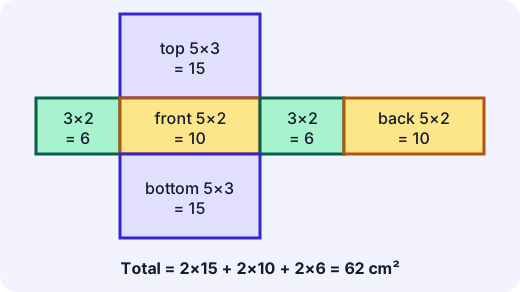
A box has six faces, in three matching pairs: top and bottom ( each), front and back ( each), left and right ( each).
Surface area
The surface area is the total area of all the faces of the solid, the area of its net. For the box:
In symbols, for a cuboid with length , width and height :
Check: . For a cube of edge every face is , so . A cube of edge 3 cm has .
Misconception. Forgetting faces you cannot see (the bottom, the back). Surface area counts every face. A good habit: write down the six (or five, or however many) faces in pairs and tick them off.
Nets of prisms and pyramids
A prism has two identical ends joined by rectangles. A triangular prism has 2 triangles and 3 rectangles. A 3-4-5 right triangle prism of length 6 cm unfolds like this:
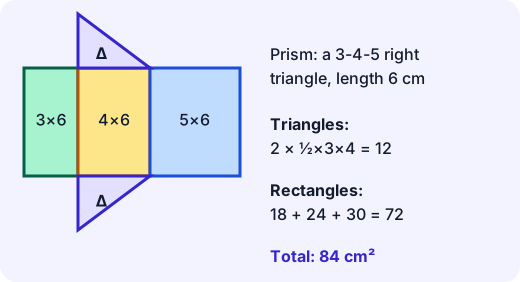
The triangles each have area . The rectangles are , and . So
A pyramid has one base and triangular faces that meet at a point. A square pyramid has 5 faces: a square and 4 triangles.
Example. A square pyramid has a base of side 6 cm. Each triangular face has base 6 cm and a slanting height of 5 cm (the height of the triangle, measured from its base up the face). Each triangle: . So .
Misconception. Using a solid's own "height" for the triangular faces of a pyramid. The triangle's height is the slant height, along the face, which is longer than the height of the pyramid straight up.
Volume
Volume is the amount of space inside a solid, measured by how many unit cubes fill it. A cuboid's volume is its base area times its height (the number of layers):
Imran's box holds one-centimetre cubes, so .
Edges that are not whole numbers
The formula still works when edges are fractions or decimals. Why? Use smaller cubes. Cut every 1 cm cube into 8 cubes of side cm, because each edge is split in two both ways (). Each small cube has volume .
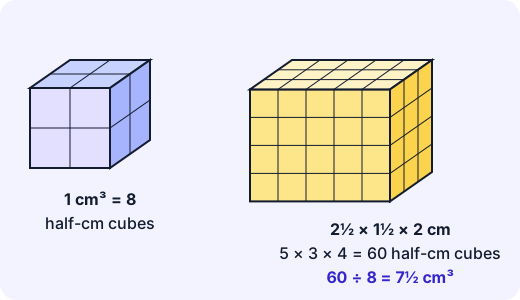
A box measures cm. In half-cm cubes that is cubes, each :
and multiplying the edges directly gives . Same answer, so for fractional edges too.
Example. A box is cm by cm by 4 cm. .
Example (missing edge). A box has volume and a base cm by cm. The base area is , so cm.
The "layers" idea gives volume for any prism: . The triangular prism above has .
Units, and what happens when you scale
Surface area is in square units (cm²) because it measures flat area. Volume is in cubic units (cm³) because it measures filling. Mixing them is the commonest slip.
Double every edge of a box. Take 2 × 3 × 4: , . The doubled box 4 × 6 × 8: , .
Edges Surface area Volume Original 52 24 Doubled 208 (4 times) 192 (8 times) Doubling makes areas 4 times and volumes 8 times as big. A bigger box needs much more filling than wrapping.
Misconception. "If the edges are doubled, the volume is doubled." It is times as big.
Two boxes can also have the same volume and different surface areas: and both hold 12 cm³, but their surface areas are 40 and 32 cm². A shape closer to a cube wraps its contents with less paper.
Summary
- A net is a solid unfolded flat; its area is the surface area.
- Cuboid: , . Count every face, in pairs.
- Prisms and pyramids: add up the areas of the faces in the net (use slant height for pyramid faces).
- Volume with fractional edges is still length × width × height; it fills with small cubes.
- Surface area is in cm², volume in cm³. Doubling edges gives 4 times the area and 8 times the volume.
Lab
The box workshop
Set the length, width and height of a box and watch its net, its surface area and its volume change. Then complete four tasks: match a given volume and surface area, find the box that wraps with the least paper, see what doubling does, and fill a box with half-centimetre cubes.
Your goals
- Read the surface area from the net and the volume from the box.
- Complete all four tasks.
The interactive lab opens once you register. Register to do this.
Quick check
Surface area and volume check
Eight questions on nets, surface area and volume. Lengths are in centimetres.
1.A box is 6 cm long, 4 cm wide and 3 cm tall. What is its surface area in cm²?
Answer with a number
2.A cube has edges of 5 cm. What is its surface area in cm²?
Answer with a number
3.A box is 4 cm by 2.5 cm by 3 cm. What is its volume in cm³?
Answer with a number
4.A box is 1½ cm long, 2 cm wide and 2½ cm tall. What is its volume in cm³?
Answer with a number
5.A box is 3 cm by 2 cm by 4 cm. In which units is its volume measured?
- cm
- cm²
- cm³
Choose one
6.A box has volume 15 cm³ and a base 2.5 cm by 3 cm. How tall is it, in cm?
Answer with a number
7.A square pyramid has a base of side 4 cm. Each of its 4 triangular faces has base 4 cm and slant height 7 cm. What is its total surface area in cm²?
Answer with a number
8.Match each solid to its number of faces.
- Cuboid
- Tetrahedron (triangular pyramid)
- Triangular prism
- Pentagonal prism
Match each to: 4 faces · 5 faces · 7 faces · 6 faces
Answering and checking are for registered learners. Register to do this.
Quick check
New puzzles with solids
Use nets, surface area and volume in situations that are new.
1.A cube of edge 3 cm and a bigger cube of edge 6 cm. How many of the small cubes would exactly fill the big one?
Answer with a number
2.A glass tank is 50 cm long, 40 cm wide and 30 cm tall. It has no lid, so it has a base and four sides. How many cm² of glass are needed?
Answer with a number
3.A water tank is 3/2 m long, 4/5 m wide and 1/2 m deep. 1 cubic metre holds 1000 litres. How many litres does the tank hold when full?
Answer with a number
4.A triangular prism has two triangle faces of area 10 cm² each, and three rectangular faces of area 12 cm², 15 cm² and 20 cm². What is its surface area in cm²?
Answer with a number
Answering and checking are for registered learners. Register to do this.
Your turn
Wrap versus fill
Write in your own words. Sketch a net if it helps and describe it.
- Explain the difference between surface area and volume using one box as your example (choose your own measurements). Say which units each uses and why they differ.
- A box measures cm by cm by cm. Explain, using half-centimetre cubes, why its volume is . How many half-cm cubes fill it?
- A friend says "if I double every edge of a box, its surface area and its volume both double". Show with a numeric example that this is wrong and say what really happens.
How it's judged
- Surface area versus volume
- Fractional edges
- Scaling
Writing and submitting your answer is for registered learners. Register to do this.
Like what you see?
Register for free to answer the quick checks, do the activities and save your work. Your work is saved on your device and syncs to your account.