Unit 12
Constructions
Draw circles, perpendicular bisectors and exact angles with only a compass and a ruler, and see why they must be right.
Read
Exact drawings with a compass
Long before anyone had a protractor, builders needed right angles. Ancient Indian ritual geometers marked out altars with stretched cords and pegs, and Egyptian rope-stretchers did the same with knotted ropes. A rope tied to a peg and swung around draws a perfect circle on the ground. From that single trick you can get straight lines that are exactly perpendicular and angles that are exactly , with no numbers measured at all. The tool on your desk, the compass, is that rope made small.
Drawing and constructing are different
A drawing is made by measuring: "mark 7 cm, then use a protractor to get ." It is only as good as your eyes and your tool, so it is approximate. A construction uses only a compass and an unmarked straightedge (a ruler used just to draw straight lines), following steps whose result is guaranteed exact by reasoning. A construction is exact; a drawing is approximate.
Circles and arcs
A circle is all the points that are the same distance from one point, the centre. That distance is the radius. A compass keeps the same distance as it turns.
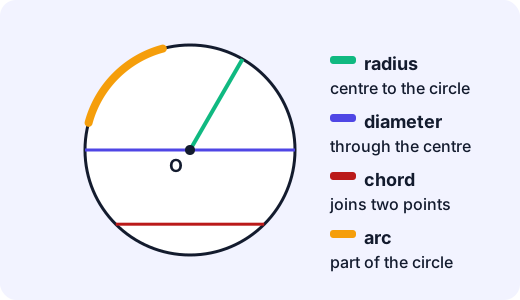
- A diameter passes through the centre; it is twice the radius.
- A chord joins any two points on the circle.
- An arc is a part of the circle. Constructions use arcs, not whole circles, to keep the page tidy. The pencil marks that remain are your construction lines: always keep them, since they are your proof.
Example. Draw a circle of radius 3 cm: put the point at the centre, open the compass until the pencil is 3 cm from the point (use the ruler once, to set it), then turn it all the way round. The diameter is 6 cm.
Perpendicular bisector
Given a segment , its perpendicular bisector cuts exactly in half and is at a right angle to it.
- Open the compass to more than half of . Draw an arc from that crosses above and below .
- Keep the same radius. Draw an arc from that crosses the first arc above and below.
- Draw a straight line through the two points where the arcs cross.
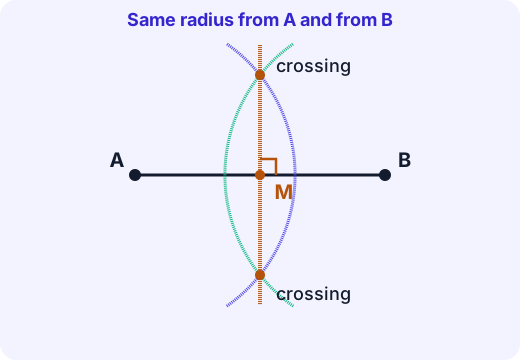
Why does it work? Each crossing point is the same distance from as from (both distances are the radius). A point that is equally far from and lies on the perpendicular bisector, and so does the other crossing. Two points make a line, so the line through them is the perpendicular bisector. Every point on it is the same distance from and . This is how you could find a spot for a well that is equally far from two villages.
Misconception. Using a radius less than half of . The arcs then never meet, and there are no crossing points. And changing the radius between the two arcs gives crossings that are not equally far from and , so the line is tilted and off-centre.
Constructing a angle
To make a angle at on a ray:
- Draw a ray from . With any radius, draw an arc from that crosses the ray at .
- Keep the same radius. Put the point on and draw an arc that crosses the first arc at .
- Draw the ray from through . Angle is .
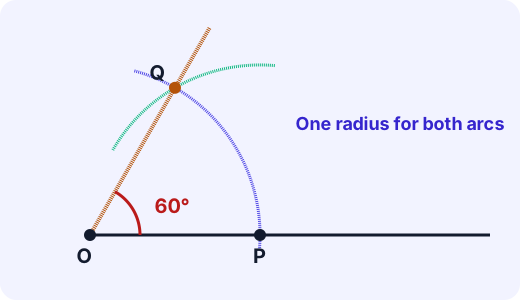
The reason: , and are all radii of the same size, so triangle has three equal sides. Such an equilateral triangle has three equal angles, and since the angles of a triangle add to , each is .
Other angles from these two tools
- : a perpendicular bisector meets the segment at a right angle. To get at a point, mark two points equally far either side of it on a line, then bisect the gap.
- : make a angle, then step another arc on from with the same radius. Two steps give .
- and : halve an angle. To bisect an angle, draw an arc from its vertex that crosses both arms, then arcs of equal radius from those two crossing points; the ray from the vertex through where those arcs meet splits the angle in two equal parts. Halving gives , halving gives .
Example. Construct : make , halve to get , halve again to get .
Tips for an accurate construction
- Use a sharp pencil and keep the compass firm so the radius doesn't slip.
- Never rub out construction arcs.
- Check with the facts you know: the perpendicular bisector should meet at and at the midpoint.
Summary
- A construction uses a compass and straightedge and gives exact results; a drawing made by measuring is approximate.
- Perpendicular bisector: equal arcs from both ends (radius more than half the segment), then join the crossings.
- : arcs of one radius from and from make an equilateral triangle. Bisect to halve an angle; step on to add angles.
Lab
Compass bench
Use a virtual compass. Part 1: construct the perpendicular bisector of AB by choosing a radius and drawing equal arcs from A and B. Part 2: construct a 60 degree angle with two arcs. Change the radius to see what goes wrong when the rule is broken.
Your goals
- Construct the perpendicular bisector of AB with equal arcs from A and B.
- Construct a 60 degree angle with arcs of the same radius from O and P.
The interactive lab opens once you register. Register to do this.
Quick check
Constructions check
Eight questions on compass-and-ruler constructions.
1.A circle has a diameter of 10 cm. What is its radius in centimetres?
Answer with a number
2.When you construct the perpendicular bisector of AB, what must be true of the compass radius?
- It must be more than half of AB, and the same for both arcs.
- It must be less than half of AB.
- It must be exactly the length of AB, and nothing else works.
- Any radius works, and it can change between arcs.
Choose one
3.A point P lies on the perpendicular bisector of AB. P is 7 cm from A. How far is P from B, in centimetres?
Answer with a number
4.The perpendicular bisector of AB crosses AB at M. AB is 9.4 cm long. How long is AM, in centimetres?
Answer with a number
5.At what angle, in degrees, does the perpendicular bisector of AB meet AB?
Answer with a number
6.Put the steps for constructing a 60° angle at O in the correct order.
- Draw an arc from O that crosses the ray at P.
- Draw a ray from O.
- Draw the ray from O through Q.
- With the same radius, draw an arc from P that crosses the first arc at Q.
Put these in order
7.Match each angle to a way of constructing it.
- 60°
- 90°
- 30°
- 120°
Match each to: a perpendicular bisector · arcs of the same radius from O and P · two 60° steps, one after the other · bisect a 60° angle
8.Why is the angle in the 60° construction exactly 60°?
- OP, OQ and PQ are all the same radius, so the triangle is equilateral and its angles are 60° each.
- Because it looks like 60° when you draw it carefully.
- Because the radius is always 6 cm.
- Because a protractor confirms it.
Choose one
Answering and checking are for registered learners. Register to do this.
Quick check
New puzzles with constructions
Use what constructions guarantee in new situations.
1.You construct a 60° angle, bisect it, and then bisect one of the halves. How many degrees is the angle you finish with?
Answer with a number
2.Two villages A and B are 12 km apart. A new well must be equally far from both. What is the shortest possible distance, in kilometres, from the well to A?
Answer with a number
3.Using only the 60° construction, the perpendicular, bisecting and adding angles, which of these angles can you NOT make?
- 15°
- 45°
- 120°
- 80°
Choose one
4.You construct a 60° angle with the compass set to 5 cm, so OP = OQ = 5 cm. How long, in centimetres, is the straight distance PQ?
Answer with a number
Answering and checking are for registered learners. Register to do this.
Your turn
Explain constructions
Write your answers in your own words. Describe or sketch the steps.
- Write the steps for constructing the perpendicular bisector of a segment , and say what each step makes sure of.
- A friend uses a compass radius that is smaller than half of . What happens, and why? Another friend changes the radius between the arc from and the arc from . What goes wrong?
- Explain why a angle made with a compass is exactly but one made by "judging by eye" is not. Use the idea of an equilateral triangle.
How it's judged
- Steps and what they guarantee
- What goes wrong
- Exactness of constructions
Writing and submitting your answer is for registered learners. Register to do this.
Like what you see?
Register for free to answer the quick checks, do the activities and save your work. Your work is saved on your device and syncs to your account.