Unit 11
Lines and angles
Use three simple angle facts to find angles you cannot measure, from a signpost to a crossing of two roads.
Read
Angles you can find without measuring
Two roads cross in the middle of a town. A surveyor measures one of the four angles at the crossing with a protractor: . A fence, a lamp post and a shop all stop her from measuring the other three. Does she need to go round to the other side? No. Once you know a few facts about angles, one measurement is enough to work out all four.
Angles and the turns they come from
An angle measures a turn. We count it in degrees: a full turn all the way round is , half a turn is , and a quarter turn is a right angle of . You already measured angles with a protractor. This unit is about reasoning to an angle instead of measuring it.
We often name an angle with a small letter, like or , or with three capital letters, like , where the middle letter is the point where the two arms meet (the vertex).
Diagrams are usually "not to scale". An angle may look like but be . Trust the facts and the numbers on the diagram, not your eyes.
Fact 1: angles on a straight line add up to
A straight line is half a turn, so any angles that sit on one side of a straight line, sharing a vertex, fill exactly .
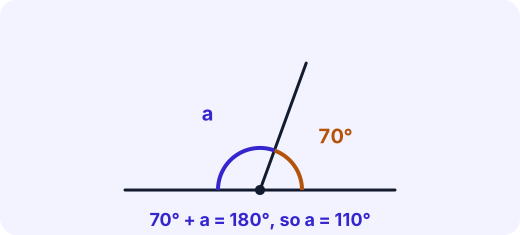
Example. One angle is . The other is .
Example. Three angles share a straight line: , and . Then , so .
Fact 2: angles around a point add up to
Go all the way round a point and you have made one full turn.
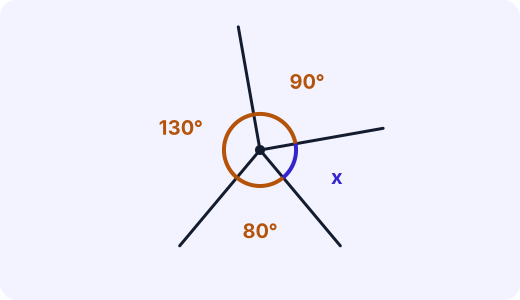
Example. The angles , and are shown, and one is missing. They add to , so .
Misconception. Mixing up 180 and 360. Ask: "Is it a straight line (half a turn) or all the way round (a full turn)?"
Fact 3: vertically opposite angles are equal
When two straight lines cross they make four angles. The two angles that face each other across the crossing point are vertically opposite angles. ("Vertically" has nothing to do with up and down. It refers to the vertex, the meeting point.)
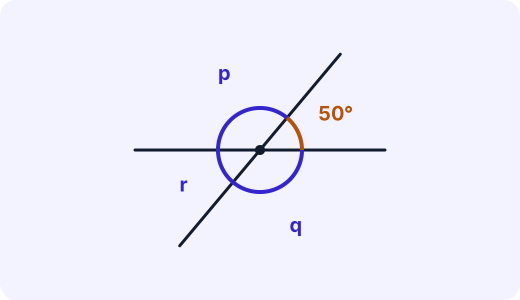
Look at the picture. Angle and the angle sit on a straight line, so . Angle and also sit on a straight line, so . So , which is opposite the angle, is as well. Finally is opposite and also sits on a straight line with , so .
This always works. If the angles in order round the crossing are , , , , then and , so . The reasoning, not the picture, is what makes it true for every pair of crossing lines.
Misconception. "Angles next to each other at a crossing are equal." No: neighbours add to . Only the pairs opposite each other are equal.
So the surveyor's crossing has angles , , and , going round. One measurement gave all four.
Using the facts with a letter
Often the angles are written as expressions. This is where equations help.
Example. Two angles on a straight line are and degrees. Find them. They add to : , so and , giving . The angles are and . Check: . ✓
Example. At a crossing, one angle is and the angle opposite is . Opposite angles are equal, so and .
A method for any angle puzzle
- Find what is given: lines that are straight, a point with angles all round it, or crossing lines.
- Pick the fact that connects a known angle to the one you want: straight line (), full turn () or opposite ().
- Write it as a sum or equation. Solve.
- Check the answer is sensible: an angle on a straight line next to cannot be bigger than .
You can often chain facts: use one to find an angle, then use that angle in the next step, as we did for , and .
Summary
Fact Rule Angles on a straight line add up to Angles around a point add up to Vertically opposite angles are equal Angles that make a right angle add up to Angle facts let you find angles you cannot measure, and the reasons tell you why the facts always work.
Lab
Angle detective
Part 1: turn one of two crossing lines and watch all four angles, then say which pairs are always equal. Part 2: six angle puzzles. Find the missing angle using angle facts (the pictures are not to scale) and type it in.
Your goals
- Turn the crossing lines to at least four different positions and spot which angles are always equal.
- Solve all six missing-angle puzzles.
The interactive lab opens once you register. Register to do this.
Quick check
Lines and angles check
Eight questions on angles on a line, around a point and where lines cross. Diagrams are not to scale.
1.Two angles lie on a straight line. One is 72°. How many degrees is the other?
Answer with a number
2.Four angles meet at a point. Three of them are 90°, 120° and 100°. How many degrees is the fourth?
Answer with a number
3.In the picture, find the angle p.
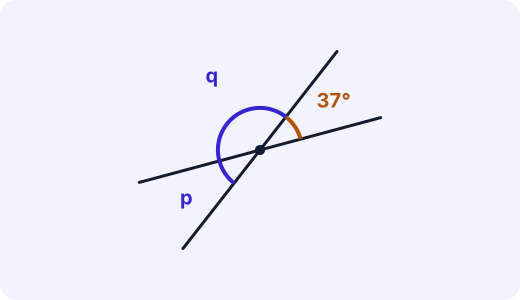
Answer with a number
4.In the same picture, find the angle q.
Answer with a number
5.Which statement about vertically opposite angles is always true?
- They are equal.
- They add up to 180°.
- They add up to 90°.
- They are equal only when the lines are perpendicular.
Choose one
6.Three angles on a straight line measure x, 2x and 3x degrees. Find x.
Answer with a number
7.Match each situation to the fact about its angles.
- angles on a straight line
- angles around a point
- vertically opposite angles
- two angles that together make a right angle
Match each to: add up to 360° · add up to 90° · are equal · add up to 180°
8.Two straight lines cross and one of the four angles is 90°. What are the other three?
- All three are 90°.
- Two are 90° and one is 180°.
- They can be any sizes.
- 45°, 45° and 90°.
Choose one
Answering and checking are for registered learners. Register to do this.
Quick check
New puzzles with angles
Use angle facts in new situations. Sketch the picture first.
1.At 5 o'clock the angle between the clock hands, measured the short way round, is 150°. What is the angle measured the long way round?
Answer with a number
2.Two straight roads cross. One angle between them is 3 times as big as the angle next to it. How many degrees is the smaller angle?
Answer with a number
3.Three straight lines pass through one point O and make six angles. Going round, the angles are a, b, c, a, b, c, because opposite angles are equal. If a = 35° and b = 70°, how many degrees is c?
Answer with a number
4.Four angles meet at a point. Which set of four angles CANNOT be the set?
- 90°, 90°, 90°, 90°
- 120°, 100°, 80°, 60°
- 150°, 100°, 70°, 50°
- 200°, 100°, 40°, 20°
Choose one
Answering and checking are for registered learners. Register to do this.
Your turn
Explain angle facts
Write your answers in your own words and include a sketch or a clear description. Diagrams are not to scale.
- Two straight lines cross. One of the angles is . Find the other three angles and name the fact you used for each.
- Explain why vertically opposite angles are always equal. Call two neighbouring angles at a crossing and and the angle opposite call . Use straight lines to show .
- A classmate says "The angle next to at the crossing must also be , because they look the same size in the picture." Explain what is wrong with this.
How it's judged
- Finding angles with facts
- Reasoning why opposite angles are equal
- Diagrams versus facts
Writing and submitting your answer is for registered learners. Register to do this.
Like what you see?
Register for free to answer the quick checks, do the activities and save your work. Your work is saved on your device and syncs to your account.