Unit 6
Fluency with decimals
Add, subtract, multiply and divide decimals with confidence, and know where the decimal point belongs and why.
Read
Where does the point go?
At a stationery shop Imran buys a notebook for ₹14.60, a ruler for ₹3.75 and a pencil for ₹0.80. The cashier's screen shows ₹18.15. Imran frowns. "That feels about right, but is it?" he asks. A fluent calculator does not just trust a screen or a rule. They also know roughly what the answer should be, and where every digit of it belongs.
This reading is about doing decimal arithmetic quickly and correctly with the standard written methods, and also about the checks that catch a misplaced point.
(Spoiler: the screen was wrong. The sum is ₹19.15. We will see how to know.)
Place value, again
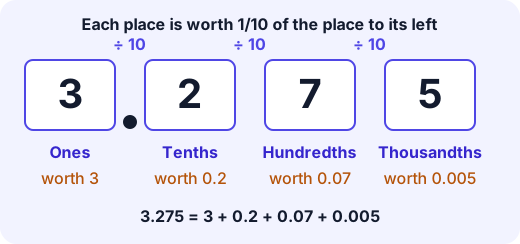
Every place is worth ten times the place to its right and a tenth of the place to its left. In the digits are worth , , and . All the methods below depend on this one fact.
Misconception. " because 45 is more than 5." A longer decimal is not a bigger one. Compare place by place after giving both the same number of decimal places: against . Now 45 hundredths is less than 50 hundredths.
Adding and subtracting: line up the points
Write the numbers in a column with the decimal points directly above each other. Fill empty places with zeros so every number has the same number of decimals. Then add or subtract as with whole numbers, working from the right and carrying or borrowing.
Example. .
  14.60
   3.75
 +  0.80
 ------
  19.15
Hundredths: . Tenths: , write 1 and carry 2. Ones: . Tens: . So the sum is , and the cashier's screen was wrong.
Example. . Write as :
  20.00
 - 7.38
 ------
  12.62
Misconception. Lining numbers up on the right edge, as with whole numbers. lined up on the right adds 6 tenths to 5 hundredths. The point, not the right edge, is the anchor.
Estimate first. is about . The answer 19.15 is close to 20; a value like 191.5 or 1.915 would be a red flag. An estimate catches big slips like these, but not small ones: the cashier's 18.15 is also "near 20". That is why we still do the careful column.
Multiplying: count the places at the end
Method. Ignore the points and multiply the numbers as whole numbers. Then put the point so that the answer has as many decimal places as the two factors have in total.
Example. .
- .
- has 1 decimal place and has 2, so the answer has .
- with three decimal places is .
Why does this work? and . So . Each decimal place is one division by 10.
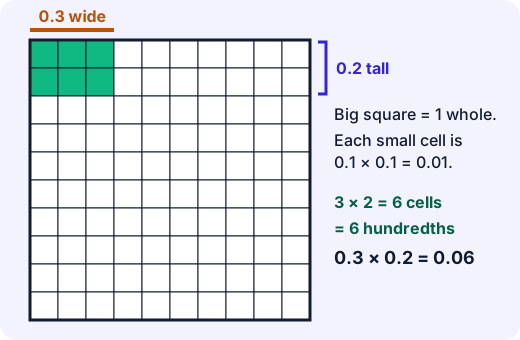
The grid shows the most famous trap. The big square is 1. A strip wide and tall covers 3 columns and 2 rows of small cells, which is 6 cells. Each small cell is , so the product is hundredths: , not .
Misconception. "Multiplying makes bigger." Not when both numbers are below 1: is smaller than either. You are taking a part of a part.
Estimate check. . The answer is close; or would not be.
Example (with zeros to fill). : ; decimal places; so . We must add a zero in front, because 56 thousandths is , not .
Dividing: make the divisor a whole number
Dividing by a whole number is long division with the point placed straight up in the answer:
To divide by a decimal, multiply the divisor and the dividend by the same power of 10 so that the divisor becomes a whole number. The quotient does not change, because both numbers are scaled equally (just as ).
Example. . Multiply both by 10: .
Example. . Multiply both by 100: .
Check by multiplying back: . ✓
Example. . Multiply both by 100: . A sense check: is a quarter, and each 1 holds 4 quarters, so 4.5 holds quarters.
Misconception. "Only move the point in the divisor." If you turn into but leave alone you get , which is ten times too small.
Four habits of a fluent calculator
- Estimate before you start. Round each number to one or two non-zero digits.
- Use the right anchor: the point for and ; the total number of places for ; the divisor's places for .
- Check the size of your answer against the estimate.
- Check by the inverse. Add back to check a subtraction, multiply back to check a division.
Fluency is not speed for its own sake. When the arithmetic runs smoothly, your attention is free for the interesting part of the problem: what is being asked, and what the answer means.
Summary
- Add and subtract with decimal points aligned; fill gaps with zeros.
- Multiply as whole numbers, then give the answer as many decimal places as both factors have together.
- Divide by a decimal by scaling both numbers by 10, 100, ... until the divisor is whole.
- Always estimate first and check the size of the answer; .
Lab
The point placer
Seven decimal problems with the digits done for you. For multiplication, choose how many decimal places the answer needs and watch the number change size. For division, shift the point in both numbers until the divisor is whole, then give the quotient.
Your goals
- Place the decimal point correctly in four products by counting places.
- Shift both numbers in three divisions until the divisor is whole, then give each quotient.
The interactive lab opens once you register. Register to do this.
Quick check
Decimal fluency check
Eight questions on computing with decimals. Estimate first, then calculate.
1.8.6 + 12.45 + 0.9 = ?
Answer with a number
2.15 − 6.47 = ?
Answer with a number
3.2.5 × 0.36 = ?
Answer with a number
4.25.2 ÷ 6 = ?
Answer with a number
5.What is 0.4 × 0.05?
- 0.2
- 0.02
- 0.002
- 0.45
Choose one
6.Which is the best estimate for 4.87 × 2.03?
- About 1
- About 10
- About 100
- About 7
Choose one
7.6.3 ÷ 0.09 = ?
Answer with a number
8.Put these from least to greatest.
- 0.5
- 0.054
- 0.405
- 0.45
Put these in order
Answering and checking are for registered learners. Register to do this.
Quick check
New puzzles with decimals
Use decimals in real situations. Work out what to do first, then compute carefully.
1.Three notebooks cost ₹24.75 each and a pen costs ₹8.50. Anita pays with a ₹100 note. How many rupees change does she get?
Answer with a number
2.Petrol costs ₹104.50 per litre. How much do 6.4 litres cost, in rupees?
Answer with a number
3.A strip of ribbon 12.6 m long is cut into pieces of 0.35 m. How many pieces?
Answer with a number
4.Ravi works out 4.2 × 0.3 and gets 12.6. Which is the best reason to doubt his answer without recalculating?
- 4.2 × 0.3 should be less than 4.2, because 0.3 is less than 1, so the decimal point has been left out.
- Multiplying decimals always gives a number with one decimal place.
- He should have lined up the decimal points as in addition.
- The answer must be a whole number.
Choose one
Answering and checking are for registered learners. Register to do this.
Your turn
Explain the decimal point
Write in your own words. You may sketch grids or write columns.
- A friend says because "3 times 2 is 6". Say what is wrong. Use a grid (describe it) or fractions to show the correct answer.
- Work out . Explain why multiplying both numbers by 10 does not change the answer. Check your result by multiplying back.
- A shop's screen says . Estimate the sum by rounding. Say what your estimate can and cannot tell you about the screen's answer. Then use a column to find the correct sum and the digit where the screen went wrong.
How it's judged
- Multiplying decimals
- Dividing by a decimal
- Estimating
Writing and submitting your answer is for registered learners. Register to do this.
Like what you see?
Register for free to answer the quick checks, do the activities and save your work. Your work is saved on your device and syncs to your account.