Unit 7
Ratios and rates
Compare quantities that grow together, from chai recipes to speeds, and use tables, number lines and unit rates to solve problems.
Read
Things that change together
Meena's grandmother makes chai for two. She uses 2 cups of milk and 3 cups of water. When the relatives arrive, there are ten people to serve. Meena pours in 4 more cups of milk and 4 more cups of water, because "the recipe says to add some". The tea tastes strangely watery.
What went wrong? To make more chai that tastes the same, the milk and the water have to grow together, in step. Adding the same amount to each is not in step. That idea is called a ratio.
What is a ratio?
A ratio compares two quantities. The chai recipe has milk : water , read "2 to 3". It says: for every 2 cups of milk there are 3 cups of water.
Order matters. is milk to water; would be water to milk, a different statement. Always say what is being compared.
Ratios come in two flavours:
- Part to part: milk to water, .
- Part to whole: milk to the whole drink, (because cups in all). Written as a fraction, milk is of the chai.
Example. In a class there are 12 boys and 18 girls.
- Boys to girls: , which simplifies to by dividing both numbers by 6.
- Boys to the whole class: .
Equivalent ratios: scale both numbers
Two ratios are equivalent if one is the other multiplied (or divided) by the same number. Like equivalent fractions, they describe the same relationship.
Milk 2 4 6 10 20 Water 3 6 9 15 30 Each column is scaled by 1, 2, 3, 5 and 10. This is a ratio table. Notice what you do to get from one column to another: the same multiplication for both rows.
For ten people you need five times the recipe: 10 cups of milk and 15 cups of water. Meena's mixture of 6 cups of milk and 7 cups of water is , which is not equivalent to , so it tasted different.
Misconception. "To keep the ratio, add the same amount to both." Adding 4 to each of gives , which is not equivalent to . Ratios stay the same when you multiply both parts by the same number, never when you add.
Sharing in a ratio
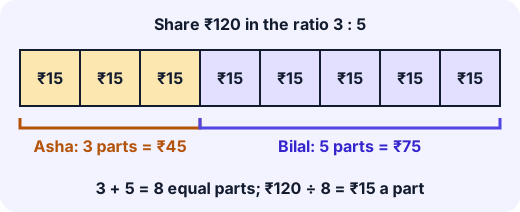
Example. Asha and Bilal share ₹120 in the ratio .
- Count the parts: .
- One part is .
- Asha gets and Bilal gets .
- Check: . ✓
Rates and unit rates
A rate is a ratio of two quantities with different units: kilometres and hours, rupees and kilograms, words and minutes. A unit rate is the rate for one of the second quantity.
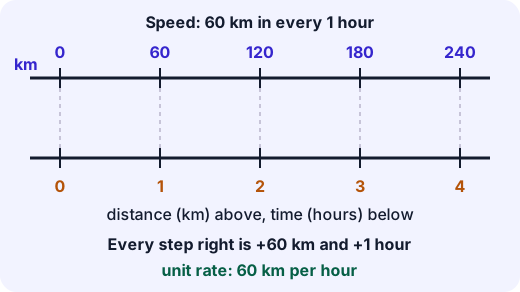
Example. A train covers 240 km in 4 hours. The unit rate is km per hour. On the double number line, every step of 1 hour goes with a step of 60 km.
With a unit rate, many questions become easy:
- How far in 7 hours? km.
- How long to go 150 km? hours.
Example (unit price). A shop sells 500 g of ragi flour for ₹45 and 750 g for ₹63. Which is better value?
- Small pack: rupees per 100 g.
- Large pack: rupees per 100 g.
The 750 g pack costs less for the same amount, so it is the better buy. Comparing 45 with 63 directly tells you nothing; you have to bring both to the same amount, such as per 100 g.
Three tools, one idea
Tool Best for How it works Ratio table Scaling up and down Multiply or divide both rows by the same number Double number line Seeing the pairs line up Equal steps on both lines Unit rate Comparing and many "how much for ?" questions Find the amount for 1, then multiply Example, all three. 3 notebooks cost ₹54. What do 7 cost?
- Unit rate: rupees for 1, then .
- Table: 3 → 54; 1 → 18; 7 → 126.
Another way. A rate can be written as a fraction: . Equivalent fractions give equivalent rates.
Watch for it. A part-to-part ratio is not a fraction of the whole. Milk : water does not mean milk is of the chai. The whole has parts, so milk is of it.
Check your thinking
- Is the same as ? (Yes: divide both by 2.)
- If you double only the milk in a chai recipe, is the ratio the same? (No: the ratio changes, the chai is stronger.)
- Which is faster: 150 words in 5 minutes, or 210 words in 7 minutes? (Both are 30 words per minute: equal speed.)
Summary
- A ratio compares two quantities; order matters.
- Equivalent ratios come from multiplying or dividing both parts by the same number, not adding.
- To share in a ratio, add the parts, find one part, then multiply.
- A unit rate is the amount for 1; it makes comparing and scaling simple.
Lab
The recipe mixer
Six mixing jobs, from chai to paint. Use the plus and minus buttons to set the amounts, then check that your batch has the same ratio as the recipe and the amount the job asks for. The last job starts with a batch where someone added instead of multiplying.
Your goals
- Make batches that are equivalent to the recipe ratio and match each job's amount.
- Fix a batch that was scaled by adding instead of multiplying.
The interactive lab opens once you register. Register to do this.
Quick check
Ratios and rates check
Eight questions on ratios, equivalent ratios and rates.
1.A class has 12 boys and 18 girls. What is the ratio of boys to girls in simplest form?
- 2 : 3
- 3 : 2
- 2 : 5
- 12 : 30
Choose one
2.3 : 4 = 12 : ?
Answer with a number
3.A bus travels 330 km in 6 hours at a steady speed. What is its speed in km per hour?
Answer with a number
4.₹180 is shared between two friends in the ratio 4 : 5. How many rupees does the friend with the larger share get?
Answer with a number
5.Rice is sold as a 2 kg pack for ₹150 or a 5 kg pack for ₹360. Which is the better value?
- The 2 kg pack
- The 5 kg pack
- They cost the same per kg
- You cannot tell without more information
Choose one
6.A paint mix uses 2 tins of red for every 3 tins of white. Bhavna wants more paint, so she adds 4 tins to each and uses 6 red : 7 white. What is wrong?
- Nothing. Adding the same amount keeps the ratio.
- 6 : 7 is not equivalent to 2 : 3. Both parts must be multiplied by the same number, for example 6 : 9.
- She should have added 4 to the red only.
- The ratio should have been 3 : 2.
Choose one
7.Match each ratio to an equivalent one.
- 2 : 3
- 5 : 2
- 1 : 4
- 3 : 5
Match each to: 15 : 6 · 8 : 12 · 9 : 15 · 3 : 12
8.4 pens cost ₹68 at the same price each. How many rupees do 7 pens cost?
Answer with a number
Answering and checking are for registered learners. Register to do this.
Quick check
New puzzles with ratios and rates
Use ratios and rates in situations that are new. Choose a table, number line or unit rate, whichever you like.
1.Zoya types 150 words in 5 minutes at a steady speed. How many words would she type in 12 minutes?
Answer with a number
2.A drink is made with 1 part concentrate to 5 parts water. How many litres of concentrate are in 3 litres of the finished drink?
Answer with a number
3.Tap A fills 12 litres in 3 minutes. Tap B fills 20 litres in 4 minutes. Which is faster?
- Tap A
- Tap B
- They are equally fast
Choose one
4.On a map, 1 cm stands for 5 km. Two towns are 7.5 cm apart on the map. How many kilometres apart are they really?
Answer with a number
Answering and checking are for registered learners. Register to do this.
Your turn
Explain ratios and rates
Write in your own words. Tables or sketched number lines are welcome.
- A friend says: "To make a bigger batch of the chai, add 2 cups of milk and 2 cups of water." Explain what is wrong. Give a correct bigger batch and show how you know its ratio matches.
- Shop A sells 6 pencils for ₹39. Shop B sells 10 pencils for ₹63. Which is the better price? Show your method and explain why you cannot decide just by comparing 39 with 63.
- Explain the difference between a ratio of two quantities and a unit rate, giving one example of each from daily life.
How it's judged
- Equivalent ratios
- Comparing prices
- Ratio versus rate
Writing and submitting your answer is for registered learners. Register to do this.
Like what you see?
Register for free to answer the quick checks, do the activities and save your work. Your work is saved on your device and syncs to your account.