Unit 5
Dividing fractions
Find out how many of one fraction fit inside another, and see why "flip and multiply" is not a magic trick.
Read
How many fit?
A tailor in Surat has a roll of ribbon 3 metres long. Each party favour needs a piece of a metre long. How many favours can she make?
You can probably see it without any rule. Each metre gives 4 pieces, so 3 metres give pieces. In symbols, .
Notice something odd. We divided, and the answer (12) is much bigger than what we started with (3). By the end of this reading you will know why that is not odd at all, and why a rule that sounds like a magic trick ("flip the second fraction and multiply") always works.
Division means "how many fit?"
There are two ways to think about :
- Sharing: split into equal groups. How big is each group?
- Measuring: how many copies of fit inside ?
Sharing a quantity into " of a group" does not make much sense. Measuring does. So for dividing by a fraction we use the measuring meaning:
Method 1: draw it with same-sized pieces
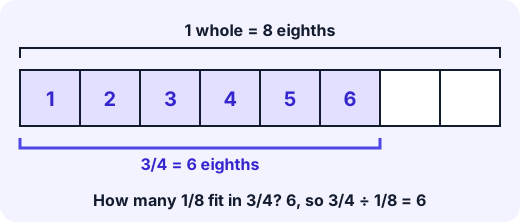
Cut one whole into eighths. Three quarters is the same as six eighths, so six pieces are shaded. Each shaded piece is one . Count them: 6. So
Example. . Write as . Now is 5 sixths and the divisor is 2 sixths. How many groups of 2 fit in 5? Two whole groups and half of another, so .
Once both fractions are written with the same denominator, the denominators are like units that can be ignored, and you are just dividing numerators: "5 sixths ÷ 2 sixths = 5 ÷ 2".
When the divisor does not fit exactly
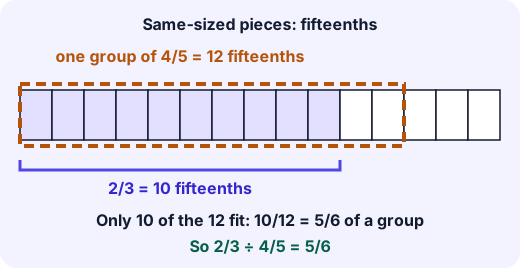
Now . Use fifteenths, because :
So the question is "how many groups of 12 fit in 10?" Not even one whole group. Only of a group fits:
Misconception. "Dividing always makes the answer smaller." That is true when you divide by a number greater than 1 (sharing 6 sweets among 3 children). It is false when you divide by a number less than 1: the pieces you are counting are smaller than 1, so more of them fit. is bigger than 3. And is smaller than 1 because the group (four fifths) is bigger than what we have (two thirds).
A quick check you can always make: if the divisor is less than 1, the answer is bigger than the dividend; if the divisor is more than 1, it is smaller.
Method 2: where "multiply by the reciprocal" comes from
The reciprocal of a fraction is what you get by turning it upside down. The reciprocal of is ; the reciprocal of 5 is . A number times its reciprocal is always 1.
Look at the ribbon again. How many s fit in 1 whole? Four. So how many fit in 3 wholes? . Dividing by is the same as multiplying by 4, which is the reciprocal.
The same works for any fraction. How many fit in 1? Cut 1 into parts: each part is , and is of them. So one group takes parts out of , and groups fit in 1. (Check: in 1: groups. Two full groups use , and is left, which is of a group. Yes.)
So the number of s that fit in is times as many as fit in 1:
Only the second fraction (the divisor) is turned upside down. Flip the wrong one and you answer a different question.
Example. . It matches the picture.
Example. . It matches the fifteenths.
Example, with a mixed number. . Change to first: . Check: two groups of make . ✓
Words, and the other direction
Division and multiplication undo each other. If a rectangle of area is m wide, its length is
because . In general is the number that, multiplied by , gives .
Example (a rate). A cyclist covers km in hour. How far does she go in a whole hour? A whole hour holds quarter-hours, so she covers times as far:
Her speed is km/h.
Which method when?
Situation Handy method Small, friendly fractions Draw it, or use a common denominator Big or awkward fractions Multiply by the reciprocal You are not sure the answer is sensible Estimate: is the divisor above or below 1? Whatever the method, finish by asking: does the size of my answer make sense?
Summary
- with fractions asks "how many s fit in ?"
- With a common denominator, .
- Dividing by a fraction is multiplying by its reciprocal, because copies of fit in 1.
- Dividing by a number less than 1 gives a bigger result.
- Only the divisor is flipped.
Lab
How many fit?
Each problem shows a bar cut into equal pieces with the first fraction shaded. Take groups the size of the second fraction until the shaded part is used up, then type how many groups you took, including any part of a group. Afterwards the lab shows the same answer from the reciprocal shortcut.
Your goals
- Solve all six fraction divisions by taking groups on the bar.
- Notice that the picture and the "multiply by the reciprocal" shortcut always agree.
The interactive lab opens once you register. Register to do this.
Quick check
Dividing fractions check
Eight questions on dividing by fractions. Draw a bar if it helps.
1.A 3 metre ribbon is cut into pieces that are 1/4 metre long. How many pieces?
Answer with a number
2.3/4 ÷ 1/8 = ?
Answer with a number
3.What is 2/3 ÷ 4/5?
- 5/6
- 8/15
- 6/5
- 15/8
Choose one
4.5/6 ÷ 1/3 = ? Give your answer as a decimal.
Answer with a number
5.Which of these equal 6 ÷ 2/3? Choose all that apply.
- 6 × 3/2
- 9
- 6 × 2/3
- 4
- 18/2
Choose all that apply
6.Without working it out fully, which division has an answer greater than 5?
- 5 ÷ 1/2
- 5 ÷ 2
- 5 ÷ 1
- 5 ÷ 3/2
Choose one
7.One batch of parathas uses 3/4 cup of flour. Rani has 4 1/2 cups. How many batches can she make?
Answer with a number
8.Match each division to its answer.
- 1/2 ÷ 1/4
- 3/4 ÷ 1/2
- 1/4 ÷ 3/4
- 2 ÷ 1/2
Match each to: 1/3 · 4 · 2 · 1 1/2
Answering and checking are for registered learners. Register to do this.
Quick check
New puzzles with fraction division
Use fraction division in situations that are new. Decide first what is being divided by what.
1.A rope 3 1/2 m long is cut into pieces of 7/8 m each. How many pieces are there?
Answer with a number
2.A rectangular mat has area 3/4 square metres and is 1/2 m wide. How long is it, in metres? Give a decimal.
Answer with a number
3.Which story is described by 3/4 ÷ 1/2?
- How many half-litre bottles can be filled from 3/4 of a litre of juice?
- What is half of 3/4 of a litre of juice?
- What is 3/4 of a half-litre bottle?
- How much juice does each of 3/4 of a child get from half a litre?
Choose one
4.A snail crawls 3/8 m in 1/4 hour at a steady pace. How many metres does it crawl in one hour? Give a decimal.
Answer with a number
Answering and checking are for registered learners. Register to do this.
Your turn
Explain dividing fractions
Write in your own words. Describe or sketch bars where it helps.
- A friend says: "Division always makes things smaller, so must be less than 3." Work out and explain, with a real situation, why the friend's rule fails.
- Work out in two ways: (a) with a picture or common denominators, (b) by multiplying by a reciprocal. Explain why the two answers must agree.
- Explain why dividing by is the same as multiplying by . Start from "how many fit in 1?".
How it's judged
- Dividing by a number less than 1
- Two methods agree
- Why the reciprocal works
Writing and submitting your answer is for registered learners. Register to do this.
Like what you see?
Register for free to answer the quick checks, do the activities and save your work. Your work is saved on your device and syncs to your account.