Unit 9
Expressions with letters
Use a letter to stand for a number, write rules like a taxi fare as expressions, and see why 3(x + 4) and 3x + 12 are the same.
Read
A letter that stands for a number
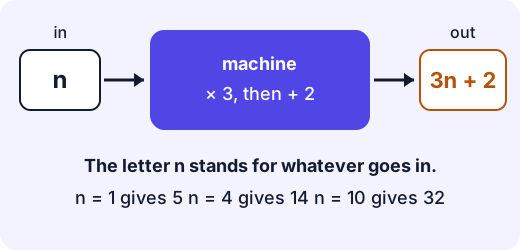
A taxi in Pune charges ₹50 just to start the meter, plus ₹12 for every kilometre. A 3 km ride costs rupees. An 8 km ride costs rupees. You could work out the fare for every possible trip one at a time, or you could write the rule once and let it handle them all. To write the rule you need a symbol for "however many kilometres": a letter.
Variables and expressions
A variable is a letter that stands for a number that can change, or one we don't know yet. If is the number of kilometres, the fare in rupees is
That is an expression: a mix of numbers, letters and operations, with no equals sign. It is not a statement that can be true or false. It is a recipe for getting a number once you know .
Some habits make expressions short:
- means . We leave out the times sign between a number and a letter.
- is written , and is written .
- The number in front of a letter is its coefficient (12 in ). A number on its own, like 50, is a constant. The parts joined by plus and minus signs are the terms: has two terms.
Writing an expression from words is a skill of its own:
In words Expression 7 more than 7 less than 7 times shared equally among 7 5 more than twice Watch the last row. "Twice " is , and then we add 5. It is not .
Evaluating an expression
To evaluate an expression, replace each letter by its number (we say substitute) and then follow the usual order of operations: brackets, powers, multiplication and division, then addition and subtraction.
Example. Evaluate when . Replace by 5: .
Example. Evaluate when . Brackets first: . Then .
Example. Evaluate when . The power applies to only: , so . Compare with : . Brackets change the answer.
Misconception. " means 3 and side by side, so when it is 35." No: means , which is 15. And is a different expression again (8 when ).
Equivalent expressions
Two expressions are equivalent if they give the same value for every number you could put in the letter. Some equivalences you already believe:
- . Two of something is twice that thing.
- . Four 's and two more 's make six 's. We can add like terms (terms with the same letter part). We cannot merge unlike terms: stays as it is.
The most useful one is the distributive law, which links multiplying and adding:
Why is it true? Picture a rectangle 3 units tall and units wide. Its area is . Cut it into a part wide and a part 4 wide: the areas are and . The total area is the same however you slice it.
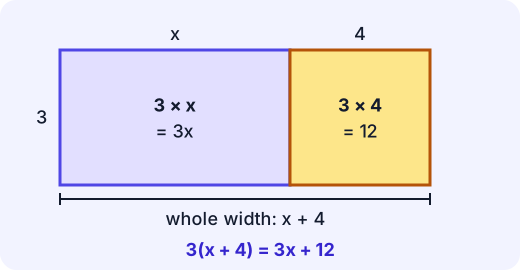
So . The 3 multiplies every term inside the brackets.
Example. Expand . and , so .
Example. Expand . and , so . The minus sign comes along.
The law also runs backwards. This is called factorising: has a factor 3 in both terms, so . You can check by expanding the answer again.
Misconception. "." Only the first term got multiplied. Test it with : the left side is , the right side is . They disagree, so the expressions are not equivalent.
How to test whether two expressions are equivalent
Substituting numbers is a quick detective tool, but it works in one direction only.
- One disagreement proves they are different. If and give 5 and 0 when , you are done: not equivalent.
- Agreement proves nothing yet. Both and equal 8 when , but they are not equivalent. Likewise and both equal 4 at , yet at they give 6 and 9.
A good test uses several different values, including 0, a big number and a negative one if the problem allows it. To be sure two expressions are equivalent, you use a reason (like the area picture or the distributive law), and the numbers just support it.
Back to the taxi
The fare also tells a story: a fixed charge (the constant 50) and a charge that grows with distance (the term ). If two friends share a ride equally, each pays . Using the distributive law (dividing each term by 2), that equals . For an 8 km ride that is rupees each, which is half of 146, as it should be. Equivalent forms let you pick the one that is easiest to use.
Summary
- A variable is a letter standing for a number that can change or is unknown.
- An expression has no equals sign. Evaluate it by substituting and following the order of operations.
- Equivalent expressions agree for every value. Use like terms and the distributive law to make them.
- One counterexample shows two expressions differ; matching values do not prove they are equivalent.
Lab
Same or different?
Each round shows two expressions. Slide x to try different numbers and watch both values. Decide whether the two expressions are equivalent (equal for every x) or different. To say "different", slide to a value where they disagree. To say "equivalent", try at least five different values first.
Your goals
- Sort all seven pairs of expressions into equivalent and different.
- Find a value of x where the two sides disagree for every pair that is different.
The interactive lab opens once you register. Register to do this.
Quick check
Expressions check
Eight questions on writing, evaluating and rewriting expressions.
1.Which expression means "5 more than twice a number n"?
- 2n + 5
- 5n + 2
- 2(n + 5)
- 7n
Choose one
2.Evaluate 3x + 4 when x = 6.
Answer with a number
3.Evaluate 4(y − 1) when y = 9.
Answer with a number
4.Which expression is equivalent to 3(x + 4)?
- 3x + 4
- 3x + 12
- x + 12
- 3x + 7
Choose one
5.Which of these equal 4x + 2x for every value of x? Choose all that apply.
- 6x
- 2(3x)
- 8x
- 4x + 2
Choose all that apply
6.Match each expression to the words that describe it.
- n + 7
- 7n
- n − 7
- n / 7
Match each to: 7 more than n · 7 less than n · 7 times n · n divided by 7
7.Mina says 5 + 3x is the same as 8x. Which of these values of x would NOT show that she is wrong?
- x = 0
- x = 1
- x = 2
- x = 3
Choose one
8.A phone plan costs ₹199 plus ₹3 for every extra GB, so g extra GB cost 199 + 3g rupees. How many rupees for 14 extra GB?
Answer with a number
Answering and checking are for registered learners. Register to do this.
Quick check
New puzzles with expressions
Use letters to describe patterns and situations you have not met before.
1.A row of squares is made from matchsticks. One square needs 4 sticks. Each further square joined on the end needs 3 more sticks. How many sticks does a row of 12 squares need?
Answer with a number
2.Aarav buys 5 notebooks at ₹n each and 5 pens at ₹p each. Which expression gives the total cost in rupees?
- 5n + p
- 5(n + p)
- 5np
- n + p + 10
Choose one
3.A garden is 6 m wide and (x + 5) m long, so its area is 6(x + 5) square metres. Find the area when x = 7.
Answer with a number
4.Three of these expressions are equivalent to 4(2m + 3). Which one is NOT?
- 8m + 12
- 2(4m + 6)
- 8m + 3
- 4 × 2m + 4 × 3
Choose one
5.Evaluate 3a² − a when a = 4.
Answer with a number
Answering and checking are for registered learners. Register to do this.
Your turn
Explain letters and equivalence
Answer in your own words. Use numbers, a drawing or a short description to support your points.
- A friend says " and mean the same thing." Evaluate both when and explain what each expression actually says.
- Show that in two ways: with a rectangle (describe or sketch it), and by testing a value of .
- Neel tests and at , sees 4 on both sides, and says they are equivalent. Explain what is wrong with his reasoning and what he should do.
How it's judged
- Meaning of an expression with a letter
- Distributive law
- Testing for equivalence
Writing and submitting your answer is for registered learners. Register to do this.
Like what you see?
Register for free to answer the quick checks, do the activities and save your work. Your work is saved on your device and syncs to your account.