Unit 8
Percent problems
Use percent as a rate per 100 to find a part, find a whole and make sense of discounts, marks and changes.
Read
Per hundred
A shop in Jaipur has a kurta tagged ₹850 with the sign "20% off". Next door, the same kurta costs ₹800 with a sign saying "15% off". Which shop is cheaper? You cannot decide until you know what "20% off" really takes away. By the end of this reading you will be able to work it out in your head.
Percent means "per hundred"
The word percent comes from the Latin per centum, "for each hundred". So means "35 for each 100", or the fraction , or the decimal .
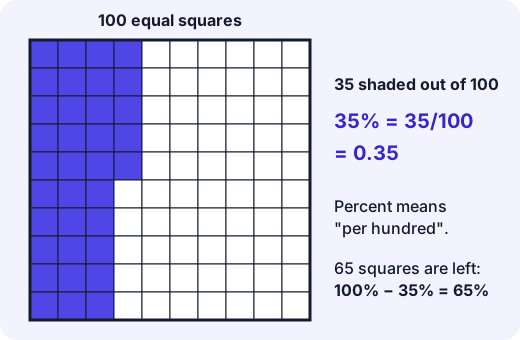
Percent is a rate: a comparison with 100 as the base. Because 100 is a common base, we can compare very different amounts. "15 out of 20 students" and "45 out of 60" both mean , and so do "3 out of 4".
Percent Fraction Decimal 50% 0.5 25% 0.25 75% 0.75 10% 0.1 1% 0.01 150% 1.5 Percentages above 100% are fine: they mean more than the whole. A price that goes up to 150% of the old price is one and a half times as much.
Three kinds of percent problem
Every percent problem has three numbers: the whole (the base, which is 100%), the part, and the percent. One is missing.
Missing Question Example Part What is 35% of 240? whole 240, percent 35 Whole 18 is 30% of what? part 18, percent 30 Percent 15 is what percent of 60? part 15, whole 60 1. Finding a part: build from 10% and 5%
The easiest percent to find is : divide by 10. From there, 5% is half of that, and 1% is one-tenth.
Example. of .
- .
- .
- .
- .
Or in one step: .
Back to the kurta. of ₹850: , so . The sale price is . The other shop: of ₹800 is , so ₹680. The prices are exactly equal!
2. Finding the whole: use a double number line
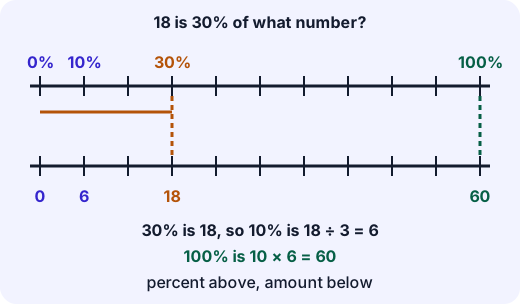
Example. 18 is 30% of a number. What is the number?
- is 18, so is .
- The whole is , which is .
- Check: of . ✓
In general: divide the part by its percent to get 1%, then multiply by 100. Here for each 1%, and .
Misconception. "18 is 30%, so the whole is " or "". Adding numbers that measure different things (an amount and a percent) makes no sense. The whole is bigger than the part, and the picture tells you by how much.
3. Finding the percent
Example. 15 out of 60 as a percent. Write the fraction , so it is . More generally, .
Example. A plant grows from 40 cm to 50 cm. The increase is 10 cm. As a percent of the original 40 cm: . A percent change is always measured against the starting amount.
The base matters
Misconception. "Up 20% and then down 20% brings me back." Start with ₹100. Up 20%: ₹120. Now down 20% of ₹120, which is ₹24: ₹96. You do not get back to ₹100, because the second 20% is a percent of a different base.
The same trap catches "50% off, then another 50% off". Take ₹400. First half: ₹200. Second half is half of ₹200, so ₹100. The shopkeeper took off 75% in total, not 100%.
Always ask: percent of what?
Percent in the real world
- Discounts: the sale price is of the old price. 20% off means you pay 80%.
- Taxes: ₹1,000 plus 18% GST costs of ₹1,000, which is ₹1,180.
- Marks: 42 out of 60 is .
- Statistics: "28% of voters" is meaningless without the group it is a percent of.
Summary
- Percent means "per hundred"; .
- To find a part, build from 10% and 5%, or multiply by the percent as a fraction.
- To find the whole, find 1% (or 10%) from the part, then scale up to 100%.
- A percent always refers to a base. Percent changes are measured from the starting amount.
Lab
The percent bar
A bar stands for the whole, cut into 20 pieces of 5% each. Shade the right number of pieces, read what each piece is worth, and solve six problems: finding a part, finding a whole and finding a percent.
Your goals
- Shade the right percent of the bar and find the part in two problems.
- Find the whole from a part and a percent in two problems.
- Find the percent from a part and a whole in two problems.
The interactive lab opens once you register. Register to do this.
Quick check
Percent problems check
Eight questions on finding the part, the whole and the percent.
1.What is 45% of 360?
Answer with a number
2.18 out of 72 is what percent?
Answer with a number
3.A bag marked ₹640 is sold at 15% off. How many rupees do you pay?
Answer with a number
4.24 is 30% of a number. What is the number?
Answer with a number
5.Which fraction is equal to 40%?
- 4/10
- 1/40
- 4/100
- 40/10
Choose one
6.A price of ₹100 goes up by 20%. Then the new price goes down by 20%. What is the final price?
- ₹100
- ₹96
- ₹104
- ₹120
Choose one
7.Which statements are true? Choose all that apply.
- 50% of 80 is 40.
- 25% of a number is a quarter of it.
- 10% of 50 is 50.
- 150% of 20 is 30.
- A percent can never be more than 100.
Choose all that apply
8.Match each percent to its fraction.
- 25%
- 20%
- 75%
- 5%
Match each to: 1/5 · 3/4 · 1/20 · 1/4
Answering and checking are for registered learners. Register to do this.
Quick check
New puzzles with percent
Use percent in new situations. Ask yourself "percent of what?" each time.
1.A restaurant bill is ₹1,250 before tax. Tax is 18% of the bill. What is the total to pay, in rupees?
Answer with a number
2.Meera scored 42 marks, which is 70% of the total marks. What is the total?
Answer with a number
3.A jacket costs ₹400. The shop takes 50% off, then takes another 50% off the new price. What is the final price in rupees?
Answer with a number
4.A town's population falls from 8,000 to 6,000. By what percent has it fallen?
Answer with a number
Answering and checking are for registered learners. Register to do this.
Your turn
Explain percent
Write in your own words. Use a number line, a bar or a table where it helps.
- A phone is priced at ₹20,000. Shop A takes 20% off. Shop B takes 10% off, then takes a further 10% off the new price. Which is cheaper, and by how much? Explain why the two shops are not the same.
- A recipe says 30% of a mixture is flour, and the flour weighs 270 g. Find the total weight. Explain the steps by thinking of 10%, and check by taking 30% of your answer.
- In your own words, explain why "percent is a rate per 100", and why a percent change always has to say what it is a percent of.
How it's judged
- Comparing discounts
- Finding the whole
- Meaning of percent
Writing and submitting your answer is for registered learners. Register to do this.
Like what you see?
Register for free to answer the quick checks, do the activities and save your work. Your work is saved on your device and syncs to your account.