Unit 10
Equations and inequalities
Treat an equation as a balance, undo one operation at a time to find the unknown, and graph inequalities that have many answers.
Read
An equation is a balance
Ananya pays ₹8 for a mango juice and counts what is left: ₹15. How much did she have before she bought it? You can probably guess: ₹23. But let's slow down and see how you know, because the same thinking solves puzzles too big to guess.
From expressions to equations
If is the amount she started with, the story says
This is an equation: two expressions with an equals sign between them. Unlike an expression, an equation can be true or false. If then , not 15, so the equation is false. A solution is a value of the letter that makes the equation true. Here works because .
The balance
Picture a see-saw with a box of unknown weight and a 5 kg block on the left, and a 12 kg block on the right. It balances, so .
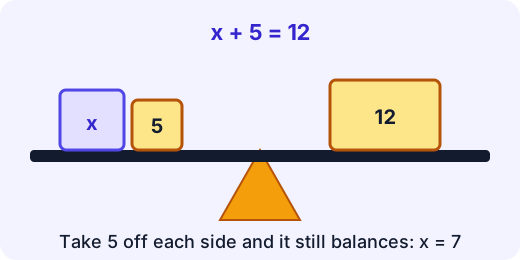
Take 5 kg off the left side and it tips. To keep it level you must take 5 kg off the right side too. Now the box alone balances 7 kg: .
This is the one rule of equation solving:
Do the same thing to both sides. An equation stays true if you add, subtract, multiply or divide both sides by the same number (not dividing by zero).
Our aim is to get the letter alone on one side. To do that, use the inverse operation, which undoes what has been done to :
The equation does this to Undo it by Form adds subtracting from both sides subtracts adding to both sides multiplies by dividing both sides by divides by multiplying both sides by Example. Solve . Subtract 5 from both sides: , so .
Example. Solve (Ananya's juice). Add 8 to both sides: .
Example. Four friends share a bill equally and each pays ₹9, so the bill satisfies . Multiply both sides by 4: .
Example. Solve . Divide both sides by 4: .
Example. Solve . Subtract 6 from both sides: . Answers can be negative, decimal or fractions: gives .
Always check
Put your answer back into the original equation. For with : . ✓. A check catches slips and takes ten seconds.
Misconception. "To solve I add: ." That does the same operation as the equation instead of the opposite one. The check fails: , not 12.
Misconception. Doing something to only one side. If you subtract 5 on the left but not on the right, the balance tips and the equation is no longer true. Try it in the lab.
Misconception. Using "=" to mean "and then the answer is". Writing says . An equals sign says both sides have the same value.
Inequalities: many answers instead of one
A sign on a roller-coaster says: "Riders must be at least 120 cm tall." Heights of 120, 121, 130 and 150.5 cm are all fine. That is not one answer but a whole range. We write it as an inequality, using these symbols:
Symbol Means is less than 3 (3 itself is not allowed) is greater than 3 (3 itself is not allowed) is less than or equal to 3 (3 is allowed) is greater than or equal to 3 (3 is allowed) The roller-coaster rule is .
An inequality's solutions are every number that makes it true, so there are infinitely many. We show them on a number line: draw a circle at the boundary and shade the direction of the solutions. An open circle means the boundary is not a solution ( and ). A closed circle means it is ( and ).
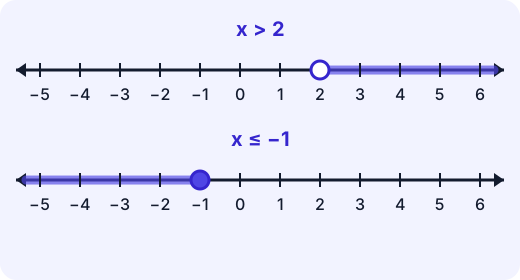
You can solve simple inequalities by the same undo method. Example. Solve . Subtract 3 from both sides: . That means any number above 4: 4.1, 5, 100. It does not include 4, since is not greater than 7.
To test a graph or a solution, pick a number: is 3 a solution of ? Yes, since 3 is equal to 3. Is 3 a solution of ? No.
Misconception. "An inequality means is 5." Not just 5: every number greater than 4, including 4.01 and 1000. The answer is a set, drawn as a shaded ray.
Summary
- An equation says two expressions are equal. A solution is a value that makes it true.
- It behaves like a balance: do the same to both sides. Use the inverse operation to get the letter alone, then check.
- An inequality has a whole set of solutions. Open circle for and , closed circle for and , shading towards the solutions.
Lab
Balance and graph
Part 1: solve six equations by doing the same thing to both sides until x is alone. You can also try changing only the left side and watch the balance tip. Part 2: draw the graph of each inequality by choosing the boundary number, an open or closed circle, and the shading direction.
Your goals
- Solve all six equations by applying operations to both sides, and read the check.
- Graph all four inequalities correctly (boundary, circle type and direction).
The interactive lab opens once you register. Register to do this.
Quick check
Equations and inequalities check
Eight questions on solving one-step equations and reading inequalities.
1.Solve x + 17 = 40.
Answer with a number
2.Solve n + 8 = 3.
Answer with a number
3.Match each equation to the step that solves it.
- x + 9 = 15
- x − 9 = 15
- 9x = 45
- x / 9 = 5
Match each to: divide both sides by 9 · add 9 to both sides · subtract 9 from both sides · multiply both sides by 9
4.Solve y / 4 = 9.
Answer with a number
5.x = 4 is a solution of which equation?
- x + 9 = 13
- 5x = 25
- x − 4 = 4
- x / 2 = 4
Choose one
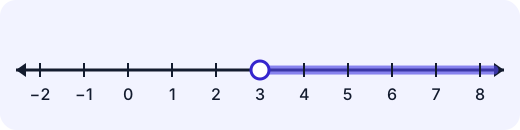
6.Which inequality does this number line show?
- x > 3
- x ≥ 3
- x < 3
- x ≤ 3
Choose one
7.Which of these numbers are solutions of x < 4? Choose all that apply.
- 3
- 4
- −10
- 3.9
Choose all that apply
8.Five identical books cost ₹275 altogether. If one book costs ₹x, then 5x = 275. How many rupees does one book cost?
Answer with a number
Answering and checking are for registered learners. Register to do this.
Quick check
New puzzles with equations
Write an equation or an inequality for each story, then solve it.
1.Tara gave away 14 stickers and has 27 left. How many did she start with?
Answer with a number
2.A rope is cut into 6 equal pieces, each 2.5 m long. How long was the rope, in metres?
Answer with a number
3.A lift may carry at most 600 kg. If the load is w kg, which inequality says the load is allowed?
- w < 600
- w ≤ 600
- w ≥ 600
- w > 600
Choose one
4.Solve x + 6 = −2.
Answer with a number
5.What is the largest whole number that is a solution of x < 7.5?
Answer with a number
Answering and checking are for registered learners. Register to do this.
Your turn
Explain equations and inequalities
Write your answers in your own words. Sketches or descriptions of a see-saw or number line are welcome.
- Ravi solves and writes . Explain what he did wrong, using the idea of a balance, and show how to solve and check it correctly.
- Solve and explain why you chose that step. Then write a short story problem whose equation is .
- Explain the difference between and . Say what the graph of each looks like and why 3 is or is not a solution.
How it's judged
- Balance idea and inverse operations
- Solving and modelling
- Inequalities
Writing and submitting your answer is for registered learners. Register to do this.
Like what you see?
Register for free to answer the quick checks, do the activities and save your work. Your work is saved on your device and syncs to your account.