Unit 4
Negative numbers
Place, compare and add numbers on both sides of zero, from freezing mornings to bank debts.
Read
The other side of zero
At 6 a.m. in Leh, Ladakh, the thermometer reads . By noon the sun has warmed the air by 11 degrees. What does the thermometer read now? You cannot count up from zero, because you start below it. To describe a morning like this, the numbers need to go past zero.
Integers and the number line
The integers are the whole numbers and their opposites:
Positive integers are to the right of zero on a horizontal number line, negative integers to the left. Zero is neither positive nor negative.
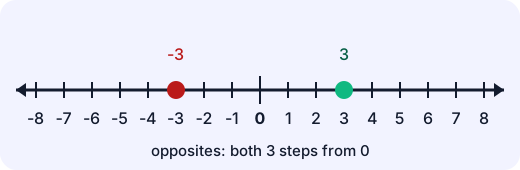
Two numbers that are the same distance from zero on opposite sides are opposites: and are opposites, and the opposite of is . The distance from zero is the absolute value, written .
Zero is a reference point, not an end. It is the place we agreed to start measuring from, like sea level for heights, or the freezing point of water for the Celsius scale.
Where integers show up
Situation Positive Zero Negative Temperature freezing point Elevation mountain above sea level sea level the Dead Sea shore, about m Money you have ₹50 nothing owed you owe ₹50: Lift floor 3 ground floor basement Comparing integers
On the number line, the number to the right is bigger. So , even though 7 looks "bigger" than 2. A debt of ₹2 is better than a debt of ₹7.
Misconception. " is bigger than because 9 is bigger than 4." On the number line lies left of , so . It is colder at than at .
Example. Put , , , and in order from least to greatest. Mark them on a number line and read from left to right: . Notice that has the biggest absolute value () but is the least number, because it is farthest to the left.
Try it: Four towns record lows of , , and . Which town was coldest? Which was the warmest? (Check your answer on a number line.)
Adding integers
Think of addition as hopping on the number line. Start at the first number. Adding a positive number hops right. Adding a negative number hops left.
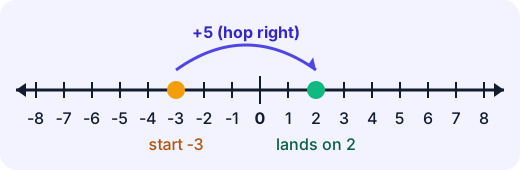
Example. : start at , hop 5 right, land on . Example. : start at 2, hop 6 left, land on . Example. : start at , hop 3 left, land on .
You can also think in groups: is a debt of 4 plus a debt of 3, which is a debt of 7.
Opposites cancel: . That is why they are called opposites.
Back to Leh. . At noon it is .
A quick rule of thumb
- Same signs: add the sizes, keep the sign. .
- Different signs: subtract the smaller size from the bigger, and keep the sign of the bigger. (9 is bigger and negative).
But always check your answer on the number line. A picture beats a rule you half remember.
Summary
- Integers are whole numbers on both sides of zero; opposites sit equally far from zero.
- To the right is greater: .
- Adding a positive hops right; adding a negative hops left.
- Zero is a reference point we choose, such as sea level or freezing.
Lab
The number line hopper
A frog starts at a number on the line. Make it hop to solve each problem: press the left or right hop buttons, then read where it lands and type the answer.
Your goals
- Hop the frog to solve all six problems about adding integers.
- Check each answer against where the frog landed.
The interactive lab opens once you register. Register to do this.
Quick check
Negative numbers check
Eight questions on placing, comparing and adding integers.
1.Which is the greatest?
- -9
- -2
- -15
Choose one
2.What is the opposite of -12?
Answer with a number
3.-3 + 5 = ?
Answer with a number
4.-4 + (-3) = ?
Answer with a number
5.2 + (-6) = ?
Answer with a number
6.At 6 a.m. it is -8 °C. By noon it has risen by 11 degrees. What is the temperature at noon, in °C?
Answer with a number
7.Put these in order from least to greatest.
- -3
- 0
- 2
- -7
Put these in order
8.Why can the Dead Sea shore have an elevation of about -430 m?
- Elevation is measured from sea level, and the shore lies below sea level.
- Because elevation can never be zero.
- Because negative numbers are bigger than positive ones.
Choose one
Answering and checking are for registered learners. Register to do this.
Quick check
New puzzles with negative numbers
Use integers in new situations. Sketch a number line if it helps.
1.A lift starts at floor 2. It goes down 5 floors, then up 3 floors. Basements are negative. Which floor number is it on now?
Answer with a number
2.Veena owes her friend ₹40 (that is -40). She earns ₹25 and pays it to him. What is her balance now, in rupees? (Use a negative number for a debt.)
Answer with a number
3.A submarine is at -120 m (below sea level). It rises 45 m. Then it dives 30 m. What is its elevation now, in metres?
Answer with a number
4.Four towns had these lows last winter. Which was the coldest?
- -4 °C
- -11 °C
- 0 °C
- -7 °C
Choose one
Answering and checking are for registered learners. Register to do this.
Your turn
Explain negative numbers
Write your answers in your own words. Use a number line sketch or description where it helps.
- A classmate says " because 9 is greater than 4". Explain what is wrong, using a real situation such as temperature or money.
- Work out and . Describe each as hops on a number line.
- Zero is not "nothing". Give two examples where zero is a chosen starting point and explain what the negative numbers mean in each.
How it's judged
- Comparing negatives
- Adding with hops
- Zero as a reference point
Writing and submitting your answer is for registered learners. Register to do this.
Like what you see?
Register for free to answer the quick checks, do the activities and save your work. Your work is saved on your device and syncs to your account.