Unit 5
Keeping clean
Meet the germs you cannot see, and learn to wash your hands and brush your teeth so they stay away.
Read
The germs you cannot see
Tara has been playing in the garden all afternoon. She has dug in the soil, patted the neighbour's dog and climbed the gate. Now Nani calls, "Lunch! Wash your hands first!"
"But they look clean," says Tara, turning her hands over.
Nani smiles. "Looking clean and being clean are not always the same thing. Come, let me show you."
Germs are too small to see
Germs are living things so tiny that you need a microscope to see them. They are on the soil, on the dog, on the gate, and on the door handle at school. Many germs are harmless, and some even help you. But a few can make you sick, with a tummy bug, a cough or a cold.
When you touch your face or eat with unwashed hands, those germs can get inside you. Washing is how you remove them.
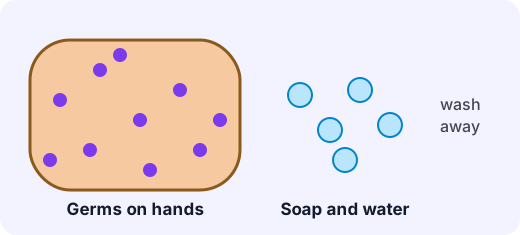
Why soap?
Water alone just rolls off your skin. Soap is clever: it grabs dirt and germs and lifts them off your skin, so the water can carry them down the drain. The rubbing helps too, so scrubbing matters. The water can be cold or warm; what counts is the soap, the rubbing and the time.
Wash your hands properly
Count slowly or sing a song twice, such as "Happy Birthday", to scrub for 20 seconds.
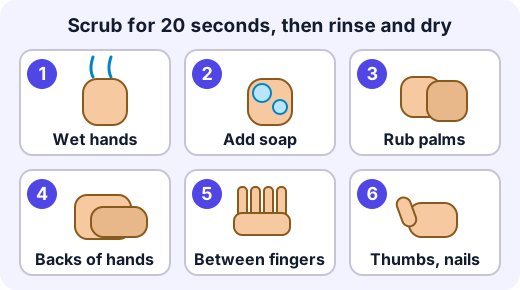
- Wet your hands with water.
- Add soap.
- Rub your palms together.
- Rub the backs of your hands.
- Rub between your fingers.
- Rub your thumbs and fingertips (germs hide under nails).
- Rinse off all the soap.
- Dry with a clean towel or in the air.
Try it: Wash your hands and count to 20. Did you reach every part: thumbs, fingertips and between the fingers?
When to wash:
- before you eat
- after you use the toilet
- after you play outside or touch animals
- after you cough or sneeze into your hands
Example. Tara's hands look clean, but she has just patted a dog. She washes with soap for 20 seconds before lunch. The germs she cannot see go down the drain.
Look after your teeth too
Your mouth has germs too. After you eat sweet things, some of them make acid that can make holes in your teeth, called cavities. Brushing removes the sticky film where germs live.
- Brush twice a day: in the morning and before bed.
- Use a pea-sized blob of toothpaste.
- Brush the front, the back and the tops of every tooth, for about two minutes.
- Spit out the toothpaste. Do not swallow it.
- After brushing at night, no more food or sweet drinks. Only water.
Mix-ups to watch for
- "If I can't see dirt, I'm clean." Germs are too small to see, so wash before eating even when your hands look fine.
- "A quick splash is enough." Water alone does not lift germs. You need soap and 20 seconds.
For the grown-up helping
Wash hands together at least a few times a day, so your child sees it is just what people do. Make 20 seconds fun with a song or a rhyme. Children this age usually need a grown-up to help or watch when brushing teeth, and often until about age 7 or 8. Visit a dentist regularly. If hands are often sore or dry, ask a doctor or pharmacist about gentle soap or cream.
Lab
Scrub off the glitter germs
Pretend glitter germs are on your hands. Wet them, add soap, and scrub each part until every germ is gone.
Your goals
- Wet your hands and add soap.
- Scrub all six parts of your hands until no germs are left.
- Rinse and dry.
The interactive lab opens once you register. Register to do this.
Activity
The glitter germ test
Pretend flour or glitter is germs, and see which way of washing gets it off. About 15 minutes.
You'll need
- A little flour or fine glitter (flour is best for young children)
- A sink with running water
- Soap and a clean towel
- A timer or a song to sing
Steps
- A grown-up puts a pinch of flour or glitter on your child's palms. Your child rubs hands together, then touches a table or a toy. Look at how far the "germs" travel.
- Wash with water only, for about 5 seconds. Look at the hands. Is there any flour or glitter left?
- Add more flour. This time wash properly, with wet hands, soap, and rubbing palms, backs, between fingers, thumbs and fingertips for 20 seconds (sing Happy Birthday twice). Rinse and dry.
- Look at the hands again and compare. Ask "What did the soap and the rubbing do?"
- Ask "Why can't we see real germs the way we can see flour?"
Safety
- Keep glitter away from eyes and mouths. Use flour with children who put hands in their mouths.
- A grown-up should be at the sink with young children. Wipe up spilled water so nobody slips.
- Check for flour or other allergies, and do not use this activity if anyone has one.
Keeping a log of the activity is for registered learners. Register to do this.
Quick check
Keeping clean check
Six questions about germs, hands and teeth.
1.For how many seconds should you scrub your hands with soap?
Answer with a number
2.Why do we wash with soap, and not just water?
- Soap lifts germs off your skin so the water can wash them away
- Soap only makes your hands smell nice
- Soap turns germs a different colour
Choose one
3.Put the handwashing steps in order.
- Rub all over for 20 seconds
- Add soap
- Wet your hands
- Rinse off the soap
- Dry your hands
Put these in order
4.When should you wash your hands? Pick all that apply.
- Before eating
- After using the toilet
- After touching a dog or cat
- Never, if they look clean
Choose all that apply
5.Can you see most germs on your hands with your eyes?
- No, they are too tiny; the picture shows them big
- Yes, they are like tiny dots on the skin
Choose one
6.How often should you brush your teeth?
- Twice a day: morning and before bed
- Once a week
- Only when a tooth hurts
Choose one
Answering and checking are for registered learners. Register to do this.
Quick check
New puzzles
Use what you know about germs in new situations.
1.Amit's hands look clean after cricket, and lunch is ready. What should he do?
- Wash with soap, because germs are too small to see
- Eat, because his hands look clean
- Wipe them on his shirt
Choose one
2.A handwashing song takes 10 seconds to sing once. How many times must you sing it to scrub for 20 seconds?
Answer with a number
3.Dev has just brushed his teeth for bed and wants a sweet drink. Why is that not a good idea?
- The sugar would sit on his teeth all night and feed the germs that make holes
- Sweet drinks make you tall
- It is fine; nothing happens
Choose one
4.Sia sneezes into her hands. What is the best thing to do next?
- Wash her hands with soap and water
- Wipe them on her clothes
- Do nothing; they are fine
Choose one
Answering and checking are for registered learners. Register to do this.
Activity
Tell it back
Your child explains why we wash and brush, in their own words. Three minutes.
Steps
- Ask "My hands look clean. Do I still need to wash them before I eat? Why?"
- Ask "What does the soap do? Why 20 seconds?"
- Ask "Why do we brush our teeth in the morning and at night?"
- Write down what your child says, in their words. Ask "Tell me more" instead of correcting.
Keeping a log of the activity is for registered learners. Register to do this.
Like what you see?
Register for free to answer the quick checks, do the activities and save your work. Your work is saved on your device and syncs to your account.