Unit 6
Naming feelings
Put names to happy, sad, angry, scared, worried and proud, and find things that help when feelings are big.
Read
What am I feeling?
It was Sports Day. Kabir stood at the start line. His tummy felt fluttery, his hands felt cold, and his heart went thump, thump, thump.
"I feel funny," he whispered to his teacher.
"Hmm," said Ms Okafor. "Fluttery tummy, thumping heart, just before a race. That sounds like worried, or maybe excited. Does either word fit?"
Kabir thought. "Worried. I want to do well." Just naming it made the feeling a little smaller. He took three slow breaths. Then the whistle blew.
Feelings have names
A feeling is something you notice inside. Everybody has them, every day. Here are six to learn.
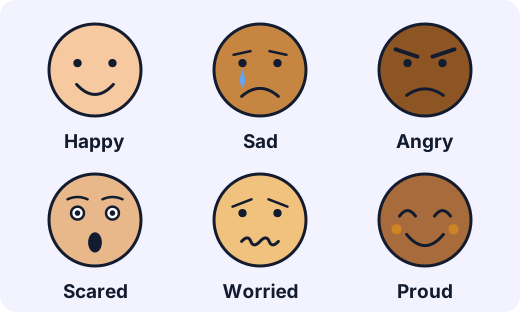
Feeling What it feels like A time you might feel it Happy light, smiling, bubbly playing with a friend Sad heavy, teary, quiet a pet is lost, or a friend moves away Angry hot, tight fists, loud someone breaks your toy on purpose Scared shaky, wanting to run or hide a big dog runs towards you Worried fluttery tummy, thoughts that go round the night before a test Proud tall, warm, glowing you tie your shoelaces by yourself Scared is about something dangerous happening now. Worried is about something that might happen later.
Try it: Notice your body right now. What do you feel in your tummy, your face, your hands? What name fits?
You can learn to read feelings in other people too. Look at faces, listen to voices, and think about what happened in a story. "Her eyes are wet and her mouth is turned down. I think she is sad."
All feelings are allowed
There are no "bad" feelings. Feelings are like weather: they come, and then they pass. Being angry or scared does not make you a bad person. Even scared is useful: it tells you to be careful.
What matters is what you do with a feeling. That is a choice. When you are angry, you can hit someone, and that hurts and makes things worse. Or you can pick something that helps.
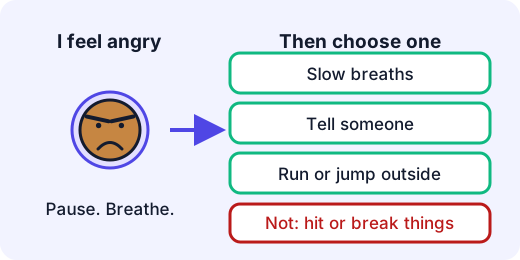
Things that help
- Breathe: five slow breaths, in through the nose and out like blowing out a candle.
- Tell someone: "I feel sad because..." Saying it to a grown-up or friend makes it lighter.
- Move: run, jump, dance or push against a wall to get the angry energy out.
- Draw or squeeze something soft.
- Ask for a hug, or sit somewhere quiet for a bit.
Different things help different people, and different feelings. Try a few and find yours.
Example. Naz is angry because her brother knocked down her tower. Her fists are tight. She says, "I feel angry!" She takes three slow breaths, then tells her mum what happened. Naz felt angry and chose a helpful thing to do.
Mix-ups to watch for
- "Boys don't cry" or "good girls don't get angry." Everyone has every feeling. Crying and anger are normal.
- "If I feel it, I have to act on it." No. You can feel angry and still choose not to hit.
For the grown-up helping
Name feelings aloud, for yourself and for your child: "You look disappointed. Am I right?" Give the feeling a name before trying to fix it. Never say a feeling is silly or wrong, but you can say a behaviour is not OK ("You can be angry, but you may not hit"). Show your own calming steps. If a child is often very sad, anxious or angry for weeks, or their feelings stop them playing, eating or sleeping, talk to your doctor or school counsellor.
Lab
Feelings detective
Read six short stories and name the feeling in each. Then pick something that helps for three big feelings.
Your goals
- Name the feeling in each of six stories.
- For three big feelings (angry, sad, scared), pick something that helps.
The interactive lab opens once you register. Register to do this.
Activity
Feelings faces and my calm plan
Your child makes feelings faces, spots feelings in a book, and makes their own "what helps" plan. About 20 minutes.
You'll need
- Paper plates or paper circles, and crayons or pens
- A picture book with characters showing strong feelings
- A piece of paper for the calm plan
Steps
- Draw six faces on paper plates, one each for happy, sad, angry, scared, worried and proud. Your child can draw them or you can do it together.
- Play "show me". Call out a feeling and your child holds up the face, or makes the face with their own face. Then swap, so that you make a face and they name it.
- Read a picture book. Pause at the faces and ask "How does she feel? How can you tell?"
- Ask "When did you feel angry? What happened in your body? What helped?" Do the same for sad and scared. Say "That's OK. All feelings are allowed."
- Make a calm plan together. Your child draws or names one thing that helps when they feel angry, one for sad, and one for scared.
- Put the plan where your child can see it, for next time a feeling is big.
Safety
- Choose a picture book that suits your child. If a story brings up a big feeling, stop and comfort them first.
- Any thing that helps must be safe, so not hitting, breaking things or going off alone.
Keeping a log of the activity is for registered learners. Register to do this.
Quick check
Naming feelings check
Seven questions about feelings. Look at the faces carefully.
1.Which face looks sad?
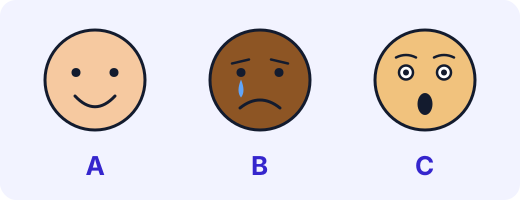
- A
- B
- C
Choose one
2.Which face looks scared?
- A
- B
- C
Choose one
3.Match each happening to the feeling it most likely brings.
- You win a prize at school
- Your balloon floats away
- Someone breaks your toy on purpose
- A big dog runs at you
Match each to: Angry · Sad · Proud · Scared
4.The night before a test, Rani's tummy feels fluttery and her thoughts keep going round. Which feeling is this?
- Worried
- Proud
- Sleepy
Choose one
5.Which sentence is true?
- All feelings are allowed; what we do with them is a choice
- Angry is a bad feeling you must never have
- If you feel scared, you must hide it
Choose one
6.You feel very angry. Which things could help? Pick all that apply.
- Take slow breaths
- Tell a grown-up how you feel
- Run or jump outside to let the energy out
- Hit your friend
Choose all that apply
7.You tie your shoelaces all by yourself for the first time and feel tall, warm and glowing inside. What is this feeling called? Type the word.
Answer with a word or phrase
Answering and checking are for registered learners. Register to do this.
Quick check
New puzzles
Use what you know about feelings in new stories.
1.Mina's best friend is moving to another city. Mina's eyes are wet and she is quiet. Which feeling is most likely?
- Sad
- Proud
- Angry
Choose one
2.Raju says, "Boys don't get scared." Is Raju right?
- No. Everybody feels scared sometimes, and that is OK
- Yes, boys never feel scared
- Only girls get scared
Choose one
3.Naz feels angry and her fists are tight. What could she try first?
- Stop and take three slow breaths
- Hit the nearest person
- Pretend she feels nothing
Choose one
4.Which sentence names a feeling?
- I feel worried about the dentist.
- I have a dentist.
- The dentist has a chair.
Choose one
Answering and checking are for registered learners. Register to do this.
Activity
Tell it back
Your child tells you, in their own words, about feelings and what they do with them. Three minutes.
Steps
- Ask "Can you name three feelings? When did you last feel one of them?"
- Ask "Is it OK to feel angry? What can you do when you feel angry?"
- Ask "Is it OK to feel scared? Why might a scared feeling be useful?"
- Write down what your child says, in their words. Do not correct them. Say "Tell me more."
Keeping a log of the activity is for registered learners. Register to do this.
Like what you see?
Register for free to answer the quick checks, do the activities and save your work. Your work is saved on your device and syncs to your account.