Unit 1
Games with rules
Play tag, relay and kho-kho the fair way, and find out why a game without rules falls apart.
Read
Rules make the game
At lunch break, Zoya and Aryan were playing tag. Zoya tapped Aryan on the shoulder. "Got you!" she said.
"No way," said Aryan. "I was standing on the safe stone!"
"There is no safe stone," said Zoya.
"There is! I made it up!"
Then they stopped running and started shouting. The game was over, and nobody had won anything. What was missing? A rule that both of them knew.
What is a rule?
A rule is something everybody who plays agrees to do (or not do). Think of it as a promise between the players. Rules tell you how to start, what you may do, what you may not do, and how someone wins.
Games have three kinds of rules, and each does a different job.
Kind of rule Its job Example Safety Keeps everyone from getting hurt Tag with a gentle, open hand. Play on flat ground. Fair play Gives every player a fair chance Both teams start from the same line. How to play Tells you what the game is In tag, the person tagged becomes "it". Try it: Think of a game you play. Say one rule from each row of the table.
Three games with rules
Tag. One player is "it" and tries to touch the others. When you are tagged, you become "it". Zoya and Aryan's trouble would have vanished if they had agreed on the rule at the start: "Is there a safe place? Where is it?"
Relay. Teams run in turns. Each runner runs a lap, then hands a baton to the next teammate. The team's time depends on all its runners together, so every person matters.
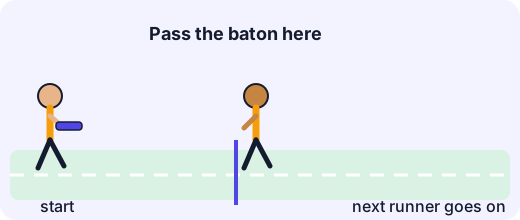
A relay has rules that make it fair: everyone starts behind the same line, the baton must be handed over (not thrown), and you wait for the baton before you run.
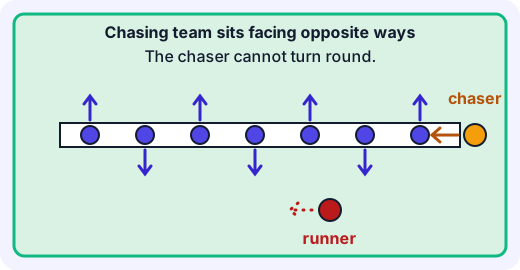
Kho-kho. This team game comes from India and is very old. The chasing team's players sit in a row down the middle of the field, each facing the opposite way from the next one. One player from that team is up and running as the chaser, trying to tag runners from the other team. The chaser may not turn around. To change direction, the chaser says "Kho!" and taps a sitting teammate, who stands up and becomes the new chaser. That one rule gives the game its shape.
Worked example: making a game fair
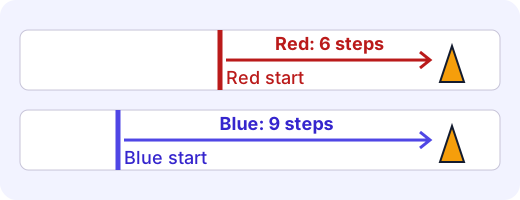
Example. Two teams, Red and Blue, race to a cone. Red's start line is 6 steps from the cone. Blue's start line is 9 steps from the cone.
- Count the steps each team runs: Red runs 6, Blue runs 9.
- Blue runs 3 steps more. Red will win even if Blue runs just as well.
- To fix it, move Blue's line 3 steps closer, or Red's line 3 steps back, so both run the same number of steps.
Now the winner is whoever played better. That is what a fair game means.
Teams, and winning and losing
In a team game, you win or lose together, so how you treat your team matters.
- Cheer for your teammates, even when they drop the baton.
- If you break a rule by accident, say so. Owning up keeps the game going.
- If you lose, say "Well played." If you win, don't boast.
When there's an argument
Aryan and Zoya could have stopped and asked a few questions: Which rule are we using? Did anyone see what happened? Can we play that point again? Asking a grown-up or a friend who was watching is fine. If everybody agrees, you may even change a rule. But you agree to the change before the next round, not in the middle when you are losing.
A mistake people make
Some people say "rules spoil the fun." Try playing tag where each person makes up the rules as they go. It ends in shouting, as Zoya and Aryan found. Rules aren't there to stop the fun. They are what lets the game happen. And winning by breaking a rule isn't really winning, because the other players aren't playing the same game.
For the grown-up helping
Play with your child, and let them be the rule-keeper sometimes. Before a game starts, ask: "What are our rules? Is there anything unsafe?" Arguments are normal at this age; they are how children learn why rules matter. Stay calm, ask for each child's version, and help them agree on the rule rather than deciding who is right. Choose flat, clear ground away from roads and water. Children with a disability or an injury should be offered a role that suits them, such as caller, referee or scorer.
Lab
Fair start
Two teams race to their cones. Slide each team's start line so that both teams run the same number of steps, then press Race.
Your goals
- Set both teams' start lines so each runs exactly the number of steps the rule says.
- Race and see a tie in all three rounds.
The interactive lab opens once you register. Register to do this.
Activity
Play, then fix the rules
Your child plays a short tag or relay game with friends or family, agrees the rules first, and then fixes one rule that was unfair. About 25 minutes.
You'll need
- An open space with flat ground, away from roads and water (a park, playground or large room)
- Two or three players besides your child (more is fine)
- Something to mark a start line (a rope, a chalk line or a shoe)
- A baton substitute for a relay, such as a rolled-up sock or a spoon
Steps
- Before playing, sit together and agree three rules: one for safety (such as a gentle, open-hand tag), one for fairness (such as the same start line) and one for how to play (such as who is "it" first). Say each rule aloud.
- Play tag for about 5 minutes, using the three rules.
- Play a relay in two teams. Each player runs to a marker and back, then puts the baton in the next player's hand. Start both teams at the same line.
- Play again, but this time give one team an unfair start, such as a start line a few steps nearer the marker. Ask: "Is that fair? How do you know?"
- Together, fix the unfair rule and play once more.
- Finish with a sit-down. Ask your child: "Which rule did we need most? What happens in a game with no rules?"
Safety
- Play on flat ground with no stones, holes or traffic. Keep away from roads, water and steps.
- Tag with a gentle, open hand on the shoulder or back. No pushing or grabbing.
- Wear sturdy shoes, or play barefoot only on clean, soft ground. Take drink breaks.
- Stop the game at once if anyone says stop or gets hurt.
Keeping a log of the activity is for registered learners. Register to do this.
Quick check
Games and rules check
Six questions about games with rules.
1.Why do games have rules?
- So everyone knows how to play and the game is fair and safe
- So the biggest player always wins
- So the game takes as long as possible
Choose one
2.Look at the picture. Which team has the longer run to the cone?
- Red
- Blue
- They run the same distance
Choose one
3.Which of these are good safety rules for a running game?
- Play on flat ground with no stones
- Stop when someone says stop
- Push the person in front so you can go faster
- Tag gently with an open hand
Choose all that apply
4.Put the steps of a relay in the right order.
- Wait behind the start line
- After passing on the baton, cheer while your teammate runs
- Put the baton into your teammate's hand
- Run your lap
Put these in order
5.In kho-kho the chaser (who has to keep facing forward) cannot turn round. What can the chaser do to go the other way?
- Turn round quickly when no one is looking
- Say "Kho!" and tap a sitting teammate, who stands up and chases
- Stop the game
Choose one
6.Pavan says Ria did not tag him. Ria says she did. What is the fairest thing to do?
- Keep arguing until one of them gives up
- Ask a friend or grown-up who saw it, or play that part again
- Say the game is silly and walk away
Choose one
Answering and checking are for registered learners. Register to do this.
Quick check
New puzzles
Rules turn up in games you have not played before. Can you use what you know?
1.Maya is 5 and her cousins are 9. They play tag and agree that Maya has a big safe circle where she cannot be tagged. Why is this a good rule?
- It gives a younger, slower player a fair chance to play
- It breaks the rules of tag
- It means Maya will always win
Choose one
2.In a relay, each of 4 runners on a team runs one lap. Two teams play. How many laps are run in all?
Answer with a number
3.Kids play a ball game in a lane beside a road. Which rule should they agree first?
- The winner gets two points
- Nobody runs after the ball onto the road; wait for a grown-up
- Play as fast as you can
Choose one
4.Match each rule to its job.
- Tag with a gentle, open hand
- Both teams start at the same line
- Say "Kho!" to change the chaser
Match each to: Tells you how the game works · Keeps everyone safe · Makes the game fair
Answering and checking are for registered learners. Register to do this.
Activity
Tell it back
Your child explains, in their own words, why games need rules. Three minutes.
Steps
- Ask "Pretend we play tag with no rules at all. What would happen?" Let your child act it out or describe it.
- Ask "Name one rule that keeps people safe and one that keeps the game fair."
- Ask "What should you do if two people disagree about a rule?" Wait for their ideas before giving yours.
- Write down what your child says, in their words.
Keeping a log of the activity is for registered learners. Register to do this.
Like what you see?
Register for free to answer the quick checks, do the activities and save your work. Your work is saved on your device and syncs to your account.