Unit 6
Managing big feelings
Spot what sets off a big feeling, then use a calm-down plan of breathe, count and talk.
Read
Breathe, count, talk
Arjun spends an hour building a tall tower from wooden blocks. Just as he adds the last block, his cousin runs past. Crash! The tower is on the floor.
Arjun's face goes hot. His hands squeeze into fists. His heart thumps. He wants to shout, and he wants to push his cousin.
Have you ever felt like Arjun? Big feelings, like anger, fear, sadness or worry, can feel like a storm inside you. Everyone gets them. This lesson is about what to do when they come.
What sets a feeling off?
A trigger is the thing that happens right before a big feeling and sets it off. For Arjun, the trigger was the tower crashing. Other triggers are losing a game, being left out, a loud noise, being hurried, or being very tired or hungry.
Your body also gives you clues. When a feeling gets big, you may notice a fast heartbeat, a hot face, tight fists, a tight tummy or tears. Noticing these clues early is a good first step.
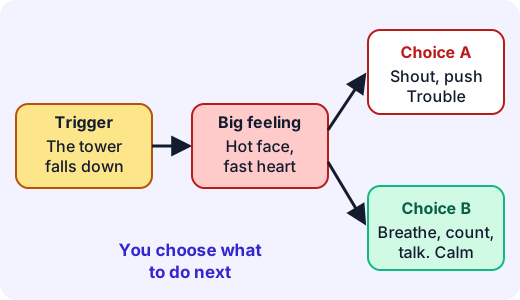
You can't always choose a feeling, but you can choose what to do
Arjun did not choose to feel angry. The feeling came by itself, and that is fine. Feelings are not bad. But what he does next is his choice.
- Shouting and pushing might feel good for a second, but then someone gets hurt and Arjun gets into trouble.
- A calm-down plan helps the storm pass, so he can think clearly.
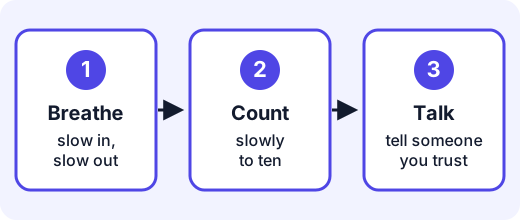
The calm-down plan: Breathe, Count, Talk
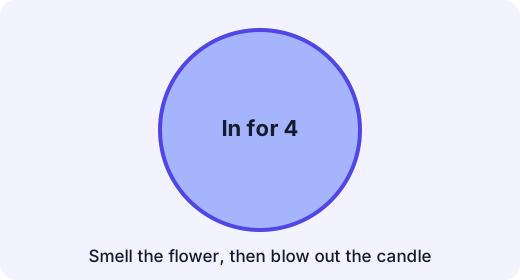
1. Breathe. Breathe in slowly through your nose for a count of 4, as if smelling a flower. Breathe out slowly through your mouth for a count of 4, as if blowing out a candle. Do it three times.
2. Count. Count slowly to ten. Or look around and name five things you can see. Counting gives your brain something else to do while the big feeling gets smaller.
3. Talk. Tell a trusted person what happened and how you feel. A good sentence is: "I feel ___ because ___." For example: "I feel upset because my tower fell down."
Example. Arjun takes three slow breaths. His heart slows down. He counts to ten. Then he tells his cousin, "I feel sad because I worked on that tower for a long time. Please be careful next time." His cousin says sorry and helps rebuild.
Try it: Do three slow breaths right now, even if you feel calm. Practising when calm makes the plan easier when a storm comes.
Mix-ups to watch for
- "If I feel angry, I'm bad." No. Feeling angry is normal. It's what you do that matters.
- "Don't cry." Crying is a normal way to let a big feeling out.
- "The plan makes the feeling vanish." It helps the feeling become smaller. Sometimes you need to try it more than once.
If a big feeling stays for many days, or makes you feel unsafe, always tell a trusted grown-up such as a parent, teacher or doctor.
For the grown-up helping
Practise the plan with your child when everyone is calm, so it is familiar when feelings run high. Stay close and calm yourself during a big feeling. Name it ("You look really upset") and wait until your child is calmer before talking about what happened. Help them notice triggers over the week. If big feelings are very frequent, last a long time, or lead to hurting themselves or others, speak to your child's doctor or school.
Lab
The calm-down coach
Three children have big feelings. Find each trigger and pick the best next step in the plan. Then do three slow breaths with the breathing circle.
Your goals
- Find the trigger and choose the best next step for three children.
- Practise three slow breaths with the breathing circle.
The interactive lab opens once you register. Register to do this.
Activity
My calm-down plan card
Your child makes a calm-down plan card, practises it while calm, and notices triggers for a few days. About 20 minutes, then a few minutes a day.
You'll need
- A card or half-sheet of paper
- Pencils or crayons
Steps
- Fold the card in three. Write or draw "Breathe", "Count" and "Talk" on the three parts.
- Practise breathing together. Smell an imaginary flower for 4 counts, blow out an imaginary candle for 4 counts. Do three breaths.
- Practise counting slowly to ten. Then practise saying "I feel ___ because ___."
- Choose a safe, calm spot at home where your child can go to use the plan. Put the card there.
- For the next few days, when a big feeling happens, help your child jot down what set it off (the trigger) on the back of the card.
- At the end of the week, look at the triggers together. Ask "What could we do about this one?"
Safety
- Never use the card as a punishment. It is a tool your child chooses to use.
- Stay nearby and calm when a big feeling happens, and make sure nobody gets hurt.
- If big feelings are very frequent or very strong, or your child talks about hurting themselves or others, talk to a doctor or the school.
Keeping a log of the activity is for registered learners. Register to do this.
Quick check
Big feelings check
Six questions about triggers and the calm-down plan.
1.Sam's feelings get big when his little sister scribbles on his drawing. What is the trigger?
- His sister scribbling on his drawing
- Sam having feelings at all
- The paper being white
Choose one
2.Put the calm-down plan in order, first to last.
- Take slow breaths
- Talk to someone you trust
- Count slowly to ten
Put these in order
3.Your feeling is very big. Which of these are good things to do next?
- Take three slow breaths
- Count slowly to ten
- Hit or throw something
- Tell a trusted grown-up what happened and how you feel
Choose all that apply
4.Which sentence is true?
- You can always choose not to feel angry.
- You cannot always choose a feeling, but you can choose what to do next.
- Once a feeling starts, you cannot choose anything.
Choose one
5.Match each step of the plan to what you do.
- Breathe
- Count
- Talk
Match each to: Say the numbers 1 to 10, slowly · Smell the flower, blow out the candle · Say "I feel upset because..." to someone you trust
6.In the breathing picture, you breathe in for 4 counts and out for 4 counts. How many counts is one whole breath?
Answer with a number
Answering and checking are for registered learners. Register to do this.
Quick check
New puzzles
Use the calm-down plan and what you know about triggers in some new situations.
1.Lena notices she shouts most often on school mornings when she is rushed. What could she do with that information?
- Get her bag and shoes ready the night before, so mornings feel less rushed
- Nothing. Triggers cannot be noticed.
- Blame her family for every shout
Choose one
2.Ravi's team just lost. He feels his heart pounding and wants to kick the ball away. What should he try first?
- Take slow breaths: in for 4, out for 4
- Kick the ball as hard as he can
- Shout that the game was unfair
Choose one
3.Maya does 5 whole breaths. Each breath is 4 seconds in and 4 seconds out. How many seconds does she spend breathing?
Answer with a number
4.Dev is calm again. His friend took his turn on the swing. Which sentence is the best way to talk about it?
- "I feel upset because it was my turn."
- "You always spoil everything!"
- Say nothing and stay cross all day
Choose one
Answering and checking are for registered learners. Register to do this.
Activity
Tell it back
Your child explains the calm-down plan and what a trigger is, in their own words. Three minutes, when everyone is calm.
Steps
- Ask "What is a trigger? Can you tell me one of yours?"
- Ask "What can you do when a feeling gets really big?" Let them answer before you prompt.
- Ask "Can we choose which feelings we have? What can we choose?"
- Write down what your child says, in their words.
Keeping a log of the activity is for registered learners. Register to do this.
Like what you see?
Register for free to answer the quick checks, do the activities and save your work. Your work is saved on your device and syncs to your account.