Unit 5
Sleep and rest
Find out what your body and brain do while you sleep, and keep a sleep diary for a week to see how sleep changes how you feel.
Read
What happens while you sleep
On Monday, Tara can't keep her eyes open in class. She drops her pencil, forgets her friend's name for a second and snaps at her little brother at lunch. "I stayed up reading under the blanket until really late," she admits.
On Thursday, after an early night, Tara runs fast in games, remembers her spelling words and laughs at everything. Same girl. Different amount of sleep.
Sleep is not "doing nothing"
When you are asleep, you look still. But inside, your body and brain are hard at work.
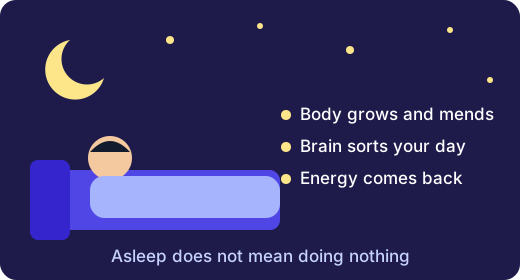
- Your body grows and mends. Scrapes heal, muscles repair after games, and you grow taller. Much of your growing happens while you sleep.
- Your brain sorts and stores. It goes over what you learned today and files it away, so you can remember it tomorrow.
- You get your energy back. After enough sleep you wake up ready to play and think.
When you don't sleep enough, you may feel tired, cross, forgetful, clumsy or too wriggly to listen. You might catch more colds, too.
How much sleep?
Children of about six to seven years old usually need around 9 to 12 hours of sleep each night. Grown-ups need less, about 7 to 9 hours. Some children need a little more and some a little less.
To find out how long you slept, count from bedtime to wake-up time.
Example. Ishaan goes to bed at 8:30 pm and wakes at 6:30 am.
- Count from 8:30 pm to 12:30 am (half past midnight). That is 4 hours.
- Count from 12:30 am to 6:30 am. That is 6 hours.
- Add them: 4 + 6 = 10 hours.
Rest is different from sleep
Rest means your body and mind slow down while you are awake. Sitting quietly, lying down with a book, listening to music or watching clouds are all rest. Rest helps when you feel tired in the day. But it is not a replacement for a full night of sleep.
Keep a sleep diary
A sleep diary is a small table where you write each morning when you went to bed, when you woke up and how you feel. After a week, you can spot patterns.
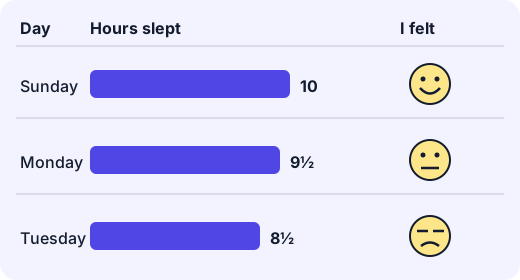
Look at the diary above. On the night with the least sleep, this child felt the sleepiest. Your diary might show something similar. It might not! That's fine; a diary just tells you what is true for you.
Tips for falling asleep
- Go to bed and get up at about the same time each day.
- Switch off screens at least an hour before bed. Bright light tells the brain to stay awake.
- Do something calm: a wash, a quiet story, soft music.
- Keep your room dark, cool and quiet.
Try it: Tonight, notice your bedtime. Tomorrow, write it down along with how you feel.
Mix-ups to watch for
- "Sleep is a waste of time." It's when your body grows and your brain stores what you learned.
- "I can catch up on one weekend." It helps a little, but regular sleep every night works best.
For the grown-up helping
Keep to a steady bedtime routine with a calm last half hour. Help your child fill in the diary each morning (the child can draw a face for how they feel). Avoid using bedtime as a punishment. If a child snores loudly, often wakes up scared, can't fall asleep for long periods, or is very sleepy every day, talk to a doctor.
Lab
Find the right bedtime
Four children each need a bedtime. Slide the moon to a bedtime and watch the hours of sleep change. Pick bedtimes that give a healthy night.
Your goals
- Find a bedtime that gives 9 to 12 hours of sleep for each of the first three children.
- Work out the bedtime that gives exactly 10 hours for the fourth child.
The interactive lab opens once you register. Register to do this.
Activity
My sleep diary
Your child keeps a sleep diary for seven mornings and then looks for a pattern. Two minutes each morning, then ten minutes at the end of the week.
You'll need
- A sheet of paper or a small notebook
- A pencil and a ruler
- Coloured pencils (optional)
Steps
- Draw a table with seven rows (one for each day) and columns for "Went to bed", "Woke up", "Hours slept" and "How I felt".
- Each morning, your child writes the time they went to bed and woke up. Help them count the hours.
- Your child draws a face for how they feel (happy, okay, sleepy, cross).
- After seven days, draw a bar for each night's hours on squared paper or on the back of the sheet.
- Look at the diary together. Ask "Which nights did you sleep the most? How did you feel the next day?"
- Talk about one small change to try, such as 15 minutes earlier, or a quiet story instead of a screen.
Safety
- Do not pull a child out of bed in the middle of the night to fill in the diary. Fill it in the next morning.
- If your child often cannot sleep, snores loudly, or seems very sleepy every day, talk to a doctor.
Keeping a log of the activity is for registered learners. Register to do this.
Quick check
Sleep and rest check
Seven questions about sleep, rest and sleep diaries.
1.About how many hours of sleep does a child of six or seven need each night?
- About 4 to 5 hours
- About 9 to 12 hours
- About 15 to 16 hours
Choose one
2.Neel goes to bed at 9:15 pm and wakes up at 6:15 am. How many hours does he sleep?
Answer with a number
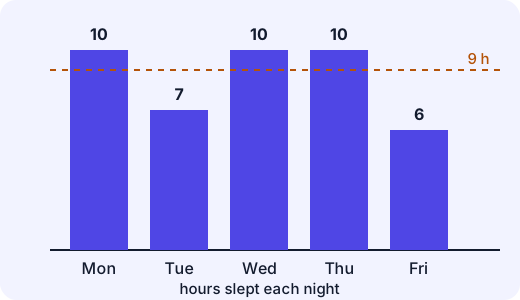
3.Look at the sleep diary chart. On which night did the child sleep least?
- Monday
- Tuesday
- Friday
Choose one
4.In the same chart, on how many of the five nights did the child sleep 9 hours or more?
Answer with a number
5.Which things happen while you sleep? Pick all that are true.
- Your body grows and mends itself
- Your brain sorts and stores what you learned
- Your body stops working until morning
Choose all that apply
6.What is rest?
- Slowing your body and mind down while you are awake, like sitting quietly with a book
- The same thing as sleeping all night
- Playing a fast game as loudly as you can
Choose one
7.Which of these helps you fall asleep?
- A quiet story in dim light
- A fast video game on a bright screen
- Racing around the house
Choose one
Answering and checking are for registered learners. Register to do this.
Quick check
New puzzles
Use what you know about sleep in some new situations.
1.Tomás wakes up at 6:45 am and wants 10 hours of sleep. What time should he be asleep?
- 8:45 pm
- 9:45 pm
- 7:45 pm
Choose one
2.On Saturday, Aria's diary says she went to bed at 10 pm and woke at 9 am. How many hours did she sleep?
Answer with a number
3.For a week, Sana has been cross and clumsy at school. Her diary shows she goes to sleep after 11 pm and wakes at 6:30 am. What is the most helpful thing to try?
- An earlier bedtime, with a calm routine
- An even later bedtime
- Nothing, because sleep does not change how you feel
Choose one
4.After lunch, Dhruv lies quietly on the sofa listening to soft music. He does not fall asleep. Is that rest?
- Yes. It is rest, even though he did not sleep.
- No. Rest only counts if you are asleep.
Choose one
Answering and checking are for registered learners. Register to do this.
Activity
Tell it back
Your child explains, in their own words, what sleep does and how it changes how they feel. Three minutes.
Steps
- Ask "What does your body do while you are asleep?" Let your child answer first.
- Ask "How do you feel after a good sleep? How do you feel when you did not sleep enough?" If they kept the diary, they can use it.
- Ask "What is the difference between rest and sleep?"
- Write down what your child says, in their words.
Keeping a log of the activity is for registered learners. Register to do this.
Like what you see?
Register for free to answer the quick checks, do the activities and save your work. Your work is saved on your device and syncs to your account.