Unit 8
Adding tens and ones
Add tens to tens and ones to ones, and find 10 more and 10 less in a snap.
Read
Tens with tens, ones with ones
Zainab sells pencils from her uncle's shop. They come in packs of 10. She has 3 packs and 4 loose pencils. That is 34 pencils.
Then her uncle brings 2 more packs. How many pencils does she have now?
Zainab does not count every pencil. She counts the packs: 3 packs and 2 packs make 5 packs. The 4 loose pencils did not change. Now she has 5 packs and 4 loose pencils, which is 54.
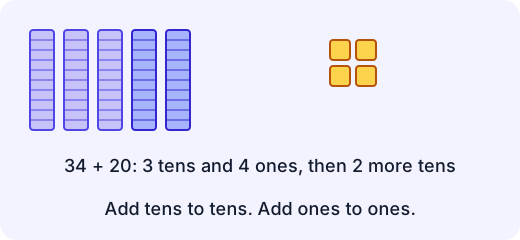
Add tens to tens
Remember that a two-digit number is made of tens and ones. When you add a number of tens, only the tens change.
Start Add Tens Ones Answer 34 20 3 + 2 = 5 4 54 41 30 4 + 3 = 7 1 71 26 50 2 + 5 = 7 6 76 A number like 20, 30 or 50 is just 2 tens, 3 tens or 5 tens. So is like "3 tens and 2 tens", and you already know that is 5 tens.
10 more and 10 less
Adding one ten is the quickest jump of all. It changes only the tens digit, and it goes up by 1.
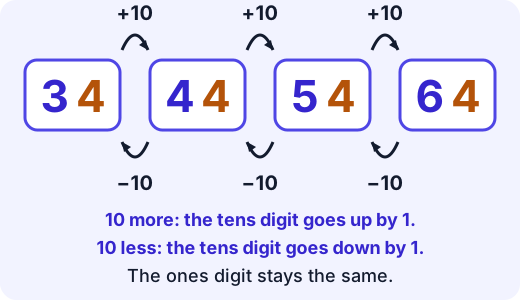
- 10 more than 47 is 57.
- 10 less than 82 is 72.
- 10 more than 90 is 100.
On a hundred chart, 10 more is one row down, and 10 less is one row up. Try it: put your finger on 23 and slide down one row. You land on 33.
Add ones
Adding a one-digit number to a two-digit number only changes the ones, at least at first.
: the ones are . The tens stay the same. The answer is 39.
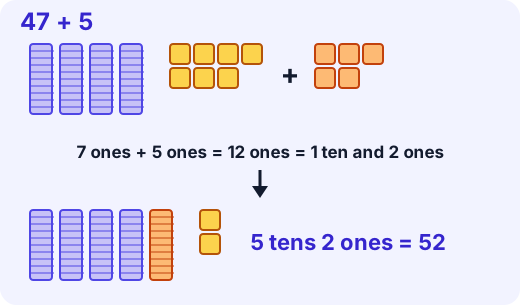
Sometimes the ones make a new ten. That is when you bundle ten ones into a ten, just like tying sticks.
Example. .
- Ones: ones.
- Twelve ones is 1 ten and 2 ones. Tie ten of them into a new ten.
- Now count the tens: tens and new ten make tens. The ones left over are .
- tens and ones is 52.
Another way is to make the next ten first. To add , you need 3 to get to 50. So split the 5 into . Then and .
Mistakes to watch for
- Adding the tens to the ones. Some children say , because they add the 2 to the 4. But 20 is 2 tens, so it goes with the 3 tens. The answer is 54.
- Changing the wrong digit for 10 more. is 57, not 48. Ten is a tens thing.
- Forgetting the new ten. In , you have 12 ones. Write "2" in the ones place and remember to give the ten to the tens.
Try it: Use real things. Make 28 with 2 bundles of ten and 8 loose sticks. Add 6 loose sticks. What happens when you have more than 9 loose ones? How many bundles and loose sticks do you have in the end?
For the grown-up helping
Use bundles of ten (sticks tied with a rubber band, or pencils in groups) and a hundred chart. Practise "10 more, 10 less" until it is quick, then add tens (30, 40), then ones, and only last the case where the ones make a new ten. Ask "What stayed the same, and what changed?" every time. If your child counts on by ones, that is fine at this stage. The aim is to notice how the digits change. Do not rush them to write the sum in a column.
Lab
Hop on the hundred chart
Use the hundred chart to add tens and ones. Press +10 to jump down a row, and +1 to move along one square.
Your goals
- Hop to the answer for five tasks, using 10 more, 10 less and ones.
- Notice which digit changes when you press +10 and which stays the same.
The interactive lab opens once you register. Register to do this.
Activity
Bundles and cards
Your child adds with bundles of ten and loose sticks, then plays a "10 more, 10 less" card game. About 20 minutes.
You'll need
- About 70 sticks, straws or pencils
- Rubber bands or string
- 8 small pieces of paper
- A pencil
Steps
- Together, tie 5 bundles of ten sticks. Keep 20 sticks loose.
- Build 34 with 3 bundles and 4 loose sticks. Say: Now add 20. What do we do? Your child adds 2 bundles. Ask how many bundles and loose sticks there are now, and what number that is (54).
- Build 47. Say: Now add 5. Your child adds 5 loose sticks, then has more than 9 loose. Ask: What can we do with ten loose sticks? They tie a new bundle. Ask what the number is now (52).
- Do two more of your own, such as 26 + 30 and 38 + 4.
- On the pieces of paper, write four two-digit numbers (for example 15, 38, 52, 76) twice. These are your cards.
- Turn the cards over. Your child turns one over and you call out 10 more or 10 less. They say the answer, and check it by sliding a finger up or down a hundred chart if you have one.
- End by asking "What stays the same when we add 10?"
Safety
- Keep rubber bands away from babies and toddlers.
Keeping a log of the activity is for registered learners. Register to do this.
Quick check
Adding tens and ones check
Seven questions. Think about tens and ones.
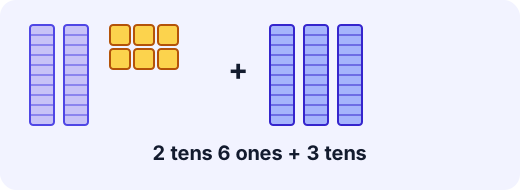
1.How many are there in all? Add the blocks.
Answer with a number
2.What is 10 more than 47?
Answer with a number
3.What is 10 less than 82?
Answer with a number
4.What is 34 + 5?
Answer with a number
5.What is 28 + 6?
Answer with a number
6.You add 20 to 35. Which digit changes?
- The tens digit
- The ones digit
- Both digits
Choose one
7.Match each sum to its answer.
- 23 + 10
- 23 + 20
- 23 + 5
- 23 − 10
Match each to: 33 · 28 · 13 · 43
Answering and checking are for registered learners. Register to do this.
Quick check
New puzzles
Use what you know about tens and ones in new places.
1.Hari has 45 stickers. His aunt gives him 30 more. How many stickers does Hari have now?
Answer with a number
2.In a game you start with 74 points. You lose 10 points. How many points do you have now?
Answer with a number
3.A farmer has 29 eggs in a box. She puts in 4 more. How many eggs are in the box now?
Answer with a number
4.Sam notices that 67 + 10 = 77 and 67 + 20 = 87. What is 67 + 30?
Answer with a number
5.What is 52 + 4? Asha says 56. Ben says 92. Who is right?
- Asha is right
- Ben is right
- Neither of them
Choose one
Answering and checking are for registered learners. Register to do this.
Activity
Tell it back
Your child explains, in their own words, how to work out 34 + 20 and why the 4 does not change. Three minutes.
Steps
- Write 34 + 20 on paper. Ask your child to work it out. Let them use sticks if they want.
- Ask "How did you do it?" and "Why is the answer 54 and not 36?"
- Ask "Which digit changed? Which digit stayed the same? Why?"
- Write down what your child says in their own words.
Keeping a log of the activity is for registered learners. Register to do this.
Like what you see?
Register for free to answer the quick checks, do the activities and save your work. Your work is saved on your device and syncs to your account.