Unit 7
Story problems
Act out and draw a story to find out what is happening, then write it as a number sentence.
Read
What is the story doing?
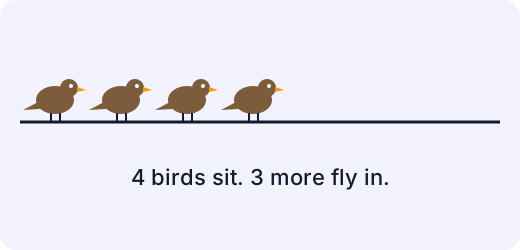
Kavya is watching the wire outside her window. Four birds are sitting on it. Then three more birds fly in.
"How many birds are on the wire now?" asks her brother.
Kavya does not need a rule. She watches what happens. Birds come, so there are more. She counts on from 4: five, six, seven.
Stories are things that happen
A story problem is a little story with a number question inside it. To solve it, picture what is happening. There are three main kinds of story.
The story What happens Example Join Some more come, or two groups are put together 5 birds, 3 more come. How many now? Separate Some go away or are taken away 6 apples, 2 are eaten. How many are left? Compare Two groups sit side by side. Which has more, and how many more? 4 red and 7 blue. How many more blue? 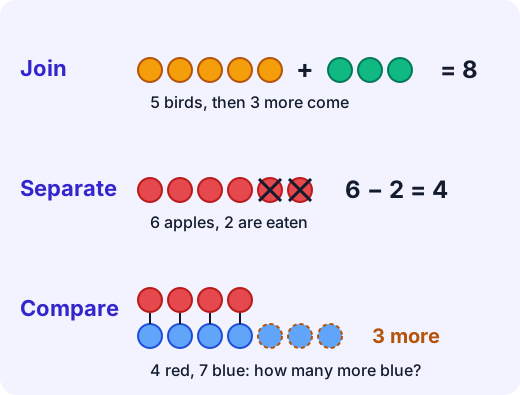
Draw it or act it out
Here is a way that works for every story.
- Read the story slowly. Picture it.
- Draw circles for the things, or use counters, beans or buttons.
- Do what the story does. Add more circles. Cross some out. Line up two groups.
- Count to find the answer.
- Write the number sentence.
- Check: does your answer make sense in the story?
Example. Tara has 9 ripe mangoes and 5 green mangoes. How many mangoes in all? Draw 9 circles and 5 more. Count them all: 14. The sentence is .
Example. There were 15 children on the bus. 8 got off at the market. How many are on the bus now? Draw 15 circles and cross out 8. Seven are left. The sentence is .
Example. Anil has 8 marbles. Zara has 13. How many more does Zara have? Line up Anil's 8 next to 8 of Zara's. The extra marbles are the answer: 5. The sentence is .
Number sentences
A number sentence is the story told in numbers. says "4 and 3 more make 7". Sometimes the story hides one number. We hold its place with a box:
"Sana has 8 pencils. A friend gives her some more. Now she has 11." Draw 8 circles, keep drawing until there are 11, and count the new ones: 3. So the box is 3.
The story tells you, not the little words
Some people say "more means add" and "left means subtract". Be careful! The words can trick you.
Sana has some pencils. Her friend gives her 4 more. Now she has 11. How many did she start with?
The story says "more", but the answer is not . Draw 11 circles. Four of them are the new ones from her friend. Cover those 4. The ones that are left are the ones she started with: 7. So , and .
The rule that always works: picture what happens in the story. Let the picture tell you what to do.
Try it: Make up a story for . Then make up a different story that also uses 9 and 4 but is a compare story. What is the same and what is different?
For the grown-up helping
Let your child act every story out with real things before drawing or writing. Beans, buttons and cups all work. Ask "What is happening in the story?" before "Do we add or take away?", and avoid teaching key words, because they fail on stories like the pencil one. Ask for the number sentence only after the answer is found. It is normal for children to find compare stories and "how many did I start with" stories harder than join and separate stories. Lots of acting out is the cure.
Activity
Act out the story
Your child acts out six short stories with counters and writes a number sentence for each. About 20 minutes.
You'll need
- About 20 counters (dried beans, buttons or coins)
- A cup or a small cloth to cover counters
- Paper and a pencil
Steps
- Tell story 1 slowly: Priya has 5 stickers. Her aunt gives her 4 more. How many stickers now? Your child shows 5 counters, adds 4, counts, and writes the number sentence.
- Story 2: There are 12 mangoes in a basket. We eat 5. How many are left? Your child puts out 12 counters, moves 5 away, counts what is left, and writes the sentence.
- Story 3, a compare story: Rahul has 6 pebbles and Zoya has 9. How many more does Zoya have? Your child lines up two rows, one above the other, and counts the extra pebbles.
- Story 4, the start is hidden: Leila had some stickers. She got 3 more and now has 10. How many did she have first? Your child puts out 10, covers 3 with the cup, and counts the rest.
- Story 5: Ben had 11 marbles. He lost some. Now he has 6. How many did he lose? Your child puts out 11, takes away counters until 6 are left, and counts how many were taken.
- Story 6: your child makes up a story with the numbers 8 and 3 and tells it to you. You act it out.
- After each story ask "How do you know?" and let your child point to the counters. Do not hurry them.
Safety
- Counters and beans are small. Keep them away from babies and toddlers, and do not let anyone put them in their mouth.
Keeping a log of the activity is for registered learners. Register to do this.
Quick check
Story problems check
Seven questions. Picture each story, draw it if you need to, and take your time.
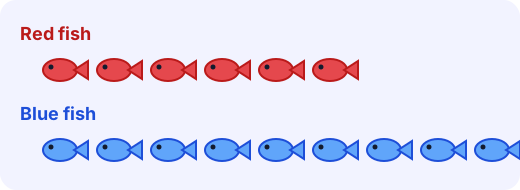
1.How many more blue fish than red fish are there?
Answer with a number
2.Mia has 7 stickers. She gets 6 more. Which number sentence matches the story?
- 7 − 6 = 1
- 7 + 6 = 13
- 7 + 7 = 14
Choose one
3.There were 15 children on a bus. 8 got off at the market. How many are on the bus now?
Answer with a number
4.Sana has some pencils. Her friend gives her 4 more. Now she has 11. How many pencils did she have at the start?
Answer with a number
5.Tara has 9 ripe mangoes and 5 green mangoes. How many mangoes does she have in all?
Answer with a number
6.8 birds are sitting on a wire. Match each story to its number sentence.
- 3 more birds land. How many now?
- 3 birds fly away. How many are left?
- Some more birds land. Now there are 11. How many landed?
Match each to: 8 − 3 = 5 · 8 + ? = 11 · 8 + 3 = 11
7.Which stories can be solved with 10 − 4? Pick all that apply.
- There are 10 cookies. 4 are eaten. How many are left?
- There are 10 red balloons and 4 blue balloons. How many more red than blue?
- Dev has 10 stickers. He gets 4 more. How many now?
- 4 children are playing. 10 more children join. How many now?
Choose all that apply
Answering and checking are for registered learners. Register to do this.
Quick check
New puzzles
These stories are new. Picture what happens in each one.
1.A shelf has 16 books. 9 of them are picture books and the rest are story books. How many are story books?
Answer with a number
2.Meera has 6 stickers. Ravi has 12 stickers. How many more stickers does Ravi have than Meera?
Answer with a number
3.Kofi had some mangoes. He gave 6 to his neighbour and now he has 8. How many mangoes did he have at the start?
Answer with a number
4.Jun has 5 red kites and 7 yellow kites. Which number sentence tells how many kites he has in all?
- 7 − 5 = 2
- 5 + 7 = 12
- 5 + 5 = 10
Choose one
5.There were 9 birds in a tree. Some more flew in. Now there are 15 birds. How many flew in?
Answer with a number
Answering and checking are for registered learners. Register to do this.
Activity
Tell it back
Your child makes up and explains two stories in their own words. About five minutes.
Steps
- Write 8 − 3 = 5 on paper. Ask your child to tell you a story that goes with it.
- Ask "How did you know this is a take-away story?" Let them use counters or a drawing to show you.
- Now write 4 + ? = 9. Ask for a story, and ask "How could we find the missing number?"
- Write down what your child says in their own words. Do not correct it. Just note it.
Keeping a log of the activity is for registered learners. Register to do this.
Like what you see?
Register for free to answer the quick checks, do the activities and save your work. Your work is saved on your device and syncs to your account.