Unit 5
Adding within 20
Add numbers up to 20 by counting on, making ten and using doubles, and see why the order does not change the total.
Read
Three ways to add
Zara has 8 mangoes in a basket. Her grandmother gives her 5 more. How many mangoes does Zara have now?
Adding means joining groups to find the total. You could count every mango from 1, but there are quicker ways. Here are three.
Way 1: Count on
Start with the bigger number, then count on the smaller one.
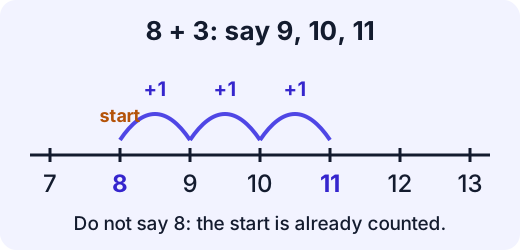
Example. 8 + 3
- Start at 8. Do not say "8" again. You are already there.
- Count on 3: 9, 10, 11.
- 8 + 3 = 11.
You can hold up fingers to keep track of how many you have counted on. Counting on works best when you add a small number, like 1, 2 or 3.
Way 2: Make ten
Ten is an easy number to add to. So fill a ten frame first.
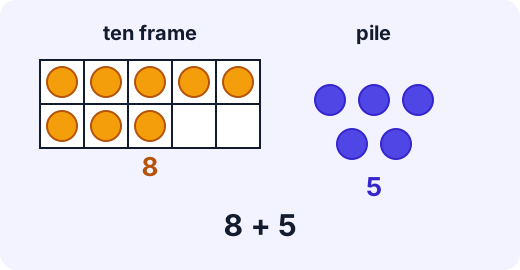
Example. 8 + 5
- 8 needs 2 more to make 10.
- Take 2 from the 5. That leaves 5 − 2 = 3.
- 8 + 5 is the same as 10 + 3, which is 13.
This is where your number bonds come in! You need to know that 8 and 2 make 10, and that 5 can be split into 2 and 3.
Way 3: Doubles
A double is a number added to itself: 6 + 6 = 12. Doubles are easy to remember.
Double Total 5 + 5 10 6 + 6 12 7 + 7 14 8 + 8 16 9 + 9 18 If you know a double, you also know the "next door" sum. 7 + 8 is one more than 7 + 7. Seven plus seven is 14, so 7 + 8 is 15.
The order does not matter
Try 3 + 9 and 9 + 3. Both make 12.
When you join two groups, you get the same total whichever group you count first. So you can swap the numbers: start with the bigger one and the counting is easier. For 3 + 9, think 9 + 3: say 10, 11, 12.
Which way should I use?
- Adding 1, 2 or 3? Count on.
- Adding to 8 or 9? Make ten.
- Two numbers that are the same, or almost the same? Use a double.
There is no wrong way to add if you get the right total and can explain how you did it.
A mistake to watch for
When counting on from 8 to add 3, some children say "8, 9, 10" and get 10. They counted the starting 8 as one of the three. Instead, hold the 8 in your head and say 9, 10, 11. Three hops, and you land on 11.
Try it: Work out 9 + 6. Which way will you use? Can you do it another way?
For the grown-up helping
Let your child use real things and a ten frame before they do it in their head. Ask "How did you work it out?" more often than "What is the answer?" Learn the sums up to 10 (like 3 + 4 or 6 + 2) until they come quickly; they are the building blocks for making ten. Using fingers is fine, and it is a good sign that your child is learning to count on.
Lab
The ten-frame filler
Fill the ten frame first by moving counters from the pile, then use what is left to find the total.
Your goals
- Make ten in the frame for each of five sums by moving counters from the pile.
- Say the total as ten plus what is left, and type it in.
The interactive lab opens once you register. Register to do this.
Activity
Ten-frame sums
Your child draws a ten frame and uses real counters to add numbers to 20 by making ten. About 20 minutes.
You'll need
- Paper and a pencil or marker
- 20 counters in two colours (10 and 10), such as coins, buttons, or paper dots
- A pair of dice (optional)
Steps
- Draw a ten frame on the paper. It is a rectangle with 2 rows of 5 boxes. Make it big enough for a counter in each box.
- Say "8 + 5". Your child puts 8 counters of one colour in the frame and 5 of the other colour beside it.
- Ask "How many more does the frame need to make ten?" Your child moves 2 counters from the pile into the frame.
- Ask "How many are in the pile now?" (3.) Say "So 8 + 5 is 10 + 3. How many is that?" (13.)
- Do four more, such as 9 + 4, 7 + 6, 6 + 8, 9 + 7.
- Now try "counting on". Say "6 + 3", and have your child start at 6 and say "7, 8, 9" while folding down three fingers.
- Optional game, roll two dice, add them (the total can go up to 12) and say which way you used.
- Finally ask "Is 3 + 9 the same as 9 + 3? Show me with the counters."
Safety
- Small counters can be a choking hazard for babies and toddlers. Keep them away from younger children and put them away after the game.
Keeping a log of the activity is for registered learners. Register to do this.
Quick check
Adding within 20 check
Seven questions. Use any way you like to work out the totals.
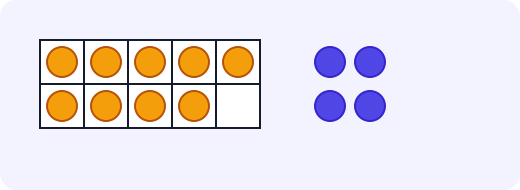
1.How many counters are there in all?
Answer with a number
2.6 + 7 = ?
Answer with a number
3.Pam works out 7 + 8 by thinking "7 + 7 = 14". What should she do next?
- Add 1 more, to get 15
- Take away 1, to get 13
- Add 8 more, to get 22
Choose one
4.Ravi counts on to work out 9 + 3. Which counting words does he say?
- 10, 11, 12
- 9, 10, 11
- 1, 2, 3
Choose one
5.7 + 9 = ?
Answer with a number
6.5 + 8 = 13. What is 8 + 5?
- 13
- 3
- 14
Choose one
7.Pick all the sums that make 12.
- 6 + 6
- 5 + 8
- 9 + 3
- 4 + 7
Choose all that apply
Answering and checking are for registered learners. Register to do this.
Quick check
New puzzles
Use your adding ways on these new puzzles.
1.Ravi has 9 marbles. He wins 6 more at the school fair. How many marbles does he have now?
Answer with a number
2.8 + ? = 15
Answer with a number
3.Zara works out 9 + 5 like this. "I take 1 from the 5 and give it to the 9. That makes 10, and 4 is left." Is Zara's way right?
- Yes. 10 + 4 = 14, which is the same as 9 + 5.
- No. The total would be 15 because she moved a counter.
- No. You are not allowed to move counters.
Choose one
4.3 + 8 + 7 = ?
Answer with a number
5.Which helps you work out 6 + 7?
- 6 + 6 = 12, then 1 more
- 6 + 6 = 12, then take 1 away
- 7 + 7 = 14, then 7 more
Choose one
Answering and checking are for registered learners. Register to do this.
Activity
Tell it back
Your child explains, in their own words, how they add 9 + 6, and why 6 + 9 gives the same total. Three minutes.
Steps
- Ask "How would you work out 9 + 6? Show me." Let your child use counters or fingers.
- Ask "Why did you do it that way?" Do not correct the method unless the total is wrong. Many methods are right.
- Then ask "What about 6 + 9? Will it be the same? How do you know?"
- Write down what your child says, in their words.
Keeping a log of the activity is for registered learners. Register to do this.
Like what you see?
Register for free to answer the quick checks, do the activities and save your work. Your work is saved on your device and syncs to your account.