Unit 4
Number bonds
Split a number into two parts in every way, and see how a number can be broken up and put back together without changing.
Read
Breaking numbers apart
Meena has 10 laddoos on a plate. Her two cousins are coming, and she wants to share them. She can put some laddoos on a blue plate and the rest on a red plate.
How many ways can she do it?
She could put 5 on each plate. Or 6 on the blue plate and 4 on the red one. Or 9 and 1. Or even 10 on one plate and none on the other!
The number of laddoos never changes. It is always 10 in all. We just break it into two parts.
Part, part, whole
A number bond shows a whole and its two parts.
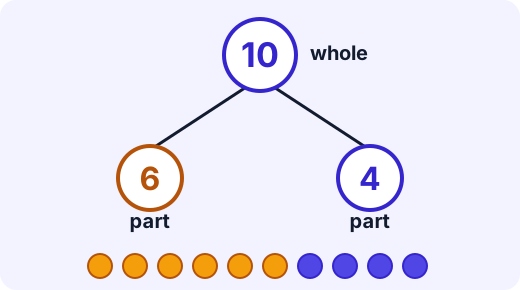
The two parts always put back together to make the whole:
If you know the whole and one part, you can find the other part. Whole 9, one part 4? The other part is 5, because 4 and 5 make 9.
All the ways to split 10
Look at all the ways to split ten counters into two parts.
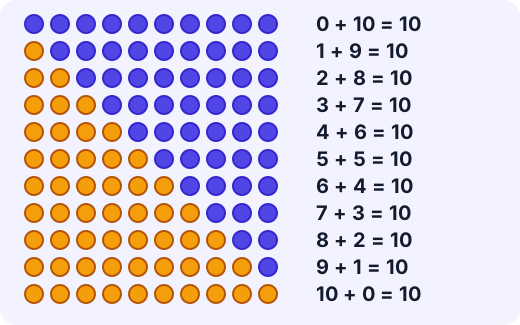
Do you see a pattern? Going down, one part gets one bigger and the other part gets one smaller. The whole stays 10.
One part The other part 1 9 2 8 3 7 4 6 5 5 The rest are the same pairs the other way round. 6 and 4 is the same pair as 4 and 6, just with the plates swapped.
Making ten
The pairs that make ten are very useful: 1 and 9, 2 and 8, 3 and 7, 4 and 6, 5 and 5. Learn them well. They will help you add and subtract bigger numbers soon.
Example. Ravi has 7 stickers. He wants 10. How many more does he need?
- 7 and what makes 10? Think of the bond: 7 and 3 make 10.
- Ravi needs 3 more.
Other numbers split too
Every number can be split. For 5, the splits are 0 and 5, 1 and 4, 2 and 3, 3 and 2, 4 and 1, 5 and 0. A whole can be 4, 8, 12, or any number you like.
Try it: Take 6 buttons. Split them into two groups. How many different ways can you find? What do the two groups always make together?
A mistake to watch for
Some children think the whole changes when the parts change. It does not. If Meena moves 2 laddoos from the blue plate to the red plate, the parts change, but there are still 10 laddoos.
For the grown-up helping
Use real objects (seeds, buttons, coins) and two bowls or a folded paper. Let your child find the splits by moving things, not by guessing. Say the bond in both directions, "6 and 4 make 10" and "10 is 6 and 4". Do not rush to written sums. Quick recall of the pairs that make ten comes from lots of playing, not from drilling.
Lab
The split machine
Pick a whole, then move counters between two trays to split it. Save every different split you find.
Your goals
- Find all 11 ways to split 10 into two parts.
- Find every way to split one other number, too.
The interactive lab opens once you register. Register to do this.
Activity
Two bowls
Your child splits 10 small things into two bowls in every way, then plays "guess the hidden part". About 15 minutes.
You'll need
- 10 small things such as dry beans, large buttons or pebbles
- Two bowls or two sheets of paper
- One cup or small cloth
- Paper and a pencil
Steps
- Put all 10 things in one bowl. Say "There are 10 in all."
- Your child moves some to the second bowl. Say the bond together, for example "6 here and 4 there, 6 and 4 make 10." Write it down (6 + 4 = 10).
- Find a new split each time. Keep going until your child thinks they have found all of them, and then count how many you wrote (there are 11 if you include 0 and 10).
- Look at your list. Ask "What do you notice?" Listen for "one goes up and the other goes down."
- Now play "hidden part". Your child closes their eyes while you hide some of the 10 under the cup. Show the rest. Your child says how many are hidden.
- Swap roles. Your child hides some and you guess.
Safety
- Beans, buttons and pebbles are choking hazards. Do not use them with children under 3 in the room, and put them away afterwards.
Keeping a log of the activity is for registered learners. Register to do this.
Quick check
Number bonds check
Seven questions about parts and wholes.
1.The whole is 9. One part is 4. What is the other part?
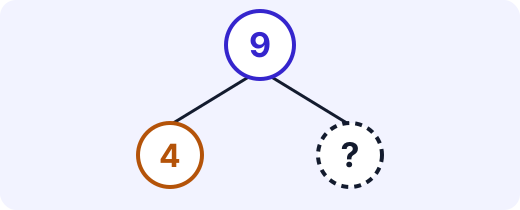
Answer with a number
2.Which two numbers make 10?
- 8 and 3
- 6 and 4
- 5 and 4
Choose one
3.10 = 7 + ?
Answer with a number
4.The ways to split 6 are: 0 and 6, 1 and 5, 2 and 4, __ and 3, 4 and 2, 5 and 1, 6 and 0. What number goes in the gap?
Answer with a number
5.Match each number to its partner that makes 10.
- 8
- 5
- 9
- 4
Match each to: 2 · 6 · 1 · 5
6.Meena has 10 laddoos on two plates. She moves 2 laddoos from one plate to the other plate. How many laddoos does she have in all now?
- 10
- 12
- 8
Choose one
7.Pick all the ways to split 8 into two parts.
- 5 and 3
- 6 and 3
- 4 and 4
- 7 and 1
- 2 and 5
Choose all that apply
Answering and checking are for registered learners. Register to do this.
Quick check
New puzzles
Parts and wholes are hiding in everyday puzzles. Can you spot them?
1.10 birds sit on a wall and a tree. 4 are on the tree. How many are on the wall?
Answer with a number
2.Ravi has 8 stickers. How many more does he need to have 10?
Answer with a number
3.Which pair is NOT a way to split 7?
- 3 and 4
- 5 and 2
- 6 and 2
- 1 and 6
Choose one
4.Zara has 9 pencils in two boxes. One box is empty. How many pencils are in the other box?
Answer with a number
5.Which makes the same total as 4 + 6?
- 6 + 4
- 5 + 4
- 10 + 4
Choose one
Answering and checking are for registered learners. Register to do this.
Activity
Tell it back
Your child explains, in their own words, what happens to the other part when one part gets bigger. Three minutes.
Steps
- Put 8 things on the table. Say "I have 8 in all. I will split them in two groups." Make groups of 5 and 3.
- Move one thing from the group of 5 to the group of 3. Ask "How many are in each group now? How many in all?"
- Ask "What happened to the 8? Why?" Let your child use the objects to show you.
- Write down what your child says, in their words.
Keeping a log of the activity is for registered learners. Register to do this.
Like what you see?
Register for free to answer the quick checks, do the activities and save your work. Your work is saved on your device and syncs to your account.