Unit 6
Subtracting within 20
Take away by counting back, and find a missing part by thinking about the whole.
Read
Taking away and finding the missing part
Meena buys 13 balloons for her little brother's birthday. A gust of wind carries 4 of them away. How many balloons are left?
Subtracting (taking away) tells us how many are left. We write it with a minus sign: 13 − 4. Here are two ways to work it out.
Way 1: Count back
Start at the whole number and hop back, one hop for each one you take away.
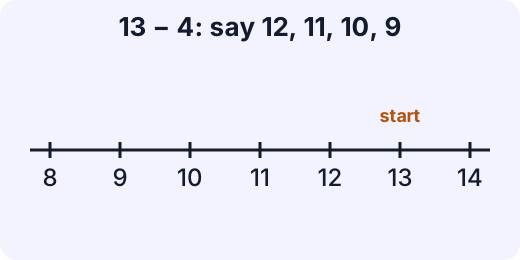
Example. 13 − 4
- Start at 13. Do not say "13" as a count. You are standing on it.
- Count back 4: 12, 11, 10, 9.
- 13 − 4 = 9.
Meena has 9 balloons left.
Counting back is a good way when you take away a small number, like 1, 2 or 3.
Way 2: Find the missing part
Remember number bonds? A whole is made of two parts. If you know the whole and one part, subtraction finds the other part.
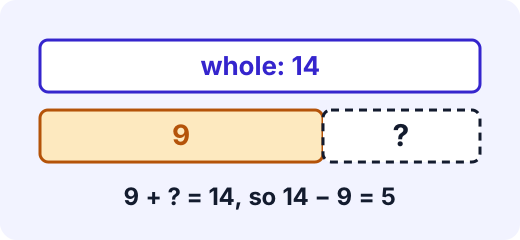
Example. 14 − 9
- Think: 9 and what makes 14? Count on from 9: 10, 11, 12, 13, 14. That is 5 counts.
- So 9 + 5 = 14, which means 14 − 9 = 5.
Subtraction is the same as finding a missing part. You can add to find the answer to a subtraction.
Finding the missing part works best when the two numbers are close together, like 14 − 9 or 15 − 12.
Adding and subtracting are partners
If 9 + 5 = 14, then these are all true too:
- 5 + 9 = 14
- 14 − 9 = 5
- 14 − 5 = 9
They use the same three numbers. The whole (14) is the biggest.
Which way should I use?
The numbers A good way Take away a small number (15 − 2) Count back The two numbers are close (16 − 13, 14 − 9) Find the missing part, counting on from the smaller number Mistakes to watch for
- Counting the number you start on. To work out 13 − 4, some children say "13, 12, 11, 10" and answer 10. Do not count the 13. Say "12, 11, 10, 9."
- Swapping the numbers. With adding, 3 + 9 and 9 + 3 are the same. With subtracting, they are not! You cannot take 9 away from 3. Always start with the whole, which is the bigger number.
Try it: There are 16 mangoes in a basket and 3 are eaten. How many are left? Now try 15 − 12. Which way did you use for each?
For the grown-up helping
Use real objects: lay out the whole, cover some with a cup, and ask how many are hidden. Do both directions often: "13 take away 4" and "4 and how many make 13?" Let your child choose the method, and ask them to say why. Fingers and number lines are good tools, and not a sign that your child is behind. Cross out counters in drawings instead of rubbing them out; it shows the thinking.
Lab
Hop on the number line
Use the number line to take away by counting back, and to find a missing part by counting on.
Your goals
- Hop back to solve three subtractions.
- Hop on to find the missing part in three more, then type the answer.
The interactive lab opens once you register. Register to do this.
Activity
Hidden counters and the chalk number line
Your child takes away by hopping back on a number line, and finds hidden parts with a cup. About 20 minutes.
You'll need
- Chalk (outdoors) or masking tape and a marker (indoors)
- 20 small counters such as coins, buttons or pebbles
- A cup or small cloth
- Paper and a pencil
Steps
- Make a number line from 0 to 20 on the ground, with a number at each step. Chalk on a path or tape on the floor both work. Leave about one big step between numbers.
- Say "14 − 3". Your child stands on 14 and takes 3 big hops backwards, saying "13, 12, 11" as they land. Ask "Where did you land?" (11.) Do four more, such as 17 − 2, 12 − 5, 20 − 4 and 15 − 1.
- Now the missing part. Put 14 counters in a row. Say "I will hide some." Cover some with the cup (for example 5) and show the rest (9). Ask "How many are hidden?"
- Ask your child to explain how they know. They might count on from 9 to 14. Write it on paper as 9 + ? = 14, and then as 14 − 9 = 5.
- Swap roles. Your child hides some counters and you work out how many are hidden.
- Do four more with different wholes between 10 and 20. At the end, pick two that your child found hard and do them again slowly.
Safety
- Hop slowly and watch for wet or slippery ground when using chalk outdoors.
- Small counters are a choking hazard for babies and toddlers. Keep them away from younger children.
Keeping a log of the activity is for registered learners. Register to do this.
Quick check
Subtracting within 20 check
Seven questions about taking away and missing parts.
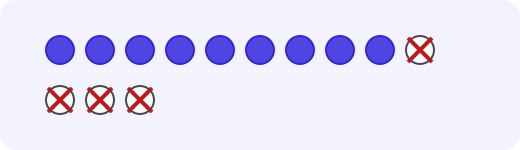
1.There were 13 counters. 4 are crossed out. How many are not crossed out?
Answer with a number
2.16 − 3 = ?
Answer with a number
3.9 + ? = 15
Answer with a number
4.Sana counts back to work out 17 − 2. Which counting words does she say?
- 16, 15
- 17, 16
- 15, 14
Choose one
5.14 − 9 = ?
Answer with a number
6.Which adding question helps you work out 12 − 7?
- 7 + ? = 12
- 12 + 7 = ?
- 12 + ? = 7
Choose one
7.Pick all the subtractions that are true.
- 15 − 6 = 9
- 13 − 5 = 7
- 11 − 4 = 7
- 17 − 8 = 9
- 12 − 3 = 8
Choose all that apply
Answering and checking are for registered learners. Register to do this.
Quick check
New puzzles
Subtraction appears in many places. Use counting back or the missing part.
1.A packet has 18 biscuits. Rohan eats 5. How many biscuits are left?
Answer with a number
2.Zara has 8 stickers. She wants 15 for her sticker book. How many more stickers does she need?
Answer with a number
3.Which is NOT a good way to work out 14 − 6?
- Count back 6 from 14
- Think 6 + ? = 14
- Count back 14 from 6
Choose one
4.Ravi has 12 marbles and gives all of them away to his friends. How many marbles does he have left?
Answer with a number
5.5 + 9 = 14. Which subtraction uses the same three numbers?
- 14 − 9 = 5
- 14 − 14 = 9
- 9 − 14 = 5
Choose one
Answering and checking are for registered learners. Register to do this.
Activity
Tell it back
Your child explains, in their own words, how an adding fact helps with a taking-away question. Three minutes.
Steps
- Say "I know that 8 + 5 = 13. Can that help me work out 13 − 8?" Let your child use counters, cups or a drawing.
- Ask "How do you know?" Do not give the answer. If your child is stuck, ask "13 is the whole. 8 is one part. What is the other part?"
- Write down what your child says, in their words.
Keeping a log of the activity is for registered learners. Register to do this.
Like what you see?
Register for free to answer the quick checks, do the activities and save your work. Your work is saved on your device and syncs to your account.