Unit 3
Comparing numbers
Find out which number is bigger, which is smaller, and when they are the same, by looking at the tens first.
Read
Which is more?
Ravi and Zara are collecting seeds for their school garden. Ravi has 47 seeds. Zara has 52 seeds.
"I have more!" says Ravi. "My number ends in 7, and 7 is big."
Is Ravi right? Let us find out, and learn a trick that never fails.
Look at the tens first
Remember bundles of ten? Let us draw both piles.
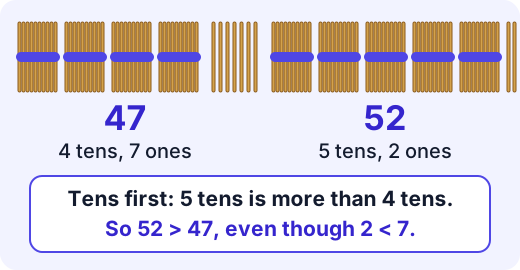
- Ravi has 4 tens and 7 ones.
- Zara has 5 tens and 2 ones.
Zara has one more whole bundle than Ravi. A bundle is ten sticks, and that is more than the few loose sticks Ravi has left over. So Zara has more.
The trick: compare the tens first. The tens are worth the most, so they decide.
What if the tens are the same?
Look at 64 and 69. Both have 6 tens, so the tens tie. Now look at the ones: 4 and 9. Nine is more than four, so 69 is more than 64.
So there are two steps:
- Look at the tens. If one is bigger, that number wins.
- If the tens are the same, look at the ones.
The signs
We use small signs so we do not have to write long sentences.
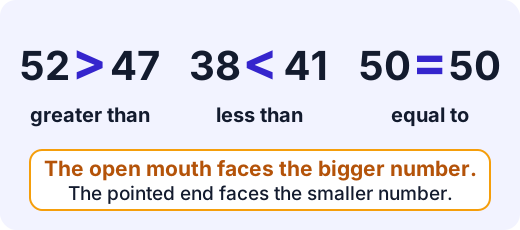
Sign We say Example > is greater than (more than) 52 > 47 < is less than (fewer than) 38 < 41 = is equal to (the same as) 50 = 50 Think of the sign as a hungry mouth. It opens towards the bigger number, and the pointed end faces the smaller one.
Example. Compare 38 and 83.
- Tens: 3 tens and 8 tens. Eight tens is more.
- So 83 is greater: 83 > 38. We can also write it the other way round: 38 < 83.
Both sentences say the same thing.
A mistake to watch for
Ravi looked at the ones first, and 7 is bigger than 2. But the 7 only means seven loose sticks. The 5 in 52 means five bundles, which is fifty. Always start with the tens.
Try it: Which is more, 29 or 31? Look at the tens first. Then check with sticks or coins.
For the grown-up helping
Let your child build both numbers from bundles, coins or ten-frames before using the signs. Ask "Which number has more tens?" before anything else. Mixing up > and < is very common at this age; the "hungry mouth" or two pencils held like a crocodile mouth helps. Do not worry about neat writing of the signs yet.
Lab
Tens first
Compare six pairs of numbers. For each pair, decide which side has more tens, then choose the sign.
Your goals
- Find which side has more tens in each pair (or that the tens are the same).
- Choose the right sign, greater than, less than or equal, for all six pairs.
The interactive lab opens once you register. Register to do this.
Activity
Digit card duel
Your child and you each make a two-digit number from digit cards and decide who has more. About 15 minutes.
You'll need
- 10 small paper squares or cards
- A pencil or marker
- Paper for writing the signs
Steps
- Write the digits 0 to 9 on the cards, one digit on each. Turn them face down and mix them.
- Each player takes two cards and makes a two-digit number (for example 3 and 7 can make 37 or 73; a 0 goes in the ones place, so 0 and 5 make 50). Choose the way that makes the bigger number, and say why.
- Put your numbers side by side. Ask "Which has more tens?" Then decide who has more. If the tens are the same, look at the ones.
- Write the comparison with a sign, for example 73 > 48. Your child says it aloud, "seventy-three is greater than forty-eight."
- Play six rounds. Then play again, but this time the player with the smaller number wins the round.
- Finish with one round of ties. Take cards until both players make a number with the same tens, such as 41 and 46, and compare the ones.
Safety
- An adult cuts the paper squares if scissors are needed.
Keeping a log of the activity is for registered learners. Register to do this.
Quick check
Comparing check
Seven questions. Look at the tens first.
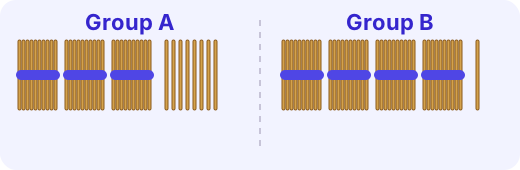
1.Which group has more sticks?
- Group A
- Group B
- They are the same
Choose one
2.Which sign makes this true? 63 __ 36
- >
- <
- =
Choose one
3.Which sign makes this true? 29 __ 31
- >
- <
- =
Choose one
4.Which is greater, 64 or 69?
- 64
- 69
Choose one
5.Use the digits 4 and 7 to make a two-digit number. What is the greatest number you can make?
Answer with a number
6.Put these numbers in order, from the least to the greatest.
- 54
- 93
- 39
- 45
Put these in order
7.Pick all the sentences that are true.
- 56 > 49
- 70 < 7
- 35 = 35
- 82 < 28
- 61 > 59
Choose all that apply
Answering and checking are for registered learners. Register to do this.
Quick check
New puzzles
Comparing numbers helps you in everyday puzzles. Use the tens first.
1.One bus has 46 children and another bus has 64 children. How many children are on the bus with fewer children?
Answer with a number
2.Amma is thinking of a number. It has 6 tens and it is less than 65. Which number is it?
- 59
- 61
- 67
- 72
Choose one
3.Use the digits 3 and 8 to make a two-digit number. What is the least number you can make?
Answer with a number
4.Sana has 45 rupees and Kabir has 54 rupees. Sana says, "I have more, because 5 is bigger than 4." What is wrong?
- She looked at the ones. The tens come first, so Kabir has more.
- Nothing is wrong. Sana has more.
- They have the same amount.
Choose one
5.Which number is greater than 67 and less than 69?
Answer with a number
Answering and checking are for registered learners. Register to do this.
Activity
Tell it back
Your child explains, in their own words, why 41 is more than 39 even though 9 is more than 1. Two minutes.
Steps
- Write 39 and 41 on paper. Ask "Which number is more? How do you know?"
- If your child says 39 because of the 9, ask "What does the 9 mean? What does the 4 mean?" Let them use sticks, coins or a drawing.
- Write down what your child says, in their words.
Keeping a log of the activity is for registered learners. Register to do this.
Like what you see?
Register for free to answer the quick checks, do the activities and save your work. Your work is saved on your device and syncs to your account.