Unit 3
Adding and subtracting within 100
Break numbers apart, make a ten and count up to add and subtract two-digit numbers in your head.
Read
Break it apart, make it easy
At the school book fair, Kabir has 47 stickers in his collection. His cousin gives him 28 more. "How many do I have now?" he asks.
He doesn't need to count 28 stickers one by one. He can break the numbers apart to make the problem easier. There is more than one way, and they all give the same answer.
First, know your facts
Quick facts to 20 make everything else faster. Two tricks:
- Doubles: , . Then is one more than a double: 15.
- Make a ten: For , take 2 from the 5 to fill up the 8. , then .
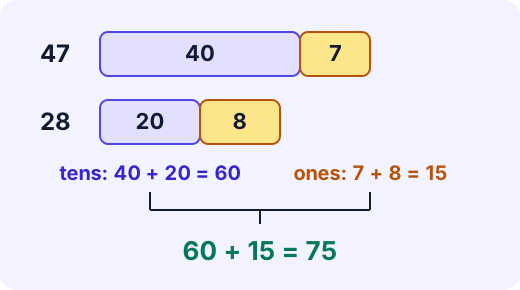
Way 1: break apart into tens and ones
Add the tens, add the ones, then put the answers together.
Example. . Tens: . Ones: . Together: .
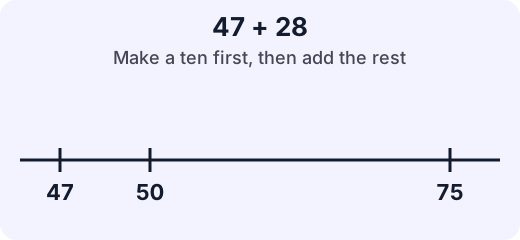
Way 2: make a ten first
Jump to the next ten, then add what is left. This works on an empty number line, where you draw only the numbers you need.
Example. . First, . The 28 has 25 left. .
Try it: Work out two ways, with tens and ones, and by making a ten. Do you get the same answer?
Taking away
Subtraction can also be broken apart.
Example. . Take away the tens first: . Then take away the ones: .
Or count up from the smaller number to the bigger one, adding the jumps:
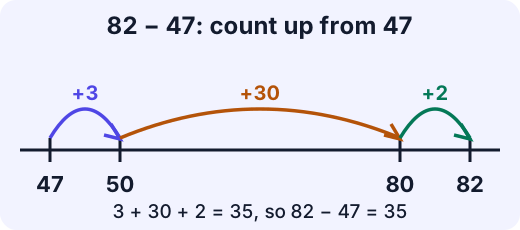
. So . Counting up is a good way when the two numbers are close, such as : just 4 steps up.
A mistake to watch for
When subtracting 82 − 47, some people see "2 minus 7, can't do it, so do 7 minus 2 instead" and write 45. That is wrong. You cannot swap the numbers! 82 is only 8 tens and 2 ones. To take 7 ones away, you need to open up one of the tens. That is why breaking apart the number you take away (as 40 then 7) is a safe way: you never need to swap anything.
You can always check by adding back: . ✓
For the grown-up helping
Let your child choose the method; there is no single "right" way, and children learn most from talking about what they did. Ask "How did you work it out?" and "Can you check another way?" Practise facts to 20 for a few minutes a day with a card game, not a long worksheet. Using 100 beads or a number line helps; do not rush to "carrying" and "borrowing" rules before your child sees why they work.
Lab
Jump on the number line
Solve three additions and two subtractions by jumping along a number line. Big jumps of 10 and 20 make it quick, small jumps fix the last bit.
Your goals
- Solve five problems by landing on the right number on the number line.
- Try to use three jumps or fewer, by jumping to a ten first and then using bigger jumps.
The interactive lab opens once you register. Register to do this.
Activity
The kitchen shop
Your child runs a pretend shop with price tags, adds up what customers buy and counts the change. About 25 minutes.
You'll need
- Eight small things from home, such as a cup, a spoon, a book, a toy, a fruit
- Eight pieces of paper for price tags
- Pencil
- Ten bundles of ten beads, buttons or paper clips (or a printed 100 chart)
Steps
- Your child writes a price between 10 and 49 on each tag and sticks it to a thing. Mix tens and ones, like 27, 35 and 48.
- You are the customer. Pick two things and ask "How much for both?" Your child works out the total out loud and shows how, using tens and ones, or jumps on a number line they draw.
- Do four customers. Ask each time "Is there another way to check?"
- Now pay with 100. Pick one thing and ask "What is my change from 100?" Your child counts up from the price to 100, for example from 65 up to 70 is 5, then up to 100 is 30, so the change is 35.
- Swap roles. You make a mistake on purpose (for example 82 − 47 = 45) and your child finds and fixes it.
Safety
- Use plastic or unbreakable items. Keep small beads and buttons away from babies and toddlers.
- This is a pretend shop; no real money is needed.
Keeping a log of the activity is for registered learners. Register to do this.
Quick check
Adding and subtracting within 100 check
Seven questions. Use any method you like, but think about how you do it.
1.What is 9 + 8?
Answer with a number
2.What is 14 − 6?
Answer with a number
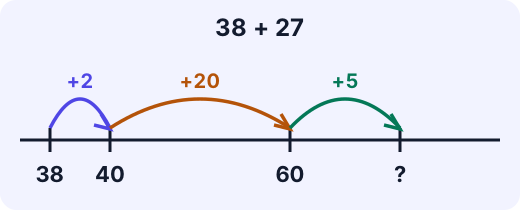
3.This number line shows the jumps for 38 + 27. Where does the last jump land?
Answer with a number
4.What is 46 + 37?
Answer with a number
5.What is 72 − 48?
Answer with a number
6.Which way will NOT give the right answer for 47 + 28?
- 40 + 20 = 60, then 7 + 8 = 15, then 60 + 15
- 47 + 3 = 50, then 50 + 25
- 47 + 30 = 77, then add 2 more
Choose one
7.Ben worked out 82 − 47 and got 45, because he did 7 − 2 in the ones. What is the right answer?
Answer with a number
Answering and checking are for registered learners. Register to do this.
Quick check
New puzzles
Use what you know about breaking numbers apart in new situations.
1.Mira has 85 stickers. She gives 39 of them to her little brother. How many stickers does Mira have left?
Answer with a number
2.One bus carries 48 children to the zoo and another bus carries 37 children. How many children are going to the zoo?
Answer with a number
3.What number goes in the box? 56 + □ = 91
Answer with a number
4.Dev works out 74 − 29 by taking away 30 first and gets 44. What should he do to fix his answer?
- Take away 1 more, so 43
- Add 1 back, so 45
- Nothing, 44 is right
Choose one
5.Which is greater?
- 48 + 37
- 90 − 4
- They are equal
Choose one
Answering and checking are for registered learners. Register to do this.
Activity
Tell it back
Your child explains how they work out an addition and a subtraction by breaking numbers apart. About five minutes.
Steps
- Write 58 + 27. Ask "How would you work this out in your head? Tell me each step."
- Write 73 − 38. Ask the same question. If your child counts up or breaks apart, ask "Why does that work?"
- Say "A friend wrote 73 − 38 = 45 because 8 minus 3 is 5. What would you tell your friend?" Write down what your child says in their own words.
Keeping a log of the activity is for registered learners. Register to do this.
Like what you see?
Register for free to answer the quick checks, do the activities and save your work. Your work is saved on your device and syncs to your account.