Unit 4
Adding and subtracting within 1000
Trade ten for one and break one into ten to add and subtract three-digit numbers.
Read
Trade ten for one
The village library has two shelves of picture books. The Hindi shelf holds 346 books and the English shelf holds 187. Zainab, the librarian, wants to know how many books there are in all.
She can't count them one by one. But she knows something clever about numbers: you can trade. Whenever you have ten of one kind of block, you can swap them for one block of the next size up.
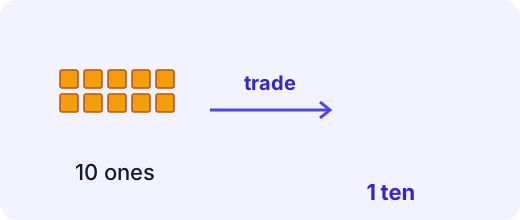
Another word for trading is regrouping. Nothing is lost. Ten ones and one ten are the same amount, just packed differently. And ten tens make one hundred.
Adding with a trade
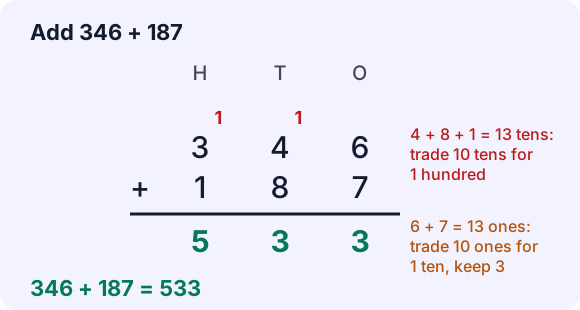
Example. . Add one place at a time, starting with the ones.
- Ones: . That is 10 ones and 3 ones. Trade the 10 ones for 1 ten. Write 3 ones, and carry 1 ten.
- Tens: (the extra 1 is the ten you just traded). That is 10 tens and 3 tens. Trade the 10 tens for 1 hundred. Write 3 tens, and carry 1 hundred.
- Hundreds: .
So . There are 533 books.
Check by estimating. is close to 350 and is close to 190. . Our answer, 533, is close, so it makes sense.
Try it: Use blocks, beans or pieces of paper to work out . How many trades do you make? (Answer: two, and the sum is 422.)
Subtracting with a break
Subtracting is trading in the other direction. If you don't have enough in a column, break one block from the column to its left into ten of the next size down.
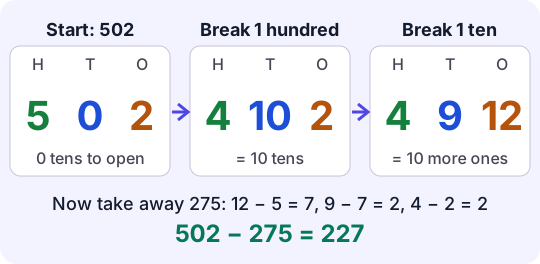
Example. . There are 2 ones, and we need to take away 5. There are no tens to break. So go to the hundreds.
- Break 1 hundred into 10 tens. Now: 4 hundreds, 10 tens, 2 ones.
- Break 1 ten into 10 ones. Now: 4 hundreds, 9 tens, 12 ones.
- Take away: ones, tens, hundreds.
So .
Check by adding back. . ✓
A mistake to watch for
When the top digit in a column is smaller, some people turn the sum around: "2 take away 5? I'll do 5 take away 2 instead." That gives the wrong answer. You can't take away more than you have, so you must break a block from the next column. If you ever find yourself doing "smaller minus bigger" in a column, stop and break a block instead.
A second slip: forgetting the carried ten. After trading, always add the extra 1 in the next column.
For the grown-up helping
Use real things before the written column method: play money (1s, 10s and 100s made of paper), bundles of straws, or blocks. Let your child do the trading with their hands and say it aloud: "Ten ones is one ten." Ask them to estimate first and to check by adding back. If a zero in the middle causes trouble (as in 502), that is normal; go slowly with blocks.
Lab
The trading mat
Add and subtract with hundreds, tens and ones blocks. Trade ten blocks for one bigger block when you add, and break one block into ten smaller ones when you subtract.
Your goals
- Solve three additions by trading ten ones for a ten, or ten tens for a hundred, until every column has 9 or fewer.
- Solve two subtractions by breaking a block when a column does not have enough, then taking the blocks away.
- Read the number left on the mat and type it in.
The interactive lab opens once you register. Register to do this.
Activity
Paper money trading
Your child makes pretend money from paper, adds and subtracts three-digit amounts, and trades by hand. About 30 minutes.
You'll need
- Paper, a pencil and a ruler
- Scissors (an adult cuts)
- A die or number cards
- About 30 small squares (the ones), 30 strips (the tens) and 12 big sheets (the hundreds)
Steps
- Adult cuts paper: small squares for ones, a strip about as long as ten squares for tens, and a big sheet for hundreds. Your child writes 1, 10 or 100 on each.
- Show that 10 squares are worth 1 strip, and 10 strips are worth 1 big sheet. Let your child swap them to check.
- Each of you rolls the die three times to make a three-digit number (first roll = hundreds, second = tens, third = ones). Lay out the paper money for each number.
- Add the two amounts together on the table. Push everything into one pile, then trade: 10 squares for a strip, 10 strips for a sheet. Say aloud what you trade. Write the sum.
- Now subtract: start with the bigger amount and take away the smaller one. When a column does not have enough, break a strip into 10 squares (or a sheet into 10 strips). Write the answer.
- Check each answer a second way, by estimating or by adding back. Do four rounds.
- Swap jobs. Make a mistake on purpose (for example 5 − 2 instead of breaking a strip) and let your child spot it.
Safety
- An adult does the cutting. Keep scissors away from small children and put the paper bits away afterwards.
Keeping a log of the activity is for registered learners. Register to do this.
Quick check
Adding and subtracting within 1000 check
Seven questions. Think about trading and breaking as you go.
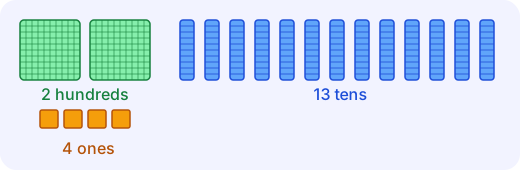
1.What number do these blocks show? (Remember that 10 tens make a hundred.)
Answer with a number
2.You add the ones and get 14. What do you do?
- Trade 10 ones for 1 ten, keep 4 ones
- Write 14 in the ones place
- Write 4 and forget the ten
Choose one
3.What is 245 + 138?
Answer with a number
4.What is 426 + 375?
Answer with a number
5.Which of these additions need a trade in the ones place? Choose all that do.
- 134 + 245
- 128 + 156
- 237 + 163
- 312 + 216
Choose all that apply
6.What is 614 − 238?
Answer with a number
7.What is 400 − 163?
Answer with a number
Answering and checking are for registered learners. Register to do this.
Quick check
New puzzles
Use trading and breaking in new situations.
1.A train leaves with 468 passengers. At the next station 175 more get on. How many passengers are on the train now?
Answer with a number
2.A shop has 700 notebooks. It sells 358 of them. How many notebooks are left?
Answer with a number
3.What number goes in the box? 289 + □ = 500
Answer with a number
4.Ben worked out 351 − 178 and got 227, because in each column he took the smaller digit from the bigger one. What is the right answer?
Answer with a number
5.Without working it out exactly, which is the best estimate for 396 + 302?
- About 600
- About 700
- About 800
Choose one
Answering and checking are for registered learners. Register to do this.
Activity
Tell it back
Your child explains, in their own words, what a trade is and why it works. About five minutes.
Steps
- Write 273 + 158. Ask "Where will you have to trade? Tell me what you do, step by step." Let your child use paper money, blocks or a drawing.
- Write 304 − 167. Ask "What do you do when there are not enough ones? What about the tens?"
- Ask "Why can you swap ten ones for one ten? Is any of the amount lost?" Write down what your child says in their own words.
Keeping a log of the activity is for registered learners. Register to do this.
Like what you see?
Register for free to answer the quick checks, do the activities and save your work. Your work is saved on your device and syncs to your account.