Unit 5
Two-step problems
Draw a bar model to find the hidden question, then solve stories that need two steps.
Read
Draw the problem
At the fruit stall, Salma's father has 48 mangoes in the morning. Then a cart brings 25 more. By evening he has sold 60. "How many mangoes are left?" Salma asks.
Notice something. The story gives three numbers, but you can't answer it with one sum. There is a hidden question: How many mangoes were there after the cart came? You have to answer that first. This is a two-step problem.
Stories like this can be messy. A good tool is a bar model: a picture that shows what you know and what's missing.
The bar model
A bar is a long box. We split it into parts and write a number in each part. A bracket above shows the whole.
- If the parts are known and the total is missing, add.
- If the total and one part are known and the other part is missing, take away.
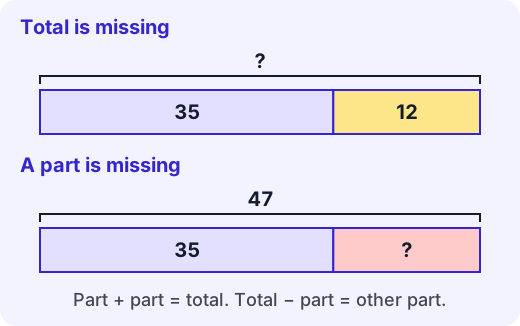
The question mark ("?") marks what you don't know yet. Drawing it makes you stop and think about which number is the whole.
Solving a two-step problem
Example. The mango stall: 48 mangoes, 25 more arrive, 60 are sold.
- Step 1: the hidden number. After the cart: .
- Step 2: the question. After selling 60: .
There are 13 mangoes left.
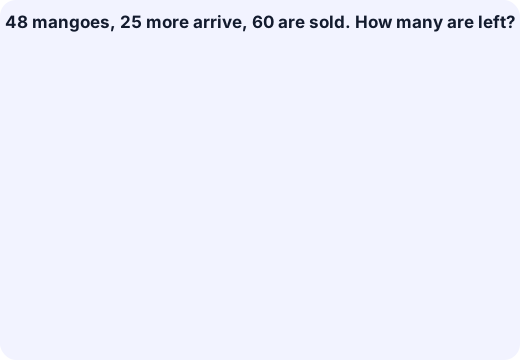
Check that it makes sense. We started with 48, got more, then sold 60. We have fewer than we started with, since 60 is more than 25. 13 is fewer than 48. ✓
Steps to follow
- Read the story twice. What is the question?
- Draw a bar model. Put in the numbers you know and a ? for the number you want.
- Ask: What do I need to find first? Work that out.
- Use that answer to answer the question.
- Check: does the answer make sense?
There can be more than one way
Example. A bag has 72 beads. 28 are red, 19 are blue and the rest are green. How many are green?
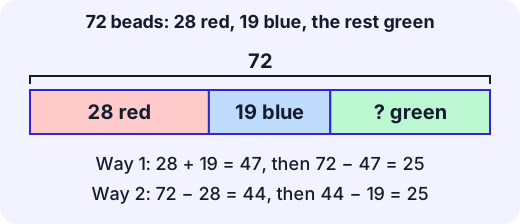
- Way 1: add the known parts, . Then .
- Way 2: take away one part at a time, and then .
Both give 25. That is a good check: do it two ways!
Try it: There are 95 stickers in an album. 36 are animals and 29 are flowers; the rest are stars. How many stars? (Answer: 30.)
Words can fool you
Example. Riya has 35 stickers. That is 12 more than Om. How many stickers does Om have?
The word "more" tempts us to add: 35 + 12 = 47. But Riya has more than Om, so Om has fewer than 35. . Om has 23 stickers.
Don't pick the sum from a clue word. Draw the bar and think about who has more. Another trap is using every number in the story. Check which numbers the question really needs.
For the grown-up helping
Let your child draw the bars, even rough ones. Ask "What is the question asking? Which number don't we know yet?" before any adding. If the answer is wrong, ask them to read it back into the story: "So the shop has 4,000 mangoes left?" Using two methods to check builds confidence.
Lab
Bar model builder
Four stories, each with a hidden question. Choose what to find first, fill in the first bar, then use the answer in the second bar.
Your goals
- For each story, choose the sensible first thing to find.
- Work out the hidden number from the first bar.
- Use it in the second bar to answer the question.
The interactive lab opens once you register. Register to do this.
Activity
Stories from home
Your child makes up and solves two-step stories about things at home, drawing a bar model for each. About 25 minutes.
You'll need
- Paper and a pencil, and two colours if you have them
- Things from home to act out stories, such as spoons, buttons or beans (not for eating)
- A ruler
Steps
- Tell a story and act it out with the things. For example, "There are 36 buttons in the tin. I put in 14 more. Then I took out 20. How many are in the tin?" Use only small numbers that your child can work with.
- Your child draws a bar for the first step (36 and 14 make ?) and works it out. Ask "What was the hidden question?"
- Next they draw the second bar (the answer, take away 20) and solve it. Ask "Does the answer make sense? Is it more or less than at the start?"
- Do two more stories, one about money (for example, a ₹100 note and two prices) and one that uses the word "more" in a tricky way (for example, "Dad is 8 years older than Mum; Dad is 40; how old is Mum?").
- Swap roles. Your child makes up a two-step story for you, and draws the bar model of it.
- Ask your child to solve one story two different ways and compare the answers.
Safety
- Use buttons, beans or paper clips only for counting; keep small things away from babies and toddlers and do not put them in mouths.
Keeping a log of the activity is for registered learners. Register to do this.
Quick check
Two-step problems check
Seven questions. Draw bar models on paper if it helps.
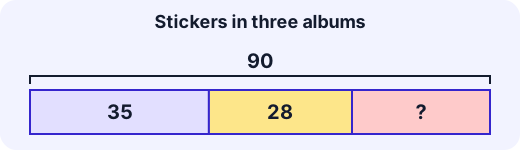
1.This bar model shows 90 stickers in three albums. What is the missing number?
Answer with a number
2.Riya has 35 stickers. That is 12 more than Om has. Which sum finds how many Om has?
- 35 − 12
- 35 + 12
- 12 + 12
Choose one
3.Tom had 54 cards. He bought 26 more and then gave 30 to his sister. How many cards does he have now?
Answer with a number
4.Put these steps for solving a two-step problem in order.
- Use it to answer the question
- Check that the answer makes sense
- Draw a bar model with a ? for what you need
- Work out the hidden number first
- Read the story and find the question
Put these in order
5.A shop has 80 pens. It sells 35 on Monday and 28 on Tuesday. How many are left? Which of these is NOT a sensible first step?
- Find how many were sold in the two days: 35 + 28
- Find how many are left after Monday: 80 − 35
- Add the pens in the shop to the Monday sales: 80 + 35
Choose one
6.Use a sensible first step to answer it. A shop has 80 pens. It sells 35 on Monday and 28 on Tuesday. How many pens are left?
Answer with a number
7.Mia saved ₹45 in January and ₹38 in February. Then she spent ₹50 on a book. How much money does she have now?
Answer with a number
Answering and checking are for registered learners. Register to do this.
Quick check
New puzzles
Find the hidden question in each story.
1.A tailor has 100 buttons. She uses 24 on shirts and 38 on dresses. How many buttons are left?
Answer with a number
2.Kavya has 47 stickers. Leo has 15 fewer than Kavya. How many stickers do they have together?
Answer with a number
3.Ali had ₹90. He bought a book for ₹35 and a pen for ₹12. Then his mother gave him ₹20. How much money does he have now?
Answer with a number
4.Nina solved this: A bag has 56 apples. 18 are bad and 20 are given away. How many are left? She wrote 56 − 18 = 38 and said the answer is 38. What should she do?
- Take away the 20 too: 38 − 20 = 18
- Add the 20: 38 + 20 = 58
- Nothing, 38 is right
Choose one
5.A library has 120 books. On Monday 45 are lent out. On Tuesday 30 are brought back. How many books are in the library after Tuesday?
Answer with a number
Answering and checking are for registered learners. Register to do this.
Activity
Tell it back
Your child explains what a hidden question is and how a bar model helps. About five minutes.
Steps
- Tell this story: "A bus has 60 passengers. 27 get off and 15 get on." Ask "How many are on the bus now? What did you work out first, and why?"
- Ask "Can you draw a bar model that shows it?" and let your child draw it and point to the ? in it.
- Say "A friend says Ann has 35 and that is 12 more than Ben, so Ben has 47 because more means add." Ask "What would you tell your friend?" Write down what your child says in their own words.
Keeping a log of the activity is for registered learners. Register to do this.
Like what you see?
Register for free to answer the quick checks, do the activities and save your work. Your work is saved on your device and syncs to your account.