Unit 6
Equal groups
Turn repeated addition into multiplication using groups and arrays, and learn the 2, 5 and 10 times tables.
Read
Groups that are the same size
For Diwali, Bhavna lines up clay lamps (diyas) on the wall. She puts 3 rows with 5 diyas in each row. How many diyas will she light?
She could count them one by one. Or she could notice something: every row is the same. That makes it much quicker.
Equal groups
Equal groups have the same number of things in each group. Four bags with 5 apples in each bag are equal groups. Four bags with 5, 5, 6 and 4 apples are not.
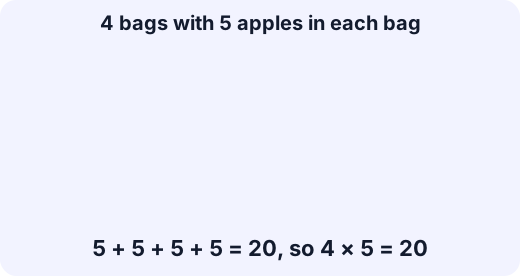
To find the total, you can add the same number again and again. This is called repeated addition:
There are 4 groups of 5. We write that as a multiplication:
Read it as "four times five equals twenty". The first number says how many groups. The second says how many are in each group. The × sign is a short way to write "groups of".
Example. Bhavna's diyas: 3 rows of 5. Repeated addition: . Multiplication: . She lights 15 diyas.
Arrays
When the equal groups are lined up in neat rows and columns, we call the picture an array. Bhavna's diyas are an array.
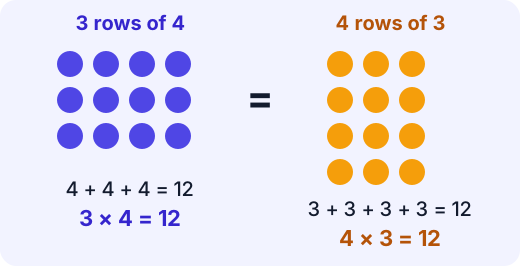
The array of 3 rows of 4 dots shows . If you turn it a quarter turn, you see 4 rows of 3, which shows . The picture looks different, but the total is the same.
Try it: Lay out 12 buttons in an array with 2 rows. How many are in each row? Then try 3 rows, then 4 rows. Which arrays work?
The 2, 5 and 10 times tables
A times table lists what you get from 1 group, 2 groups, 3 groups and so on. You already know these from skip counting:
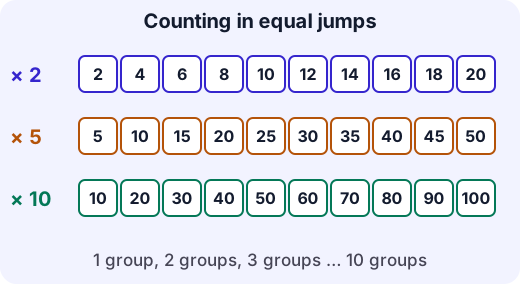
- 2s: counting by twos, all even. .
- 5s: the last digit is always 5 or 0. .
- 10s: each group adds one more ten. .
Learn them by heart, a few at a time. Say them aloud while you skip-count and they will stick.
Mistakes to watch for
- 3 × 4 is not 3 + 4. Adding gives 7 (3 and 4 together). Multiplying means 3 groups with 4 in each group: 12.
- Groups must be equal. You can't write as a multiplication, because the groups differ.
- Mind which number is which. means 3 groups of 4; means 4 groups of 3. The totals match, but the pictures are different.
For the grown-up helping
Look for equal groups all around you: eggs in a tray, window panes, wheels on bicycles, fingers on hands. Ask "How many groups? How many in each?" before you ask "How many in all?" Keep the times tables for 2, 5 and 10 playful: songs, hopping, a short game each day. Don't worry if your child counts in jumps at first; that is the idea behind multiplication.
Lab
Array maker
Build arrays of dots by choosing the number of rows and the number in each row. Watch the repeated addition and the multiplication sentence change with your array.
Your goals
- Build five arrays that match the tasks, such as 3 rows of 5 or 6 rows of 10.
- Find two different arrays with 20 dots (4 rows of 5 and 5 rows of 4) and see that the total is the same.
The interactive lab opens once you register. Register to do this.
Activity
Equal groups at home
Your child hunts for equal groups and arrays around the home, and builds some with small objects. About 25 minutes.
You'll need
- About 30 small objects such as buttons, pebbles, dry beans or paper clips (not for eating)
- Paper and a pencil
Steps
- Go on a hunt together. Find at least five examples of equal groups or arrays, for example an egg tray, a muffin tin, bicycle wheels, window panes, a bunch of bananas, or fingers on hands. For each, ask "How many groups? How many in each? How many in all?"
- For two of them, your child writes the repeated addition and the multiplication, such as 3 + 3 + 3 + 3 = 12 and 4 × 3 = 12.
- Build arrays with the small objects. Use exactly 12 objects. Make arrays with 2 rows, then 3 rows, then 4 rows. Draw each one and write the multiplication.
- Choose 20 objects. Make 4 rows of 5, then turn the array to make 5 rows of 4. Ask "What stayed the same? What changed?"
- Practise the 5 times table by putting 5 objects into each of several small bowls and counting by fives.
- Challenge your child to make an array that does not work, such as 13 objects in 3 equal rows. Ask "What went wrong?"
Safety
- Keep small objects away from babies and toddlers and do not put them in mouths.
- Stay on the ground when you look at things up high; do not climb on furniture to count.
Keeping a log of the activity is for registered learners. Register to do this.
Quick check
Equal groups check
Seven questions about groups, arrays and the 2, 5 and 10 times tables.
1.How many dots are in this array?

Answer with a number
2.Which multiplication matches 5 + 5 + 5?
- 3 × 5
- 5 × 5
- 3 + 5
Choose one
3.What is 7 × 5?
Answer with a number
4.What is 8 × 10?
Answer with a number
5.Which of these can be written as a multiplication?
- 2 + 2 + 2 + 2
- 3 + 4 + 5
- 5 + 5 + 6
Choose one
6.Match each repeated addition to its multiplication.
- 2 + 2 + 2 + 2 + 2
- 10 + 10 + 10
- 5 + 5 + 5 + 5
Match each to: 4 × 5 · 5 × 2 · 3 × 10
7.Which of these numbers are in the 5 times table?
- 15
- 24
- 35
- 52
Choose all that apply
Answering and checking are for registered learners. Register to do this.
Quick check
New puzzles
Equal groups are hiding in these stories.
1.An auto-rickshaw has 3 wheels. How many wheels do 5 auto-rickshaws have altogether?
Answer with a number
2.Rohan has 6 coins and each coin is worth ₹10. How much money does he have?
Answer with a number
3.A garden has 4 rows with 5 plants in each row. Then 2 more rows of 5 plants are added. How many plants are there now?
Answer with a number
4.Dia says that 4 × 3 and 3 × 4 cannot both be 12 because they look different. Is she right?
- No, both are 12. An array of 3 rows of 4 turns into 4 rows of 3.
- Yes, only one of them can be 12.
- No, they are both 7.
Choose one
5.Each hand has 5 fingers. How many fingers are there on 7 hands?
Answer with a number
Answering and checking are for registered learners. Register to do this.
Activity
Tell it back
Your child explains, in their own words, what 3 × 4 means and how it links to adding. About five minutes.
Steps
- Write 3 × 4. Ask "What does this mean? Can you draw it?" Let your child use objects or a drawing.
- Ask "How can you write it as an addition?" and "How is 3 × 4 different from 3 + 4?"
- Ask "Can you write 5 + 5 + 6 as a multiplication? Why or why not?" Write down what your child says in their own words.
Keeping a log of the activity is for registered learners. Register to do this.
Like what you see?
Register for free to answer the quick checks, do the activities and save your work. Your work is saved on your device and syncs to your account.