Unit 7
Sharing equally
Share things fairly, write it as division, and use the times tables to find how many each gets.
Read
Fair shares
Ishaan's grandmother has made 12 laddoos for the three cousins. "Share them fairly," she says. What does fair mean? It means everyone gets the same number.
Ishaan does it the way you would: he gives one to each cousin, then another to each, and keeps going until the plate is empty.
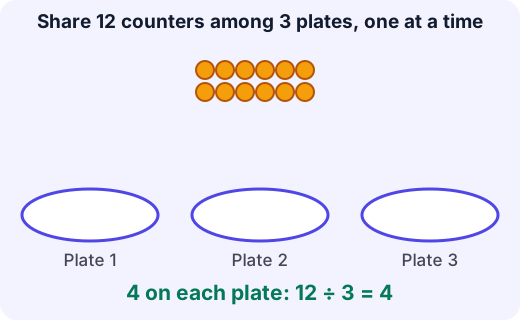
Each cousin gets 4 laddoos. We say 12 shared equally among 3 is 4 each. We write it with the division sign:
Read it as "twelve divided by three equals four" or "twelve shared among three is four each".
Sharing undoes making equal groups
Last time you made equal groups: 3 groups of 4 is . Sharing goes the other way. It starts with the total, 12, and the number of groups, 3, and asks how many go in each group.
So you can use the times tables you know. To find , ask: 5 times what makes 20? Since , the answer is 4.
Example. Share 30 mangoes equally among 10 baskets. Think: . . So each basket has 3 mangoes.
Two questions with one answer
A division can answer two different questions:
- Sharing: 12 laddoos shared among 3 cousins. How many does each get? (4)
- Grouping: 12 laddoos are put in boxes of 4. How many boxes? (3)
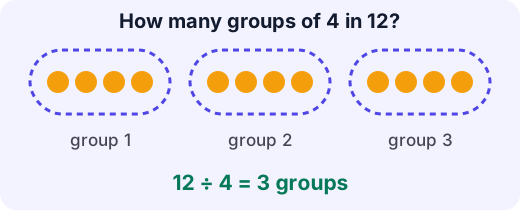
Both are . Both link to the same family of facts.
A fact family
The numbers 3, 4 and 12 belong together. They make four facts:
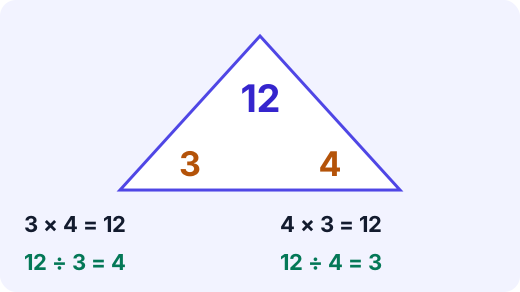
, , and . If you know one, you know all four.
Try it: Use the numbers 5, 2 and 10 to write a fact family. (Answer: , , , .)
When it doesn't come out even
Share 14 counters among 3 plates. Each plate gets 4, which uses 12 counters. There are 2 left over. You can't share 14 equally among 3 with nothing left, since no number of 3s makes 14 exactly. Some numbers share equally and some leave a remainder.
Mistakes to watch for
- Unfair is not sharing. If the plates have 5, 3, 2 and 2, they are not equal. Sharing equally means the same on every plate.
- Order matters. , but is not 4. With multiplication, the order can swap; with division, it cannot. Start with the total.
- Don't forget to check. Multiply back: ✓.
For the grown-up helping
Share real things: grapes, beans, cards, stickers or pebbles. Let your child deal one at a time, then count each pile. Ask "Is it fair? How do you know?" and "What multiplication fact helps?" Leftovers are a good time for a conversation: "What could we do with the extra?" Keep the language friendly: "shared among" first, then the ÷ sign.
Lab
Fair shares
Deal counters onto plates, one to each plate at a time, until you cannot deal a full round. Then say how many each plate got and how many are left over.
Your goals
- Share 12, 20, 18 and 30 counters equally and say how many each plate gets.
- Find out what happens when 14 counters are shared among 3 plates (some are left over).
- Link each share to a times-table fact.
The interactive lab opens once you register. Register to do this.
Activity
Fair shares at home
Your child shares small things equally among family members or toys, writes the division and the matching multiplication, and talks about leftovers. About 25 minutes.
You'll need
- 30 small objects such as buttons, pebbles, beans or paper clips (not for eating)
- Up to 10 paper plates, bowls or sheets of paper
- Paper and a pencil
Steps
- Put 12 objects in a pile and set out 3 plates. Your child deals one object at a time to each plate until the pile is gone. Ask "Is it fair? How many on each plate?" Write 12 ÷ 3 = 4.
- Ask "Which multiplication fact is the same story?" and write 3 × 4 = 12. Then write the other two facts in the family (4 × 3 = 12 and 12 ÷ 4 = 3).
- Share 20 objects among 5 plates, then 18 between 2 plates, and 30 among 10 plates. Before dealing, your child guesses the answer using a times table ("5 times what is 20?"), then deals to check.
- Now share 14 objects among 3 plates. Ask "Can you make it fair? What is left over?" Talk about what you could do with the leftover ones.
- Swap roles. You deal out an unfair share on purpose (for example 6, 4, 2 on three plates from 12) and your child fixes it and explains.
- If you like, share real snack food that is safe for everyone at the table, but check for allergies first. Whole grapes and nuts are choking hazards for small children, so cut or avoid them.
Safety
- Keep small objects away from babies and toddlers and do not put them in mouths.
- If you share real food, check allergies first and cut round foods like grapes into pieces for young children.
Keeping a log of the activity is for registered learners. Register to do this.
Quick check
Sharing equally check
Seven questions about sharing and the times tables.
1.The 18 counters are shared equally onto the 3 plates. How many counters are on each plate?
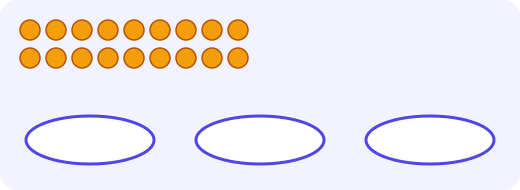
Answer with a number
2.What is 20 ÷ 4?
Answer with a number
3.30 stickers are shared equally among 10 children. How many stickers does each child get?
Answer with a number
4.Which multiplication fact helps you work out 35 ÷ 5?
- 5 × 7 = 35
- 5 × 5 = 25
- 7 × 2 = 14
Choose one
5.12 sweets are shared between 4 friends. Which way is fair?
- 4, 4, 2 and 2
- 3, 3, 3 and 3
- 5, 3, 2 and 2
Choose one
6.Match each division to the multiplication that goes with it.
- 10 ÷ 2 = 5
- 15 ÷ 5 = 3
- 60 ÷ 10 = 6
Match each to: 2 × 5 = 10 · 10 × 6 = 60 · 5 × 3 = 15
7.There are 20 children. The teacher puts them in teams of 5. How many teams are there?
Answer with a number
Answering and checking are for registered learners. Register to do this.
Quick check
New puzzles
Use sharing and the times tables in new places.
1.A shopkeeper puts 45 bananas into bags with 5 bananas in each bag. How many bags does she fill?
Answer with a number
2.17 pencils are shared equally among 5 children, giving as many as possible to each child. How many pencils are left over?
Answer with a number
3.Gita shares 16 marbles equally between herself and her brother. Then she finds 4 more marbles. How many marbles does Gita have now?
Answer with a number
4.Ravi knows that 8 × 5 = 40. Which divisions does he also know?
- 40 ÷ 8 = 5
- 40 ÷ 5 = 8
- 8 ÷ 40 = 5
- 5 ÷ 40 = 8
Choose all that apply
5.You have 20 sweets. For which number of friends can you NOT share them equally with none left over?
- 2 friends
- 4 friends
- 5 friends
- 6 friends
Choose one
Answering and checking are for registered learners. Register to do this.
Activity
Tell it back
Your child explains how sharing and equal groups are linked. About five minutes.
Steps
- Write 3 × 5 = 15. Ask "If I share 15 sweets among 3 friends, how many does each get? How did you work it out?"
- Ask "How does the times table help you share? What is the same and what is different?" Let your child draw or use objects.
- Ask "Can you share 14 sweets among 3 friends so everyone gets the same and none are left? Why or why not?" Write down what your child says in their own words.
Keeping a log of the activity is for registered learners. Register to do this.
Like what you see?
Register for free to answer the quick checks, do the activities and save your work. Your work is saved on your device and syncs to your account.