Unit 8
Halves, thirds and quarters
Cut shapes and groups into equal parts, name them, and find out why unequal pieces are never halves.
Read
Fair pieces
Zoya and her brother Imran have one roti and they are both hungry. Zoya tears it into two pieces. Imran's piece is tiny and hers is huge. "That's not fair!" he says.
What would make it fair? The two pieces must be the same size. When one whole thing is cut into equal parts, each part has a name.
Three names to know
Cut the whole into... Each part is called Say it as 2 equal parts a half one half 3 equal parts a third one third 4 equal parts a quarter one quarter Two halves make one whole. Three thirds make one whole. Four quarters make one whole. Cutting a quarter-roti into two more equal pieces gives you eighths, but that is for another day.
The big rule: the parts must be equal
A half is not "one of two pieces". It is "one of two equal pieces". Look at these two squares. Both are cut into four parts, but only one set of parts is quarters.
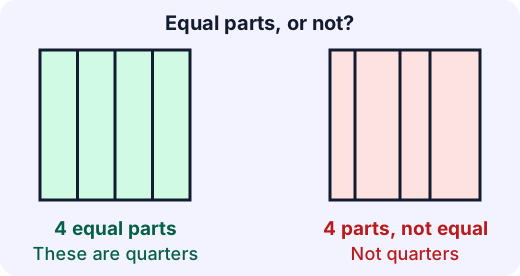
The left square has four equal parts: quarters. The right square has four parts, but they are different sizes. They are not quarters.
Try it: Fold a sheet of paper so the two sides match exactly. Open it. The fold line makes two halves. Fold it again the other way: now you have four quarters. If the edges don't match when you fold, the parts are not equal.
Equal does not have to look the same
A square can be cut into two halves by a line down the middle, across the middle, or from corner to corner. These all give two equal parts, even though the pieces look different (two rectangles or two triangles). What matters is that both parts are the same size.
More parts, smaller parts
Cut a pizza into 2 equal slices and each slice is big. Cut the same pizza into 4 equal slices and each one is smaller. So a quarter is smaller than a half, and a third is in between.
Fractions of a group
You can split a group of things into equal parts too.
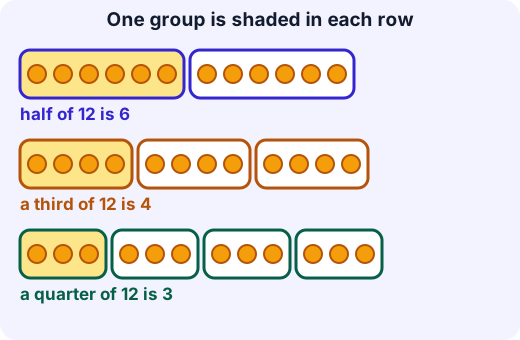
Example. What is a third of 12 marbles? Share the marbles equally into 3 groups: . One group is a third, so a third of 12 is 4.
Example. What is half of 10? Share into 2 equal groups: . Half of 10 is 5.
To find a half, a third or a quarter of a group, share it equally into 2, 3 or 4 groups. You already know how from sharing equally.
Mistakes to watch for
- Two pieces are not always halves. If one piece is bigger, they are not halves.
- Four pieces are not always quarters. Check they are all the same size.
- Half of a small thing is smaller than half of a big thing. Half a grape is smaller than half a watermelon. A fraction is always a fraction of a particular whole.
For the grown-up helping
Use real food and paper. Ask your child to cut a chapati, a banana or a sheet of paper "fairly" and to prove the pieces are equal by laying one on top of the other. Say "half of" and "a quarter of" often at snack time. Children often call any two pieces "halves", so ask "Are they the same size? How can we check?"
Lab
The fair cutter
Slide the cut lines to split a strip into equal parts, then pick out halves, thirds and quarters of a group of counters.
Your goals
- Make 2, 4 and 3 equal parts of a strip by sliding the cuts until all the parts match.
- Pick a half, a third and a quarter of groups of counters.
- Notice that unequal parts do not get a fraction name.
The interactive lab opens once you register. Register to do this.
Activity
Fold, cut and share
Your child folds paper and cuts food into halves, thirds and quarters, checks that the parts are equal, and shares a group of small objects into equal parts. About 25 minutes.
You'll need
- 4 sheets of paper (scrap paper is fine)
- A pencil and a crayon
- A chapati, a banana or a soft sandwich, and a plastic or butter knife
- 12 small objects such as buttons or beans (not for eating)
Steps
- Fold a sheet of paper so the edges match exactly. Open it and draw over the fold line. Say "two equal parts, so each is a half." Colour one half.
- Fold a new sheet in half, then in half again. Open it. How many parts? Are they equal? Colour one quarter and say "four quarters make a whole."
- Take a third sheet and try to fold it into 3 equal parts. It is tricky, so let your child try, check by laying the parts on top of each other, and fix it. Colour one third.
- Your child cuts a chapati or banana into 2 equal parts with the knife (an adult does the cutting, and the child directs where to cut). Lay one piece on the other to check. Eat a half.
- Put out 12 buttons. Share them into 2 equal groups, then into 3 equal groups, then into 4 equal groups. Each time say "half of 12 is 6", "a third of 12 is 4" or "a quarter of 12 is 3".
- On purpose, cut a sheet into 2 unequal pieces. Ask "Are these halves? Why not?" and let your child explain.
Safety
- An adult handles any knife. Use a plastic or butter knife for soft food only.
- Check for food allergies before eating anything, and cut round foods like grapes lengthways for young children.
- Keep buttons and beans away from babies and toddlers.
Keeping a log of the activity is for registered learners. Register to do this.
Quick check
Halves, thirds and quarters check
Seven questions about equal parts. Look at the pictures carefully.
1.Which square is cut into halves?
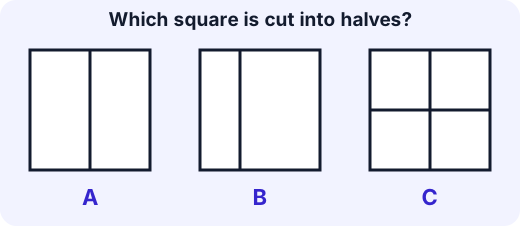
- A
- B
- C
Choose one
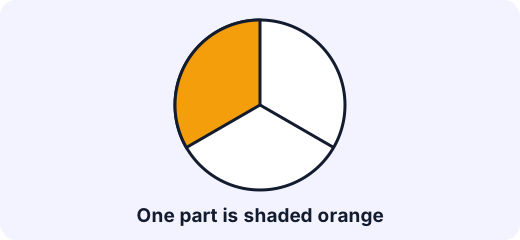
2.What fraction of the circle is shaded?
- One half
- One third
- One quarter
Choose one
3.Half of 10 marbles is how many marbles?
Answer with a number
4.What is a third of 12 mangoes?
Answer with a number
5.Tara cuts a sandwich into 2 pieces, but one piece is much bigger. She says "These are halves." Is she right?
- Yes, there are two pieces
- No, halves must be equal parts
- No, halves need three pieces
Choose one
6.Match each name to the number of equal parts the whole is cut into.
- Half
- Third
- Quarter
Match each to: 3 equal parts · 2 equal parts · 4 equal parts
7.The same chapati is cut three ways. Put one piece of each in order, biggest piece first.
- A half
- A quarter
- A third
Put these in order
Answering and checking are for registered learners. Register to do this.
Quick check
New puzzles
Use halves, thirds and quarters in new places.
1.One quarter of a rope is 3 metres long. How long is the whole rope, in metres?
Answer with a number
2.Dev has 15 stickers. He gives away a third of them. How many stickers does he have left?
Answer with a number
3.Anu cuts a square sandwich straight down the middle. Bilal cuts an identical square sandwich from corner to corner. Whose two pieces are halves?
- Only Anu's
- Only Bilal's
- Both of them
Choose one
4.Which square is NOT cut into quarters?
- Four equal small squares
- Four equal strips
- Four parts, one of them much bigger than the others
- Four equal triangles made by both diagonals
Choose one
5.Two identical chapatis. Meena eats half of one. Ravi eats a quarter of the other. Who eats more?
- Meena
- Ravi
- They eat the same amount
Choose one
Answering and checking are for registered learners. Register to do this.
Activity
Tell it back
Your child explains why the parts have to be equal to be halves, thirds or quarters. About five minutes.
Steps
- Cut a piece of paper into two unequal pieces. Ask "Can I call these halves? Why or why not?"
- Ask "How can you cut it so that I can call them halves? How could we check?" Let your child fold or cut a new sheet.
- Ask "If I cut the paper into 4 equal parts, what is each part called? Is a quarter bigger or smaller than a half?" Write down what your child says in their own words.
Keeping a log of the activity is for registered learners. Register to do this.
Like what you see?
Register for free to answer the quick checks, do the activities and save your work. Your work is saved on your device and syncs to your account.