Unit 9
Centimetres and metres
Measure with a ruler and a metre stick, and see why the whole world agrees on the same units.
Read
Everyone gets the same answer
Anu and Dev want to know how long their table is. Anu counts with her hand span and gets 8. Dev counts with his bigger hand and gets 6. Who is right?
Both are! Hands are different sizes, so they count different numbers for the very same table.
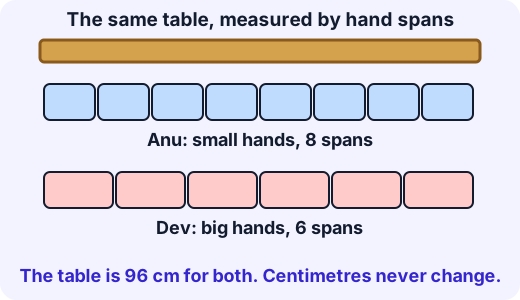
Last year you measured with things like cubes and paper clips. That works, but only if everyone uses the same size of cube. Standard units fix this problem. A standard unit is the same size everywhere, so everyone who measures the table gets the same answer: 96 centimetres.
The centimetre and the metre
- A centimetre (cm) is a small unit. A little fingernail is about 1 cm wide. We use centimetres for small things: a pencil, a leaf, a book.
- A metre (m) is a big unit. It is about the height of a door handle from the floor. We use metres for big things: a room, a rope, a playground.
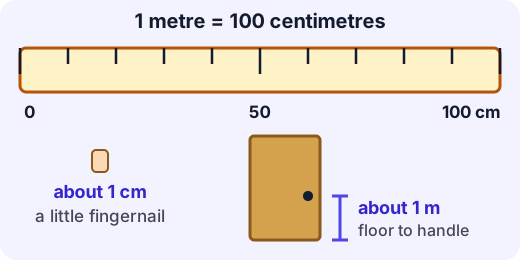
So 2 metres is 200 centimetres, and 3 metres is 300 centimetres. A ruler is usually 30 cm long. A metre stick is 100 cm.
How to measure with a ruler
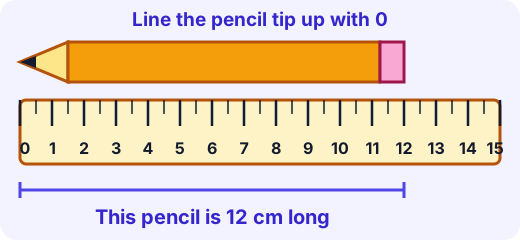
- Put one end of the object exactly at the 0 mark (not at the edge of the ruler, because some rulers have a little gap).
- Keep the object straight along the ruler.
- Read the number at the other end.
- Write the number and the unit: 12 cm, not just 12.
Example. A crayon lies on a ruler. Its flat end is at 2 and its tip is at 9. It does not start at 0! You can count the gaps between 2 and 9: 3, 4, 5, 6, 7, 8, 9 is 7 gaps. Or subtract: . The crayon is 7 cm long.
Estimating
An estimate is a careful guess. Before you measure, use something you know: your little fingernail is about 1 cm, and a door handle is about 1 m from the floor. Then measure to see how close you were. Good estimating helps you notice a mistake, like a pencil that comes out as 2 m.
Comparing lengths
To find how much longer one thing is than another, measure both and subtract.
Example. A pencil is 14 cm and an eraser is 4 cm. The pencil is cm longer.
Always compare in the same unit. A rope that is 3 m is longer than one that is 250 cm, because 3 m is 300 cm.
Mistakes to watch for
- Starting at the wrong mark. If the object starts at 2, the length is not the number at the other end.
- Forgetting the unit. "12" could mean 12 cm or 12 m. Always write the unit.
- Mixing units. Change metres to centimetres before you subtract: cm.
For the grown-up helping
Give your child a real ruler and a tape measure and let them measure things around the home. Ask "Is it longer or shorter than a metre?" and let them guess before measuring. If they start at the edge of a ruler instead of 0, show them the zero mark. Hand spans and footsteps are good for starting the conversation about why we need standard units.
Lab
The ruler workshop
Guess each length, then slide the object along the ruler and measure it. Some objects do not start at 0, so take care. Then compare lengths and choose the right unit.
Your goals
- Estimate first, then measure four objects in centimetres, including some that start away from 0.
- Find how much longer one object is than another.
- Choose centimetres or metres for different things.
The interactive lab opens once you register. Register to do this.
Activity
Measure the home
Your child estimates and then measures real things with a ruler and a metre stick or tape measure, and makes a one-metre string. About 30 minutes.
You'll need
- A ruler with centimetres
- A tape measure or metre stick (or a piece of string and a ruler)
- Paper and a pencil
- Scissors (adult uses them)
Steps
- First measure something with hand spans or footsteps. Then ask a family member to measure the same thing the same way. Do the numbers match? Talk about why we need centimetres.
- Draw a table with columns "Thing", "My estimate", "Measured". Pick five small things (a spoon, a book, a toothbrush, a leaf, a shoe). For each, your child writes an estimate in cm, then measures with the ruler starting at 0.
- Try one thing that is placed so it does not start at 0. Your child works out the length by subtracting or counting the gaps.
- Measure a bigger thing (a door, a table, a bed) with the tape measure or by marking each ruler length. Write the answer in metres and centimetres, for example 1 m 20 cm.
- Cut a piece of string exactly 1 metre long (an adult cuts). Find three things in the home that are shorter than the string, and three that are longer.
- Choose two measured things and work out how much longer one is than the other.
Safety
- An adult handles scissors.
- Metal tape measures can snap back quickly. Let the tape slide in slowly and keep fingers clear.
- Do not stand on furniture to measure high things; measure what you can reach from the floor.
Keeping a log of the activity is for registered learners. Register to do this.
Quick check
Centimetres and metres check
Seven questions about measuring.
1.How long is the crayon, in centimetres?
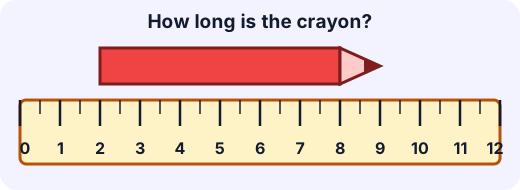
Answer with a number
2.How many centimetres are in 1 metre?
Answer with a number
3.Which unit is best for measuring the length of a classroom?
- Centimetres
- Metres
Choose one
4.Priya measures a desk with her hand span and gets 6. Kabir measures the same desk and gets 7. Why do they get different answers?
- Their hand spans are different sizes
- The desk changed size
- Kabir counted wrongly for sure
Choose one
5.A pencil is 13 cm long and a rubber is 5 cm long. How many centimetres longer is the pencil?
Answer with a number
6.About how long is a new pencil?
- 2 cm
- 19 cm
- 2 m
Choose one
7.Put these in order, shortest first.
- A paper clip (about 3 cm)
- A door (about 2 m)
- A bus (about 10 m)
- A ruler (30 cm)
Put these in order
Answering and checking are for registered learners. Register to do this.
Quick check
New puzzles
Use centimetres and metres in new places.
1.A ribbon is 1 metre long. Zoya cuts 35 centimetres off. How many centimetres of ribbon are left?
Answer with a number
2.Three equal books are stacked. Each is 4 cm thick. How tall is the stack, in centimetres?
Answer with a number
3.Mina's bed is 2 metres long. How long is it in centimetres?
Answer with a number
4.Asha says the leaf is "12". Raju says the leaf is "12 cm". Whose measurement tells you the length?
- Asha's
- Raju's
- Both are complete
Choose one
5.Rope A is 3 metres long. Rope B is 250 centimetres long. Which rope is longer?
- Rope A
- Rope B
- They are the same
Choose one
Answering and checking are for registered learners. Register to do this.
Activity
Tell it back
Your child explains why we use standard units like centimetres and metres. About five minutes.
Steps
- Measure the same table or book twice, once with your hand and once with your child's hand (or footsteps). Ask "Why did we get different numbers?"
- Ask "How could we all get the same number?" Show a ruler. Ask "What do we need to do to measure with a ruler properly?"
- Ask "When would you use centimetres and when would you use metres?" Write down what your child says in their own words.
Keeping a log of the activity is for registered learners. Register to do this.
Like what you see?
Register for free to answer the quick checks, do the activities and save your work. Your work is saved on your device and syncs to your account.